
Getting ETH from Ethereum onto Arbitrum One usually comes down to two routes. Arbitrum’s docs walk you through its official Arbitrum Bridge, while Across, a third-party option, drops the ETH into your Arbitrum wallet within seconds.
If you’re only depositing and don’t mind 15 to 30 minutes of waiting, go with the Arbitrum Bridge, because gas on Ethereum is all you’ll pay. Want the coins on Arbitrum in roughly 2 seconds, or think you’ll bring them back to Ethereum before long? That’s when Across makes more sense, since it skips the seven-day exit.
Below we weigh the pair on safety, cost and speed. You’ll also get the exact clicks for each one, and a situation where you won’t need a bridge at all.

Table of contents
Arbitrum Bridge vs Across at a glance
How to Bridge ETH to Arbitrum: Arbitrum Bridge vs Across Side by Side | |
|---|---|
| <strong>Who’s behind it</strong> | Arbitrum Bridge: it’s the bridge Arbitrum documents itself <br> Across: it’s a separate cross-chain protocol |
| <strong>What happens to your ETH</strong> | Arbitrum Bridge: it travels through Arbitrum’s own contracts <br> Across: a relayer hands you ETH on Arbitrum from its own pocket, then gets paid back |
| <strong>Ethereum to Arbitrum One</strong> | Arbitrum Bridge: somewhere around 15-30 minutes <br> Across: an estimated fill of about 2 seconds |
| <strong>Arbitrum One back to Ethereum</strong> | Arbitrum Bridge: 7 days minimum, and you still have to claim <br> Across: roughly 2 seconds according to its docs, all in one step |
| <strong>Cost to you</strong> | Arbitrum Bridge: gas on Ethereum for the deposit <br> Across: whatever’s missing between input and output, about 0.014% when we quoted 0.1 ETH (September 2026) |
| <strong>Where the security comes from</strong> | Arbitrum Bridge: the rollup’s contracts, backed by a 6.4-day dispute window <br> Across: optimistic checks that UMA settles if someone disputes |
| <strong>ETH limits</strong> | Arbitrum Bridge: the docs we read don’t mention any <br> Across: about 0.0002 ETH minimum, instant fills to about 133 ETH |
| <strong>Networks covered</strong> | Arbitrum Bridge: Ethereum plus Arbitrum chains like One and Nova <br> Across: 23 mainnet chains |
| <strong>Smart contract wallets</strong> | Arbitrum Bridge: can’t deposit ETH from one yet <br> Across: ETH sent to a contract shows up as WETH |
| <strong>Who it suits</strong> | Arbitrum Bridge: people who can wait and only want to pay gas <br> Across: anyone in a hurry, coming in, leaving, or hopping between layer 2s |
So what is the Arbitrum Bridge?
Arbitrum’s official bridge lives at bridge.arbitrum.io and handles ETH and ERC-20 tokens moving between Ethereum and Arbitrum chains. Deposits to Arbitrum One and withdrawals back out are both covered in the official quickstart.
People also call this a native or canonical bridge, meaning the chain’s own contracts do the work and no outside operator sits in the middle. It’s the very example ethereum.org picks when it explains bridges: Arbitrum’s native bridge can carry ETH from Mainnet onto Arbitrum.
What the Arbitrum Bridge gives you
- ETH and ERC-20 deposits from Ethereum land on Arbitrum One in roughly 15-30 minutes.
- Gas for the deposit is the main cost, and tokens need an approval transaction the first time you bridge them.
- Heading back to Ethereum takes 7 days or more, and it ends with a Claim button you press yourself.
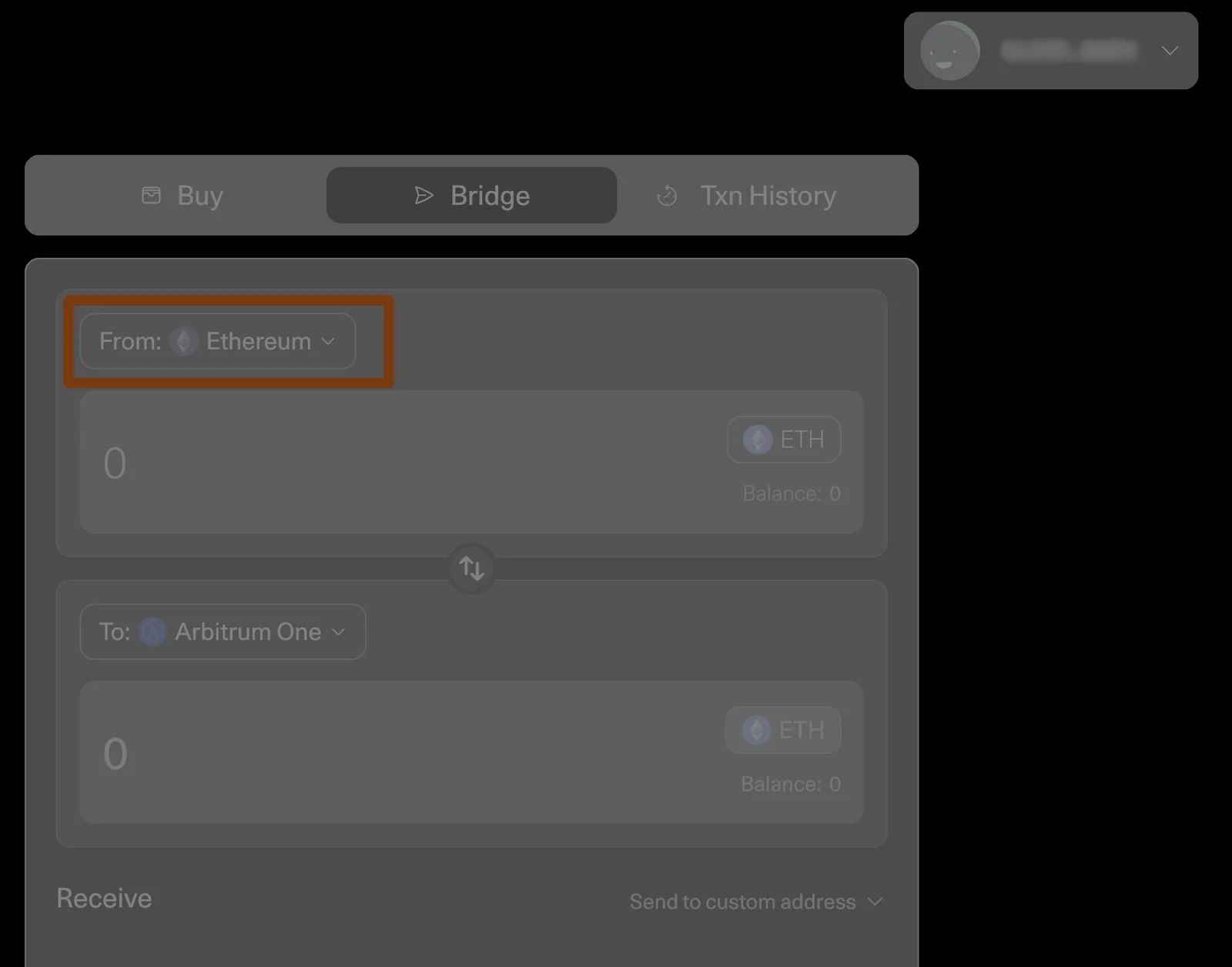
- In the app you’ll see Buy, Bridge and Txn History tabs sitting above the From and To network pickers.
- There’s a cross-chain dashboard too, handy if you ever have to claim a withdrawal outside the bridge app.
And what’s Across?
Across fills transfers on mainnet in about 2 seconds and works across 23 chains, Arbitrum included. Rather than leaving you to wait on Arbitrum’s bridge, a relayer pays out ETH on Arbitrum from its own balance and is reimbursed later through Across’s settlement.
By its own count, Across has moved $39B+ for 5M users and gets funds into wallets 1.2 seconds after confirmation on average, with “No user funds lost.” Uniswap uses it for bridging inside its app.
Keep an eye on who runs it. Risk Labs proposed converting the token-based DAO into a private U.S. company called AcrossCo, the Snapshot vote passed, and in September 2026 the $ACX exchange portal still hadn’t launched.
Where Across stands out
- Our September 2026 quotes for ETH from Ethereum to Arbitrum One showed estimated fills of 2 to 3 seconds.
- You see the fee before signing, because it’s simply what you send minus what you get.
- Anyone can run a relayer, so fillers compete for your transfer.
- Should nobody fill a deposit in time, you get the ETH back, usually after about 135 minutes.
- The docs point to OpenZeppelin audits, and a bug bounty program is in place.
How safe are the Arbitrum Bridge and Across?
Arbitrum Bridge deposits never leave Arbitrum’s own contracts. According to ethereum.org, trustless bridges of this kind inherit the security of the chains they connect instead of asking you to trust a new operator.
You pay for that on the way out. Arbitrum One’s dispute window runs 45818 blocks, roughly 6.4 days, and validators can challenge the chain’s state during it.
Why a week? Arbitrum’s FAQ explains that it leaves validators room to fight a dispute, and gives the community time to organize if Ethereum validators ever censor transactions.
Should someone actually challenge an assertion, tack on a grace period of about 48 hours. And once you’ve started a withdrawal, there’s no cancelling it.
Across asks you to trust a little more. Its dataworker gathers fills into a bundle and proposes it to the HubPool contract on Ethereum, putting up a bond of about 0.45 ABT.
During the challenge period any person can dispute that bundle. Disputes land with UMA’s Data Verification Mechanism, where holders of the UMA token vote on the outcome.
A single honest participant can stop a bad proposal, Across says. On top of that, the Across Bond Token restricts who’s allowed to propose bundles, and the docs cite OpenZeppelin audits of V2 and V3 alongside a bug bounty.
Official sources didn’t turn up a security incident for either one. Any bridge can still fail, though, and ethereum.org names contract bugs, user errors, a hacked chain and a hacked bridge as risks, so we’d always try a small amount before the big one.
Look twice at the network and address before signing anything. ETH sent on the wrong network or to the wrong address is lost for good, and no one can undo it.
Unsure what you’re checking? Our explainer on what a wallet address is covers it.
Planning to bridge stablecoins later? Arbitrum One carries two versions of USDC, native USDC and bridged USDC.e, and they sit at separate contract addresses.
Using the Arbitrum Bridge and Across day to day
An ordinary browser wallet is all either bridge needs, plus a bit of ETH on Ethereum for gas. MetaMask and OKX Wallet are the examples Arbitrum’s docs give.
Signing with a hardware wallet? Our pick of the best hardware wallets for MetaMask is worth a look.
First, get Arbitrum One into your wallet
Plenty of wallets show Arbitrum One already. When yours doesn’t, here’s how Arbitrum’s docs say to add it in MetaMask.
- Open the MetaMask extension.
- Hit the network drop-down at the top right.
- Choose “Add a custom network”.
- Fill in Arbitrum One for the name, https://arb1.arbitrum.io/rpc for the RPC URL, 42161 for the chain ID, ETH as the symbol, and https://arbiscan.io for the explorer.
How to bridge ETH to Arbitrum with the Arbitrum Bridge
- Open bridge.arbitrum.io and connect a wallet.
- Check that Ethereum shows as the source network up top.
- Pick Arbitrum One as the place the ETH should go.
- In the token drop-down, choose ETH.
- Type how much you’re sending into the From box.
- Hit “Move funds”, then approve the transaction when your wallet asks.
- Change your wallet’s network to Arbitrum One and give it roughly 15-30 minutes.
No wallet pop-up? That usually means there isn’t enough ETH left over for gas.
Coming back to Ethereum runs through the same page, just with the networks flipped. You’ll see a countdown promising funds in 7-8 days.
When it hits zero, click your profile at the top right, open the Transactions tab and press “Claim”. Until you do that, nothing lands in your Ethereum wallet, and it’s an easy step to forget a week later.
How to bridge ETH to Arbitrum with Across
- Head to across.to and click “Connect Wallet”.
- Put Ethereum in From and Arbitrum in To.
- Select ETH and type the amount.
- Look at what you’ll receive; whatever’s missing compared with your input is the fee.
- Approve it in your wallet.
- Keep the HISTORY tab open, since a typical fill only takes a few seconds.
Across pays plain ETH to an ordinary wallet address. Point it at a smart contract and you’ll get WETH, the wrapped version of ETH, instead.
No bridge needed if your ETH sits on an exchange
Coins still on an exchange can often skip bridging. Arbitrum’s docs note that most major centralized exchanges let you withdraw directly to the Arbitrum network, so choose Arbitrum One as the network.
Before parking money there for long, it’s worth reading our take on a crypto wallet vs an exchange.
Arbitrum Bridge vs Across on fees and speed
Arbitrum’s docs don’t mention a bridge fee for the official route. You’re paying for the transactions you sign: one deposit on Ethereum for ETH, plus a first-time approval for any ERC-20 token, and gas on Arbitrum One is charged in ETH as well.
Across’s fee lives inside the quote. Take what you send, subtract what arrives, and that’s the total, divided between an LP fee for liquidity providers and a relayer fee.
That relayer slice pays for gas on the destination chain, roughly 1.5 hours spent waiting to be repaid, and the risk the relayer carries.
We grabbed two live quotes on September 13, 2026, both for ETH from Ethereum to Arbitrum One. A 0.1 ETH transfer cost 0.0000140659 ETH, about 0.014%, delivered 0.099985934 ETH and carried a 2-second estimated fill.
The 1 ETH quote was cheaper in percentage terms. It cost 0.0000832 ETH, about 0.008%, with a 3-second estimate.
Neither quote included an LP fee, and relayers spend less gas filling on Arbitrum than on Ethereum. One catch: apps built on Across may add an app fee of their own, so if you’re bridging through someone else’s interface, compare the numbers.
| Route | Onto Arbitrum One | Back to Ethereum | What it costs you |
|---|---|---|---|
| Arbitrum Bridge | Around 15-30 minutes | 7 days or more, plus a Claim | Gas on Ethereum; one-off token approval |
| Across | Roughly 2-3 seconds | Roughly 2 seconds, per Across docs | Input minus output, visible in the quote |
Withdrawals are where the two really split. Arbitrum’s docs put the official exit at about a week and say third-party fast bridges often get around it, while warning that those bridges bring provider trust, fees and liquidity limits.
Is the Arbitrum Bridge or Across better value?
There’s no price tag on either one. Gas and, with Across, relayer pricing at that moment set what you pay, so our two September 2026 samples are the only figures we can give.
If a plain deposit is all you need and you’ve got half an hour, we think the Arbitrum Bridge is the better deal. It’s gas and a short wait.
Across is worth its fee when the clock matters. Both quotes came in far below a tenth of a percent, and on a withdrawal that small fee saves you a week plus a second transaction to claim.
Amount counts, too. For this route Across wanted at least about 0.0002 ETH, filled instantly up to about 133 ETH, and topped out at about 1,337 ETH.
Its docs say very large transfers are one of the usual reasons a deposit sits unfilled and gets sent back.
Arbitrum Bridge and Across: what’s good and what isn’t
What we like and don’t about the Arbitrum Bridge
What we like and don’t about Across
Which way should you bridge ETH to Arbitrum?
First trip onto Arbitrum One, and happy to wait half an hour? We’d use the Arbitrum Bridge, since it’s the official route and gas is the whole cost.
Need ETH on Arbitrum this minute, say to make a trade on a decentralized exchange? Go with Across, which filled in seconds for a sliver of a percent on our quotes.
Expect to pull the ETH back to Ethereum soon? Across is the one for that leg, because the official bridge holds you for at least 7 days and then makes you claim.
Haven’t settled on a layer 2 yet? Our Arbitrum vs Optimism breakdown is a good place to start.
Questions about bridging ETH to Arbitrum
How fast can I get ETH onto Arbitrum?
It depends on the route. Arbitrum’s official bridge takes roughly 15-30 minutes, while our September 2026 Across quotes for ETH from Ethereum to Arbitrum One estimated 2 to 3 seconds.
What does bridging ETH to Arbitrum cost?
Gas, mostly. The Arbitrum Bridge charges Ethereum gas for the deposit, and Across adds a fee we measured at about 0.014% on 0.1 ETH and about 0.008% on 1 ETH on September 13, 2026.
Why does leaving Arbitrum take a week?
Validators get a dispute window of about 6.4 days on Arbitrum One to challenge a wrong state. Batch posting and confirmation push the official bridge to roughly a week, and then you still press Claim.
Can I trust Across?
Mostly, in our view. Transfers are checked optimistically with UMA settling disputes, OpenZeppelin audits are listed and there’s a bug bounty, but it does add trust beyond Arbitrum’s contracts, so try a small amount first.
Can an exchange send ETH straight to Arbitrum?
Usually. Arbitrum’s docs say most major centralized exchanges allow direct withdrawals to the Arbitrum network; just pick Arbitrum One.
Is it possible to cancel an Arbitrum withdrawal?
No. After the wait you can claim it on Ethereum and deposit it again if you change your mind.
I sent ETH on the wrong network. Can I get it back?
No. It’s gone and nobody can reverse the transaction, which is why you should check the network and address before every signature.
Our verdict: Arbitrum Bridge or Across for your ETH?
When you’ve got 15 to 30 minutes, we’d bridge ETH onto Arbitrum One with the official Arbitrum Bridge. Gas is the only cost, and your funds stay in Arbitrum’s contracts.
Across is our choice once speed counts, and it’s clearly better for withdrawals, turning a 7-day wait into seconds for a small fee.
After the ETH arrives, hold it in a wallet whose keys belong to you. Fees and steps do change, so glance at the Across fee docs or the Arbitrum quickstart before a large transfer.
This article is for general information only and is not financial, legal, or investment advice. Prices and features change; check the vendor’s official page before buying.