
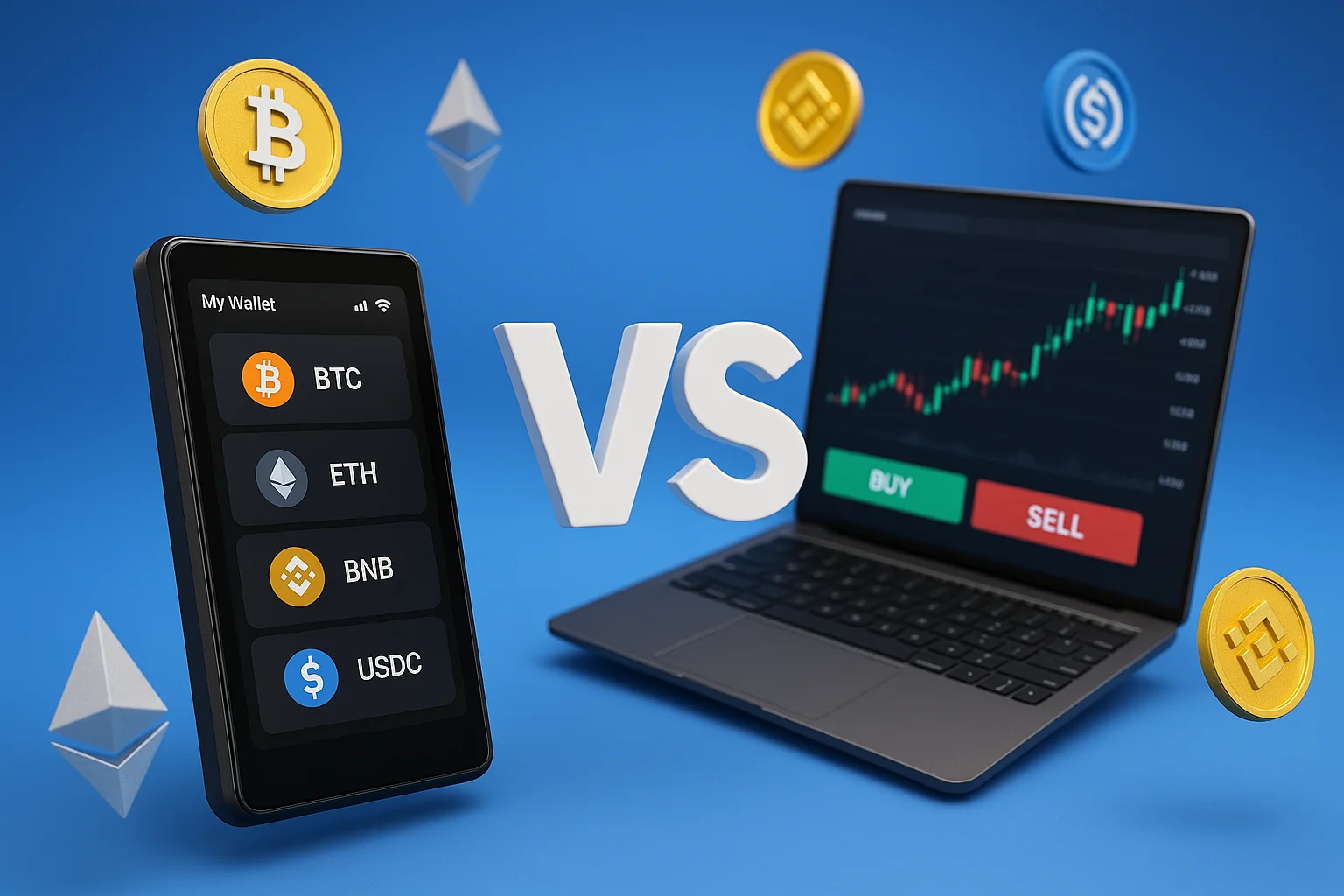
If you’re new to crypto or already trading, one question matters more than most: where should you keep your coins, in a crypto wallet or on an exchange? The answer decides how safe your assets are, how easily you can trade, and how much control you really have.
Many people learn too late that convenience has a price. Exchanges make trading simple, but a hack, an outage, or a frozen account can put your funds out of reach. Wallets give you full control, but lose your keys and the money is gone for good. No support ticket brings it back.
This guide breaks it all down: crypto wallet vs exchange, how each works, their pros and cons, and when to use each. By the end, you’ll know how to keep your crypto safe and pick the setup that fits your goals in 2026.
Table of contents
What Is a Crypto Exchange?
A crypto exchange is an online platform where you buy, sell, or trade digital assets such as Bitcoin and Ethereum.
It works much like a stock market. The exchange matches buyers and sellers in an order book, or lets users trade peer-to-peer. Many exchanges also offer fiat on-ramps (so you can deposit EUR or USD) and off-ramps (so you can cash out).
The point is access: easy buying and selling (liquidity), a wide range of coins, and tools for managing your trades.
Centralized Exchanges (CEXs)
- Companies run them and act as the middleman. They hold your funds: you deposit crypto or fiat into the platform.
- They offer deep liquidity, simple interfaces, fiat-to-crypto trading, and often strong regulatory compliance, depending on where they operate.
- Trades execute fast, with market orders, limit orders, and margin tools built in.
- The catch: because they hold everyone’s funds, they are a single point of failure. Hacks, insolvency, and regulatory action all hit the same place.
Binance, Coinbase, and OKX are all custodial trading hubs of this kind. Read our full OKX review to see how it compares.
Decentralized Exchanges (DEXs)
- You trade peer-to-peer straight from your own wallet, using smart contracts. No central party holds the funds.
- In most cases you keep your private keys, so there is no custodian that can fail you.
- The trade-off: thinner liquidity, a steeper learning curve, usually crypto-to-crypto only (little fiat support), and new risks such as smart contract bugs.
For a step-by-step guide to withdrawing safely, see our guide on how to withdraw money from Crypto.com.
How Exchanges Store and Manage User Funds
On a CEX, your deposit goes into a custodial account. You have a claim on the asset, but the platform holds the actual coins.
The exchange runs internal order books to match buy and sell orders. It keeps large sums in “hot wallets” (connected to the internet, for quick withdrawals) and “cold wallets” (offline, for added security).
On a DEX, funds stay in your wallet. Trades run through smart contracts that swap assets automatically once the conditions are met.
Benefits of Using a Crypto Exchange
- Convenience: Newcomers and frequent traders get a simple interface, fiat deposits, fast execution, and deep liquidity in one place.
- Liquidity: Big CEXs have high trading volumes and many trading pairs, so you can buy or sell large amounts without moving the price much.
- Trading tools: Market, limit, and stop-loss orders, plus margin and derivatives, are built in. If you trade often, this is where the tools live.
Risks of Using a Crypto Exchange
- Custodial risk: Keep crypto on an exchange and you are trusting the platform to hold it safely. If the exchange fails, your access can go with it. “Not your keys, not your coins” applies.
- Security breaches and hacks: Exchanges have lost user funds many times, through hacks, mismanagement, and outright fraud.
- Regulatory & liquidity risk: An exchange can run into regulatory trouble, freeze withdrawals, or, in the worst case, go insolvent. Check its licences, track record, and regulatory status before you deposit.
- Less control: If your account gets blocked or the exchange adds restrictions, your funds may be out of reach until it decides otherwise.
What Is a Crypto Wallet?
A crypto wallet is a digital or physical tool for storing, sending, and receiving cryptocurrency. Unlike an exchange account, it gives you direct control of your private keys: the cryptographic codes that prove you own your assets on the blockchain.
Hold your own keys and you hold your crypto. No middleman, no platform to depend on. “Wallet” is a broad category that covers both hot (online) and cold (offline) storage.
How Crypto Wallets Work
Every wallet has two parts:
- Public key (address): Works like a bank account number. Share it to receive funds.
- Private key: Works like your signature. It unlocks your funds and authorises transactions. Lose it and you lose access to your crypto. There is no reset button.
Wallets don’t “store” coins in any physical sense. They hold the keys that let you act on the blockchain, where your assets actually live.
Types of Crypto Wallets
1. Hot Wallets
Hot wallets are connected to the internet, which makes them handy for everyday transactions.
They come as:
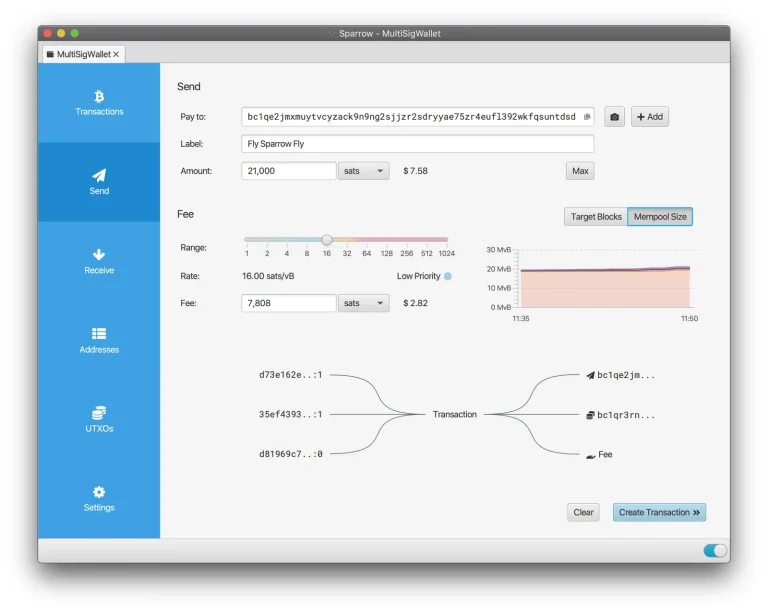
- Software wallets: Desktop or mobile apps (for example, MetaMask, Trust Wallet).
- Browser wallets: Extensions that plug into DApps or exchanges.
Pros: Fast, easy to use, and well suited to active trading or small balances.
Cons: Being online exposes them to hacking and phishing.
2. Cold Wallets
Cold wallets keep your keys offline, which makes them the better choice for long-term holding.
They include:
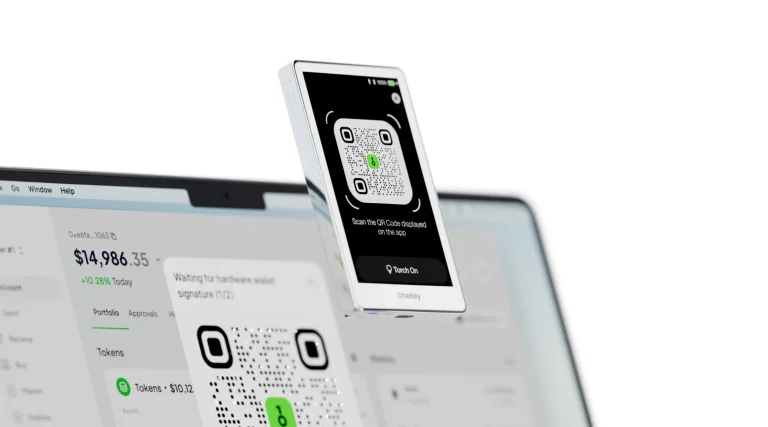
- Hardware wallets: Physical devices (for example, Ledger, Trezor) that store keys offline.
- Paper wallets: Printed QR codes or key sets.
- Air-gapped wallets: Devices that never connect to the internet.
Pros: The strongest security available. Online attacks can’t reach keys that are never online.
Cons: They cost money and are less convenient for frequent transactions.
Private Keys and Seed Phrases
When you set up a wallet, you get a seed phrase, usually 12 to 24 words. It is your master backup. Anyone who has it can take your funds.
Write it on paper and keep it offline in a safe place. Never share it, and never store it in the cloud, in email, or in a screenshot. For long-term holdings, offline keys are the safest option, and a second backup in a separate secure location protects you if the first copy is lost or destroyed.
Benefits of Using a Crypto Wallet
- Full control: You own and manage your funds with no third party in the way.
- Stronger security: Especially with cold storage, where your keys never touch the internet.
- Privacy: Transactions can stay pseudonymous and independent of any centralised system.
Follow the basics and a good wallet gives you both control and peace of mind.
Risks of Using a Crypto Wallet
- Key loss: Lose your private key or seed phrase and the funds are gone permanently.
- Device theft or damage: Without a proper backup, a lost or broken device can lock you out.
- User error: Send crypto to the wrong address or over the wrong network and it can’t be reversed.
Exchange vs Crypto Wallet: The Main Differences
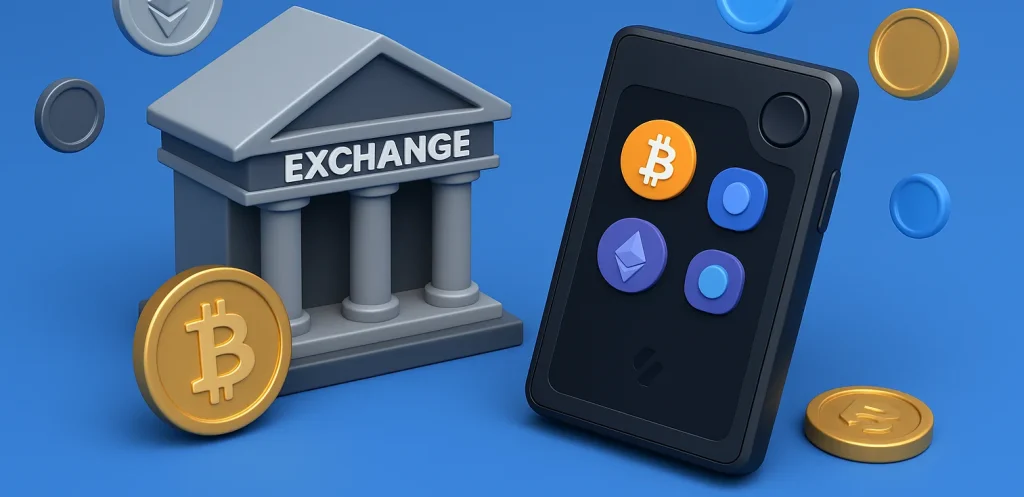
Control Over Funds
The core difference comes down to custody. On an exchange, the platform holds your assets, so you rely on a third party to keep them safe. A crypto wallet puts you in full control: only you can access your private keys, sign transactions, and move funds.
Security & Risks
Exchanges spend heavily on security, but they remain prime targets for hackers and can suffer outages or freezes. Wallets, especially cold wallets, keep your keys off the internet and are safer for long-term storage.
Wallet security still depends on you, though. Lose your keys or mishandle your backups and the loss is permanent.
Accessibility & Ease of Use
Exchanges are easier for beginners. You can trade, convert, or withdraw in a few clicks. Wallets ask you to manage seed phrases and network settings, which can feel complex at first.
In return, wallets give you more freedom: you can use decentralized applications (DApps) directly and hold many different assets in one place.
Fees & Costs
Exchanges usually charge trading and withdrawal fees, which vary by platform and trading volume. Wallets charge no management fees, but you pay network fees (also called gas) each time you send crypto.
Over time, self-custody tends to be cheaper for holders, while exchanges suit frequent traders better.
Use Case Comparison Table
| Feature | Crypto Wallet | Crypto Exchange |
| Best For | Long-term storage and savings | Active trading and quick conversions |
| Custody | User-controlled (you hold your private keys) | Platform-controlled (custodial) |
| Security | Higher, especially with cold storage | Lower, exposed to hacks or restrictions |
| Accessibility | Moderate, setup required | Very high, simple to use with fast trades |
| Fees | Network (gas) fees only | Trading and withdrawal fees |
| Risk Level | User error or key loss | Platform hacks or account freezes |
How to Move Crypto from Exchange to Wallet (Quick Guide)
Moving your crypto from an exchange to a personal wallet is one of the best ways to secure your assets. Follow these simple steps to transfer assets safely and avoid common mistakes.
- Step 1: Get Your Wallet Address
Open your wallet (software, hardware, or mobile) and find the “Receive” option. Copy your public address or scan the QR code for the cryptocurrency you want to transfer. Always double-check that you’ve selected the correct asset (e.g., BTC, ETH). Confirm the address visually before proceeding to ensure you’ll send funds to the correct address.
- Step 2: Go to Your Exchange Withdrawal Page
Log in to your crypto exchange account and open the “Withdraw” or “Send” section. Choose the same cryptocurrency and paste your wallet address in the recipient field.
- Step 3: Choose the Correct Network
Ensure the blockchain network type matches between your wallet and the exchange (for example, ERC-20 for Ethereum or BEP-20 for BNB Smart Chain). Sending to the wrong network can permanently lock your funds.
- Step 4: Enter the Amount and Confirm
Enter the amount you want to send. If it’s your first transfer, start with a small test amount to ensure everything works correctly. Review the transaction fee and confirm the withdrawal.
- Step 5: Verify and Track the Transfer
Most exchanges send a confirmation email or 2FA prompt to verify withdrawals. Once approved, you can track your transaction using a blockchain explorer (like Etherscan or Blockchain.com) to see when it’s confirmed.
Security Tips When Transferring
- Never share your private keys or seed phrase. They are for your eyes only.
- Bookmark the official exchange and wallet sites so phishing links can’t catch you.
- Check wallet addresses character by character. Don’t copy them from screenshots or messages.
- For large transfers, use a hardware wallet for the highest level of security.
Avoiding Network Errors and Scams
- Send only over compatible networks. A mismatch can mean irreversible loss.
- Watch out for fake wallet apps and exchange clones. Download only from official sources.
- Test with a small transfer first, then move the rest once it arrives.
FAQ
What’s the best type of wallet for beginners?
For beginners, software or mobile wallets such as Trust Wallet or MetaMask are the easiest place to start. They are free, simple to use, and connect directly to exchanges and decentralized applications (DApps). As your holdings grow, move up to a hardware wallet for stronger security.
Can I use both an exchange and a wallet?
Yes, and for most people it is the best setup. Use the exchange to buy, sell, or trade short term, then move your long-term holdings to a wallet you control. You get the convenience of the exchange without leaving your savings exposed.
Can you cash out from a crypto wallet?
Not directly. To turn crypto into cash, send it back to an exchange that supports fiat withdrawals, sell it, and withdraw to your bank account. Wallets are built for storing and sending crypto, not for cashing out.
Do I have to pay tax if I keep my crypto in my wallet?
Simply holding crypto in your wallet isn’t a taxable event in most countries. Tax usually applies when you sell, trade, or convert to fiat. Check your local rules to stay on the right side of them.
What are the best crypto wallets?
Top choices in 2026 include the Ledger Nano X, Trezor Model T, and BitBox02 for hardware wallets, and MetaMask, Exodus, and Trust Wallet for software. The right one depends on what you value most: security, ease of use, or multi-chain support. For a closer look at two of the hardware options, read our Trezor Model T vs Ledger Nano X comparison.
Final Thoughts
Choosing between a crypto wallet and an exchange comes down to your goals and how much risk you can live with. Exchanges give you speed and convenience for trading. Wallets, especially cold ones, give you stronger security and complete control.
In 2026, the smart approach is still a hybrid: trade on an exchange, and keep your savings in a wallet you control. Once you understand the crypto wallet vs exchange trade-off, you can protect your assets and stay in charge of your own crypto.
How I review: Reviewed by Andrei B. I buy the hardware wallets I review, test every product myself and score it on security, UI/UX, ease of use, price and supported coins. Before I publish, I also check recent user reviews and any hack reports.
The whole process is explained on the How We Review page. You can read more about me, or contact me with corrections, from the links at the bottom of this page. For general safety advice, see the FTC guide to cryptocurrency scams.