
Picture a hardware wallet with no screen, no battery and no cable. That’s the Tangem Wallet: a bank-card-sized slab with an NFC chip inside, which you tap on the back of your phone whenever you want to sign something. You buy it as two or three identical cards, and because each one carries the same private key, you’re holding your backup the moment you open the box.
If most of your crypto life happens on a phone, and the thought of guarding 24 words on paper makes you tired, it’s worth a look. People who insist on reading every transaction on the device itself should look elsewhere. So should anyone who won’t trust firmware they can’t inspect.
We’ll walk through how the cards work, what setup is like, the security model and its audits, which coins it handles, what it costs, the good and the bad, and three rivals. All the numbers here were taken from Tangem’s store, help centre and blog in September 2026.

Table of contents
So What Is the Tangem Wallet, Exactly?
It comes from Tangem AG, a Swiss company set up in Zug in 2017. The firm’s debut in 2018 was the Tangem Note, an NFC card that could hold just one asset.
A multi-currency wallet arrived in 2022. A year later, the second generation brought the option of a seed phrase, and 2025 added two new products: the Tangem Ring and Tangem Pay, a spending card you top up with USDC on Polygon.
You’ll pay $69.90 at the time of writing (September 2026) for three cards, or $59.90 for two. Tangem claims 6 million cards sold, and it lists Samsung and SBI Holdings among its backers.
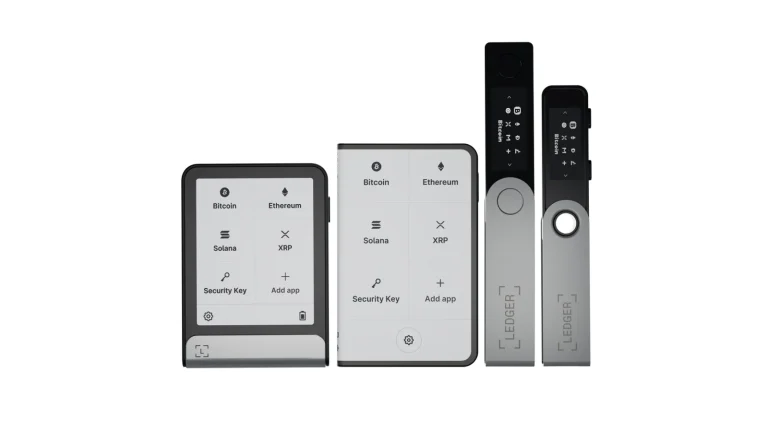
Its natural rivals are wallets with screens, like the Ledger Nano X and the Trezor Safe 5, and both cost more.
Tangem Wallet at a Glance | |
|---|---|
| What you pay | $69.90 for three cards, $59.90 for two, or $160 for the Ring plus two cards (checked September 2026) |
| What it looks like | A card the size of a bank card. There’s no screen and nothing to charge |
| How it talks to you | Only over NFC, via the Tangem app for iOS or Android |
| Where keys live | Inside a Samsung chip with Common Criteria EAL6+ certification |
| Open source? | The app is, and it’s on GitHub. The card’s firmware isn’t |
| Coins and tokens | Tangem quotes 14,100+ tokens on 90 blockchains |
| How you back it up | Clone the key to 2 or 3 cards, and add a 12- or 24-word seed phrase only if you want one |
| The app | Tangem’s own, free on iOS and Android |
| Who it fits | Anyone who lives on their phone and wants cheap cold storage minus the seed phrase |
The Tangem Wallet Features That Matter Most
- Each card in the box holds an identical private key, which means a card left in a taxi won’t cost you your wallet.
- You don’t have to create a seed phrase at all. Skip it and there’s no slip of paper for a burglar to find or a fire to burn.
- With no battery inside, there’s nothing to go flat, and the IP69K rating covers dust and water. Tangem’s stated operating range is -25°C to +50°C.
- Every card sits behind an access code, and once someone gets it wrong six times, the wait between guesses keeps growing until it reaches 45 seconds.
- Sending, swapping, buying and staking all happen in one app, which also reaches dApps via WalletConnect.
- The hardware carries a 25-year limited warranty. That’s a long promise.
Is the Tangem Wallet Easy Enough for a Beginner?
For the most part. You won’t plug anything in, charge anything or sit through a firmware update, because none of that exists here. Install the app, touch a card to the phone, and the prompts take it from there.
iPhone owners put the card against the top edge of the phone. Android is fussier: NFC has to be switched on, the screen can’t be locked, and you need to find where your particular phone keeps its NFC antenna.
A chunky or metal case can kill the connection. If a scan won’t take, pull the case off first.
Sending coins is quick once you’re set up: choose the asset, type the amount, paste the address and tap a card to sign. Fees come in three speeds, Slow, Market and Fast, and some networks let you cover the fee with a stablecoin rather than the chain’s native coin, which is handy when your gas balance is empty.
What bugs us is the lack of a screen. Every address and amount gets checked on your phone, and your phone is the thing most likely to be carrying malware.
Compare that with a Trezor Safe 5, whose touchscreen shows you the details before you say yes.
Desktop users should know that Tangem’s help centre only talks about iOS and Android, with no computer app in sight. When a dApp runs in your browser, it displays a QR code and the Tangem app scans it. Anyone who has used a mobile crypto wallet before will find the routine familiar.
How Secure Is the Tangem Wallet, Really?
Your keys sit in a Samsung chip that holds an EAL6+ rating under Common Criteria, the global scheme for grading security hardware. A random number generator built into that chip produces the key. According to Tangem, there’s no circumstance in which the key can be pulled off the card.
Firmware goes onto the chip one time, and that’s it: no updates, ever. Nobody can push a poisoned update to your card, which is good, but nobody can fix a bug on it either, which is less good.
It’s also closed. Tangem describes this as “security through obscurity” and argues that releasing the code would put its wallets at risk, an argument we’d think twice about accepting, given that Trezor publishes everything.
Outside eyes have been on it twice. Kudelski Security did an audit in August 2018, then Riscure took its turn in 2023, probing every command the card answers over NFC; it reported nothing that would leak private keys and no backdoor anyone could exploit.
The app, unlike the firmware, is open source. You’ll find the iOS and Android code on GitHub.
A bug bounty ran privately in 2024, and Tangem said a public version would follow in 2025. It also says not one of its 6,000,000 cards has been hacked since launch. Keep in mind who’s doing the counting.
That tally covers the cards, not the app. On December 31, 2024, Tangem disclosed that its mobile app had been writing the private key into its logs whenever someone activated a wallet with a seed phrase, whether they generated it or imported it. Those logs only left the phone if the owner contacted support from the app within 7 days of activation, a group Tangem puts at fewer than 0.1% of users.
Version 5.19.1 on the App Store and 5.19.2 on Google Play fixed it, and Tangem says every log sent to support has been erased and that no funds were lost. If that description fits you, Tangem’s advice is to move your coins out, reset the cards and set the wallet up again, and we’d follow it rather than lean on the promise that the logs are gone.
Backups are clones. As you set the wallet up, the cards hand the key to each other over a link protected by a 256-bit encryption key, and that handover can happen only once.
So adding a card to a wallet that already exists isn’t possible. You’d have to start a fresh wallet.
Misplace a single card and you’re fine, since the rest still work. If every card disappears and you never made a seed phrase, though, your coins go with them, permanently. Tangem can’t freeze a missing card either, because it has no way to tell identical cards apart.
Whoever picks up a stray card still has to get past the access code. Forget your own code and you’ll need two cards from the set to reset it.
There’s no account to open and no personal data collected. Tangem’s servers stay out of your transactions entirely.
Which Coins Can You Keep on the Tangem Wallet?
According to the Tangem homepage, 14,100+ tokens on 90 blockchains. A different page, the Ring’s product listing, still says over 6,000 cryptocurrencies, which looks like a figure nobody updated, so we’re going with the homepage.
DeFi and NFTs go through WalletConnect, which the app has had since version 5.27. It covers Solana plus 40+ EVM networks, among them Ethereum, Polygon, Arbitrum, Avalanche C-Chain and Base, and Tangem runs dApp domains past Blockaid before it shows a verification mark.
You can stake without leaving the app. Yield.xyz handles ATOM, BNB, GRAM (TON’s old ticker), POL, SOL and TRX.
For ETH it’s P2P.org, and you’ll need at least 0.01 ETH; ADA can go through either provider.
MetaMask is the hole. Nowhere in Tangem’s dApp docs does it come up, so WalletConnect is your route in. If you can’t live without MetaMask, our roundup of hardware wallets that work with MetaMask is a better starting point.
What the Tangem Wallet Costs, and What You Get
Here’s Tangem’s price list as of September 2026. Two cards run $59.90, three run $69.90, and the Family Pack, which is simply two sets, is $129.80.
The Tangem Ring comes bundled with two cards for $160. At the top sits the Tangem Pro Kit at $180.
Want a colour or a limited edition of the three-card set? It’s still $69.90. Kaspa-branded sets are cheaper at $59.90, and whichever you pick, the box holds a minimum of two cards and a printed walkthrough.
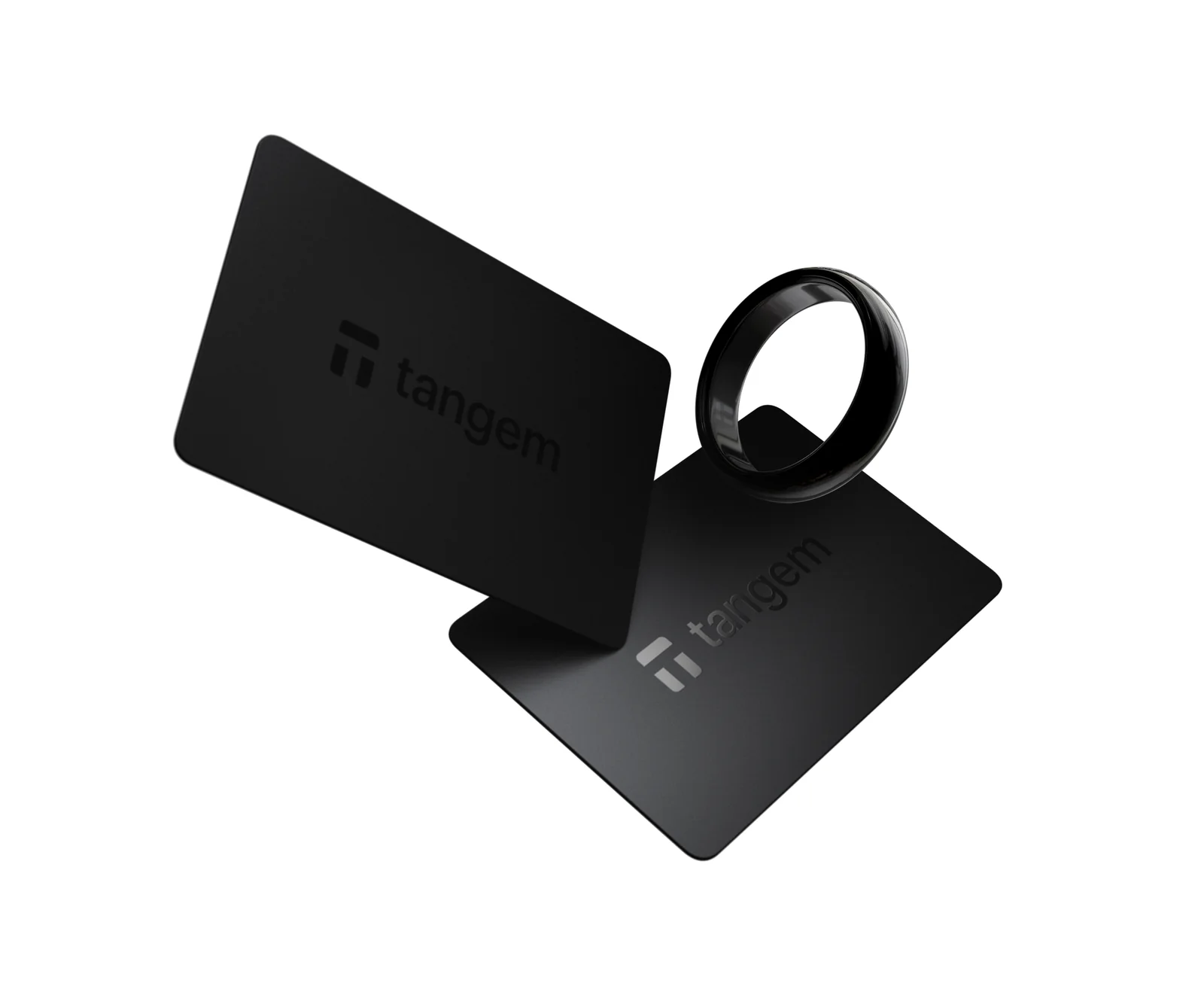
That ring is zirconia ceramic, sold in US sizes 6 to 13, and it shares the cards’ EAL6+ chip and IP69K rating. You can pair it with any second-generation Tangem card for backup.
Delivery is $3.99 to $19.90, dropping to free for standard shipping once your order passes $100 before VAT. You get 14 days to send it back, at your own postage cost.
There’s no subscription, and the app costs nothing.
Order from tangem.com and nowhere else. When you scan a card, the app confirms that Tangem built it and that Tangem firmware is on it, and a fresh card will offer to create a wallet; if one already exists, you’ll get a scam warning instead, and that card should go straight in the bin.
Where the Tangem Wallet Shines and Where It Doesn’t
Dollar for dollar, nothing we know of beats it on backups and toughness. What you give up is verification: you’re trusting your phone’s display, plus firmware that only Tangem and its auditors have read.
We’re comfortable with that for money you spend or move regularly. For savings you plan to leave alone for years, we’d rather have a wallet with its own screen.
Setting Up the Tangem Wallet, Step by Step
Grab your cards, or the Ring, and a phone that has NFC. The steps below track Tangem’s own help-centre guide for a wallet with no seed phrase.
Step 1: Get the app and tap Get Started
Download Tangem from the App Store or Google Play. Open it, then hit “Get started”.
Step 2: Tap your first card
Choose “Scan card or ring”, then rest a card on the top of your iPhone or over the NFC spot on your Android. At this point the app confirms the card is real and has never been used.
Step 3: Let the chip create your wallet
Hit “Create wallet” and scan once more; the key is made offline, on the chip. Prefer a seed phrase? Go to “Other options” and pick “Generate seed phrase”, choosing either 12 or 24 words.
Those words belong on paper and nowhere else. Don’t snap a photo, don’t enter them on a website, and don’t let them near cloud storage, since whoever reads them owns your coins.
Step 4: Copy the key to your backup cards
Pick “Add a card or ring” and scan card number two. If you have a third, do it again, then press “Finalize backup”.
Include every card you own right now. There’s no adding them afterwards.
Step 5: Choose an access code
Press “Create” and type your access code, which can be a word, a phrase or a number. After “Continue”, type it a second time and press “Submit”.
The app then asks you to scan every card again. Jot down the card numbers while you’re at it.
Step 6: Biometrics, tokens, and you’re in
Face ID or a fingerprint can unlock the app if you switch it on. Add whichever tokens you intend to hold (or don’t), and finish with “Continue to my wallet”.
Step 7: Try a small deposit before anything big
Move a tiny amount in first and wait until it shows up. Before any transfer, compare the network and every character of the wallet address.
Get either one wrong and the coins are lost. No one, not Tangem and not the exchange, can undo it.
Tangem Wallet Alternatives Worth Considering
Ledger Nano X: Bluetooth and a Screen
Ledger sells the Nano X for $99 at the time of writing (September 2026). It connects to a phone by Bluetooth and to a computer by USB-C, and its secure element, an ST33J2M0, carries EAL5+ certification.
There’s much more in our Ledger Nano X review.
Trezor Safe 5: Open Firmware and a Touchscreen
For $129 the Trezor Safe 5 gives you a touchscreen that buzzes back when you tap it. Trezor’s firmware and hardware designs are public under GPL-3.0, which is exactly where Tangem is weakest.
We go into detail in our Trezor Safe 5 review.
Keystone 3 Pro: Air-Gapped by QR Code
At $149, the Keystone 3 Pro swaps data with software wallets through QR codes, offers an Air-Gapped Mode and packs three security chips. Our Keystone 3 Pro review has the rest.
Tangem Wallet Questions People Ask
Is the Tangem Wallet actually safe?
Mostly. The keys never leave an EAL6+ Samsung chip, and neither Kudelski Security nor Riscure turned up anything that leaks them. Where it’s weaker is the lack of a screen and firmware you can’t inspect.
What does a Tangem Wallet cost?
On tangem.com in September 2026, three cards are $69.90 and two are $59.90. If you’d rather wear it, the Ring with two cards is $160.
Which cryptocurrencies work with Tangem?
Tangem puts it at 14,100+ tokens on 90 blockchains, Bitcoin, Ethereum and Solana among them, and you can stake ETH, SOL, ADA, ATOM, BNB, POL, TRX and GRAM without leaving the app.
Can I use Tangem with MetaMask?
Not as far as Tangem’s docs go; MetaMask isn’t mentioned anywhere. You connect through WalletConnect instead, which covers Solana and 40+ EVM networks.
I lost a Tangem card. Now what?
Grab another card from the same set and carry on. Things only go bad if every card is gone and you never made a seed phrase, because then the funds are lost, and Tangem has no way to recover or block anything.
Does Tangem make me use a seed phrase?
No. Your spare cards are the backup. Just choose before setup finishes, since a seedless wallet can’t get a seed phrase bolted on later.
Will my Tangem card ever get a firmware update?
Never. It’s loaded once and locked, which stops bad updates and good fixes alike.
Our Final Verdict on the Tangem Wallet
Get the Tangem Wallet if your phone is where you manage crypto, you’d like a backup that isn’t a sheet of paper, and a card that shrugs off water and never needs a charger appeals to you. Three cards for $69.90 is the least expensive way we’ve found to own a non-custodial wallet with redundancy baked in.
Pass on it if you need to confirm each address on a screen you trust, or if closed firmware is a dealbreaker. Then you’re better off with a Trezor Safe 5 or one of the Ledgers on our best hardware wallets list.
Our take? It’s a clever, inexpensive home for the crypto you use every week, as long as you go in knowing what you’re trading away.
This article is for general information only and is not financial, legal, or investment advice. Prices and features change; check the vendor’s official page before buying.