
Safe (plenty of people still call it Gnosis Safe) keeps your crypto inside a smart contract, and that contract won’t release a thing until enough of its signers agree. It’s a multisig smart account wallet.
What that buys you is simple to state: there’s no lone private key whose theft empties the account, which is exactly the weak spot of a normal wallet.
Who’s it for? Teams, DAOs and individuals sitting on real money on Ethereum or another EVM chain, people who don’t want any one person or device to have the power to move funds alone.
We’d steer you elsewhere if your coins are Bitcoin or Solana, if you only want a pocket wallet for small amounts, or if paying gas just to tweak a setting sounds maddening.
You’ll find the basics first, then setup, the security story (Bybit included), networks, fees, a walkthrough and a few alternatives worth a look.
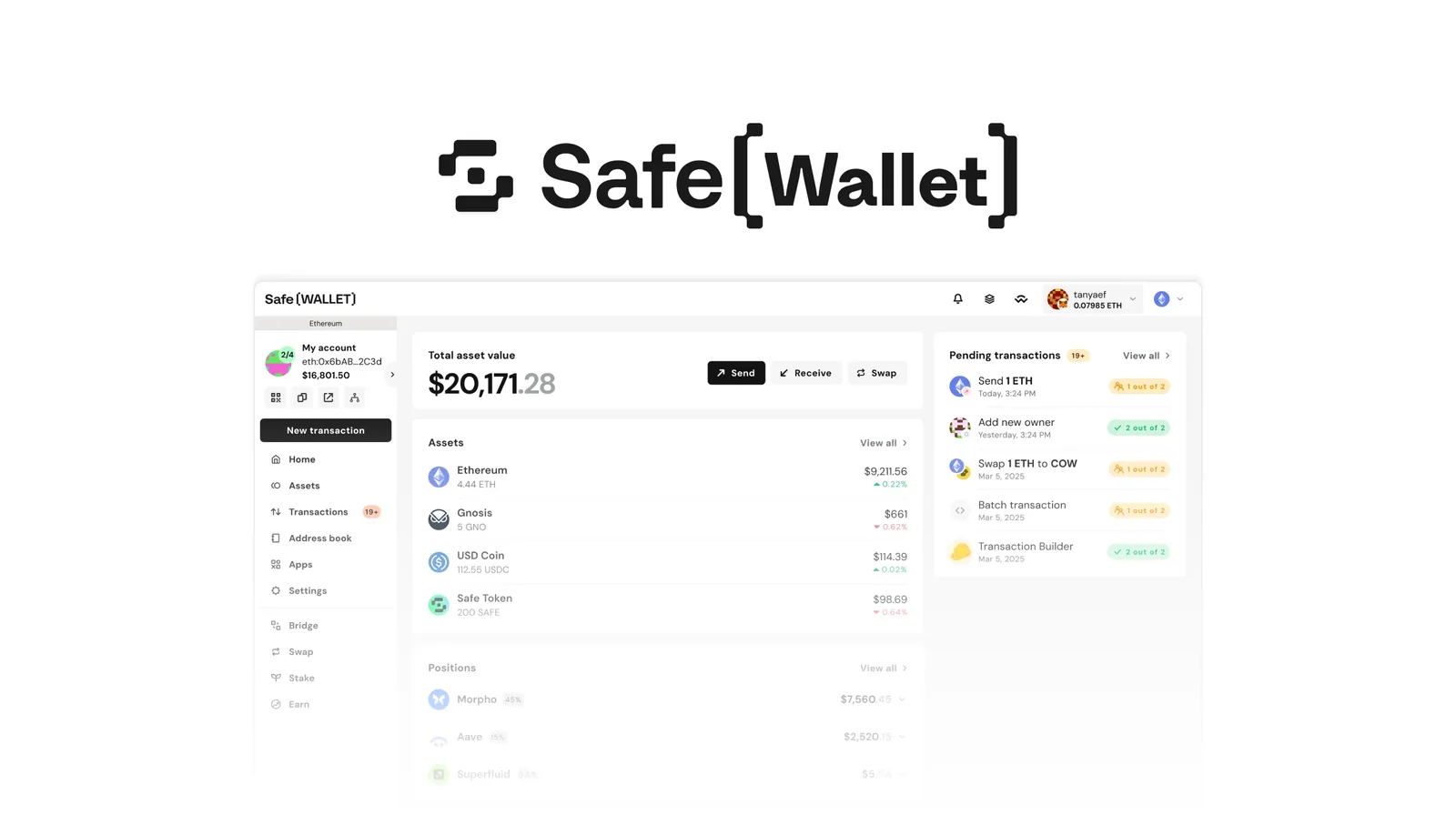
Table of contents
So What Is the Safe Wallet, Exactly?
Safe (Gnosis Safe) at a Glance | |
|---|---|
| <strong>What it costs</strong> | Nothing to use. Gas goes to the network, and the built-in swap and bridge add widget fees. |
| <strong>Where it runs</strong> | In your browser at app.safe.global, or on the Safe{Mobile} app for iPhone and Android. |
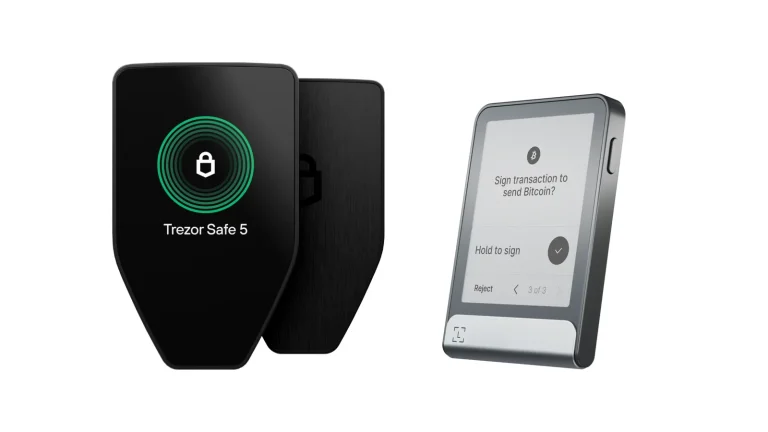
| <strong>How you connect</strong> | Through a browser signer wallet or WalletConnect, with Ledger and Trezor able to sign too. |
| <strong>Where the keys live</strong> | Each signer keeps its own key. The money itself sits in a smart contract onchain. |
| <strong>Can you read the code</strong> | Yes for the contracts (LGPL-3.0) and interface (GPL-3.0), though some newer service-layer releases use FSL. |
| <strong>What it holds</strong> | Assets on Ethereum and other EVM-compatible chains. Safe counts 28+. |
| <strong>How you back it up</strong> | Spare signers beyond the threshold, and optional recoverers via Safe{RecoveryHub}. |
| <strong>The app it comes with</strong> | Safe{Mobile}, published by Safe Labs GmbH. |
| <strong>Who it suits</strong> | Groups, DAOs and anyone guarding a big EVM balance. |
Think of Safe as a smart contract wallet with a quorum rule. A set minimum of approvals has to land before anything moves, which people shorthand as M-of-N, so a Safe with 3 owners and a threshold of 2 will act on any 2 signatures. Safe’s FAQ is blunt that no third party, Safe included, can reach in and move your funds.
Compare that with MetaMask or Exodus. Those are externally owned accounts (EOAs), governed by a single seed phrase, and a leak of that key can mean stolen funds. If you’re fuzzy on why holding your own keys shifts that burden onto you, our piece on custodial vs non-custodial wallets walks through it.
It isn’t new. GitHub shows the smart contract repository going back to September 2017.
Gnosis Safe then announced two things on July 12, 2022: a $100 million funding round led by 1kx, and a new name, Safe, following a community vote to split from Gnosis. Back then the team said it was securing more than $40 billion across over 600,000 processed transactions.
The current claims are bigger: “$1 Trillion+” in volume, “57M+” wallets and “$60B+” in value secured. Its pages don’t agree with each other, though, since the networks page says “8M+” wallets while the security page talks about “$80B+”, so we’d read all of it as marketing rather than audited figures.
You won’t pay to use it at the time of writing (September 2026). “0 AUM fees,” says the homepage.
The Safe Features That Matter Most
- Nobody moves money alone. A thief who phishes one signer still can’t drain the account, because no single key, device or person is enough.
- Teams can cap daily spending and hand out roles, deciding who may propose a transaction and who approves it.
- With the Transaction Builder you can bundle several actions and sign once, saving gas as well as clicks.
- Before you sign, Tenderly simulates the outcome and Blockaid warns about known threats.
- A multi-chain Safe keeps one address on every supported network it’s deployed to, handy if your assets are spread out.
- Safe{RecoveryHub} lets a trusted recoverer get you back in, but only after a waiting period you pick.
Is Safe Easy Enough for a Beginner?
Not really. Before creating a Safe you’ll already need at least one signer wallet, MetaMask or a hardware device for instance, which makes this a poor choice for someone buying their first coin.
Once that’s sorted, it’s quick. Safe’s help centre puts setup at 60 seconds, dropping under 20 seconds if you pick “Pay later”.
Day to day you’ll live in app.safe.global, which lays out your holdings next to a queue of transactions still waiting on signatures. If you run a team, expect to spend most of your time in that queue.
Here’s the annoying part. Adding an owner, changing the threshold, any settings change at all: each is its own onchain transaction with its own gas bill, and whoever executes it pays.
That’s softening a little. On Ethereum, Base, BNB Chain and Arbitrum, gas abstraction lets the Safe cover gas out of its own balance.
Hardware signers are slower still. Ledger owners must switch on “Contract Data”, and Safe itself concedes that approving a transaction on the device can take as many as 17 clicks, which would test anyone’s patience.
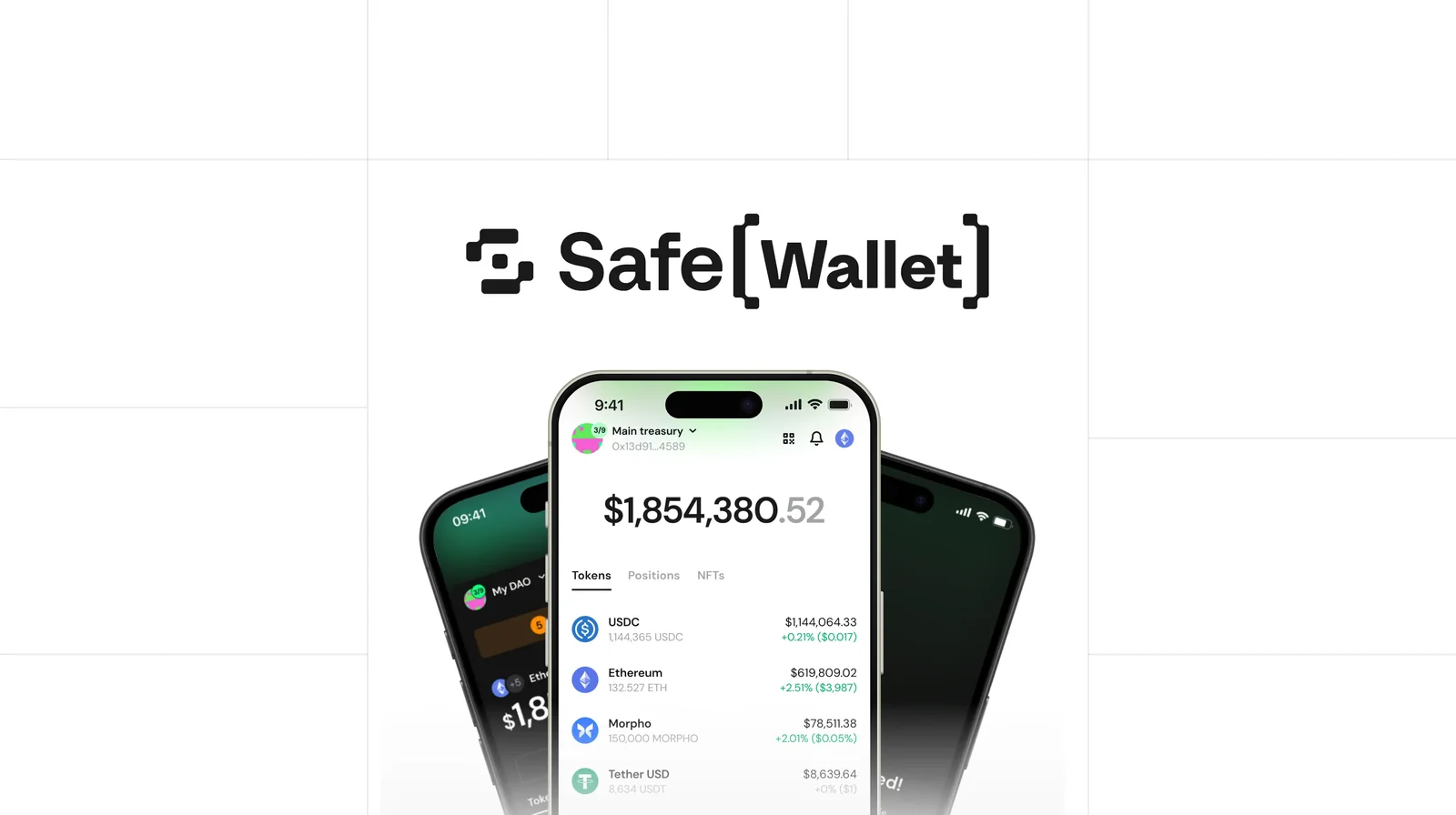
For phones there’s Safe{Mobile}, the newer app on iOS and Android, with multisig signing, Ledger support, simulation and alerts. It’s early days. When we looked at the US App Store in September 2026 it was on version 1.0.15 with a 2.3 out of 5 score, drawn from just 12 ratings.
How Secure Is the Safe Wallet, Really?
Don’t picture a hardware wallet here. Devices like the Ledger Nano X keep keys in a secure element, a chip built to resist tampering, whereas Safe parks your funds in a smart contract and leaves the keys wherever your chosen signers keep them.
Anyone can read the contracts, which are licensed LGPL-3.0. The README on GitHub lists seven audit entries, running from Alexey Akhunov’s review of v0.0.1 all the way to Certora and Ackee on v1.5.0, with G0 Group, Nethermind and Runtime Verification covering versions in between.
Version 1.5.0, the newest release, came out on July 3, 2025.
The web interface’s code is public too, under GPL-3.0. There’s a wrinkle: fresh releases of certain service-layer pieces run by Safe Labs have switched to the Functional Source License (FSL). According to Safe, that doesn’t touch the smart account, the interfaces or the SDKs, and FSL code converts to MIT once two years pass.
What Happened With Bybit, and What Came After
This is the incident everyone asks about. Bybit’s Safe was emptied by attackers in February 2025, and on February 28, 2025 the Safe Ecosystem Foundation statement traced it to “a compromised Safe{Wallet} developer machine resulting in the proposal of a disguised malicious transaction,” pinning it on the Lazarus Group.
No bug in the contracts, then. Outside forensic investigators, per that statement, “did NOT indicate any vulnerabilities in the Safe smart contracts or source code”, and Safe responded by rebuilding its infrastructure, rotating every credential and hardening the front end.
What we take from it is that you’re trusting the hosted website as well as the contracts. Check each transaction on your own signing device, every time, even when the web page looks normal.
A smaller scare followed in 2026. Safe put out a guide about a flaw in some third-party Zodiac modules, specifically Roles Modifier v2 (2.1.0 and 2.1.1) and Delay Modifier v1.1.0, and said its own contracts, app and Account Recovery were untouched.
Using one of those? Go to Settings, open Modules and delete it.
Losing a Signer: How Backup and Recovery Work
There’s no Safe seed phrase to write down. Your backup is really the way you’ve arranged the signers, so in a 2-of-3 setup a lost signer is no crisis, since the remaining two can swap it out.
Fall below the threshold, though, and Safe’s help centre is clear that your assets can’t be recovered.
That’s where Safe{RecoveryHub} comes in. You nominate a recoverer, which can be any account you trust, and it can propose fresh signers, but the proposal sits in a waiting period (28 days unless you pick 7, 14 or 56) during which your signers can reject it.
One thing bothers us. Safe{Wallet} doesn’t notify you when someone starts a recovery, so the only way to spot one is to open the app and look.
What Can You Keep in a Safe Wallet?
Ethereum, plus chains compatible with the EVM. Safe’s page for power users puts the count at “28+” networks, alongside “200+” DeFi apps it integrates with.
Non-EVM chains are the hole. You can’t hold Bitcoin, Solana or Tron in a Safe, so Bitcoin holders who want multisig should look at Electrum.
Be careful with multi-chain Safes. They share one address across networks, except on zkSync Era, which isn’t compatible, and Safe says anything sent on zkSync Era to an address you’ve used for a Safe elsewhere will be lost.
Pick the wrong network or paste the wrong address and your funds are gone for good. Nobody can undo it.
DeFi works through WalletConnect and Safe Apps, and your threshold still applies to every action you take there. New to swapping? Start with our guide on how to use a decentralized exchange.
What the Safe Wallet Costs You
Safe doesn’t charge a subscription or take a cut of what you hold. Gas is another matter: deploying the Safe costs gas, as does every transfer and settings change.
None of that gas money reaches Safe; it all goes to the network. Signing a confirmation without executing it is free.
Swaps and bridges inside the app are where Safe takes a slice, through widget fees that are partly passed to the Safe Foundation. On ordinary swap pairs you’ll pay 0.70% up to $50,000, then 0.35% between $50,000 and $100,000, 0.20% up to $1,000,000 and 0.1% beyond it, while stablecoin-to-stablecoin swaps run 0.15%, 0.10%, 0.07% and 0.05% over the same bands.
| How big the trade is | Regular swap | Stablecoin-only swap | Bridge |
|---|---|---|---|
| $50,000 or less | 0.70% | 0.15% | 0.35% |
| Between $50,000 and $100,000 | 0.35% | 0.10% | 0.35% |
| Between $100,000 and $1,000,000 | 0.20% | 0.07% | 0.20% |
| Above $1,000,000 | 0.1% | 0.05% | 0.10% |
Bridging runs through LI.FI at 0.35% up to $100,000, 0.20% up to $1,000,000 and 0.10% past that, deducted from whatever token you’re sending. MetaMask’s swap fee, by way of contrast, is 0.875%.
Stick to app.safe.global, and to the app store links you find on safe.global.
Where Safe Wins and Where It Falls Short
What Safe gets right is baked into its design, namely public, audited contracts and no single point of failure. What it gets wrong is mostly friction, meaning gas bills, a fiddly setup and a dependence on Safe’s hosted website, and you can blunt that last one by checking every transaction on your hardware wallet’s screen.
Setting Up a Safe Wallet, Step by Step
- Type https://app.safe.global/ into Google Chrome by hand. Chrome is the browser Safe recommends.
- Hook up a signer wallet that holds a little of the chain’s native coin, ETH for example, since deploying the Safe needs a transaction fee.
- Got Safes already? Hit “Create new account” and name the new one; that name never leaves your computer.
- Paste each signer’s Ethereum address or ENS name. For one person, Safe’s own suggestion is 3 signers, say 1 MetaMask and 2 hardware wallets.
- Choose a threshold above 1 but below your signer count. 2 of 3 is the classic.
- On the review screen, pick “Pay now” to deploy immediately, or “Pay later” to deploy alongside your first transaction; deployment itself takes 20-40 seconds.
- Move a tiny test amount over the right network and confirm it landed. Only then send the rest.
Every signer wallet has its own seed phrase, and each one belongs on paper or steel, offline, never typed into a website. Safe Labs says it won’t ever contact you first or ask for that phrase.
One more warning bears repeating: a Safe address used on the wrong network, or an address with a typo, means your funds are lost and nobody can get them back. Need signer hardware? Our list of the best hardware wallets for MetaMask is a good place to shop.
Wallets to Weigh Against Safe
Electrum, for Bitcoin Multisig
For Bitcoin, Electrum fills the role Safe plays on Ethereum. Under File, New you select “Multi-signature wallet”, set a scheme like 2 of 2 and swap master public keys with your cosigners, and it handles hardware wallets and cold storage as well.
Our full Electrum review goes deeper.
MetaMask Paired With a Hardware Wallet
Maybe multisig is overkill for you. Then MetaMask with a Ledger, Trezor or Keystone keeps a single signer’s keys offline and gives you EVM, Solana and Bitcoin addresses, though losing both the device and its seed phrase means losing the funds. Our MetaMask vs Coinbase Wallet comparison shows how it stacks up.
Rabby, If You Want One Key and Clear Previews
Rabby sticks to one key on EVM chains. Its simulation lays out how your balances will change before you sign, and it’ll work with Ledger, Trezor, Keystone and other hardware wallets. Non-EVM networks aren’t supported.
Safe Wallet FAQ
Can I trust the Safe wallet?
Mostly, yes. Anyone can read its audited contracts, and investigators found no flaw in them after the Bybit attack, which came in through a hacked developer’s computer. Still, check every transaction on your own signing device.
Are Gnosis Safe and Safe one and the same?
Yes. The name changed in July 2022, once the community voted to spin the project out of Gnosis.
Does Safe cost anything?
Using it is free. You’ll pay gas to the network, and swaps inside the app add a widget fee that ranges from 0.70% on smaller trades to 0.1% on the biggest.
Can Safe hold Bitcoin?
No. It only works with Ethereum and EVM-compatible chains, so Bitcoin holders wanting multisig should try Electrum.
Will Safe work with my MetaMask or Ledger?
Both work. MetaMask, Ledger, Trezor and wallets that connect over WalletConnect can each be a signer, though a Ledger has to have Contract Data switched on first.
What if one of my signers goes missing?
That depends on your threshold. When the signers you still have can meet it, they simply remove the lost one and add a replacement; when they can’t, only a recoverer you set up beforehand can help, and without one the assets stay locked.
Our Verdict on the Safe Wallet
If you’re a team, a DAO or an individual with a large balance on Ethereum or an EVM chain, Safe is the tool we’d reach for. It gets rid of the single key, its audit history stretches back to v0.0.1, and apart from gas it’s free. Use hardware wallets as signers and a sensible threshold, 2 of 3 for example.
Bitcoin and Solana holders should look elsewhere. So should anyone with a small balance or a wish for a one-tap phone wallet. For EVM assets, though, it’s the multisig wallet we rate highest, as long as you verify each transaction on your own device.
This article is for general information only and is not financial, legal, or investment advice. Prices and features change; check the vendor’s official page before buying.