
Choosing a crypto wallet in 2026 is harder than it should be. Among the many options, two names come up again and again: MetaMask and Coinbase Wallet. Both promise strong security, full control of your keys, and easy access to Web3.
The reality is messier. Many users get burned by high gas fees, confusing interfaces, or wallets that don’t support the coins they hold. Others worry about losing everything to a weak backup or an unclear recovery process.
This MetaMask vs. Coinbase Wallet comparison is here to help you decide. We cover what matters: security, supported networks, usability, fees, and what real users say. By the end, you’ll know which wallet fits how you use crypto in 2026.
Table of contents
Quick Overview: MetaMask or Coinbase Wallet | |
|---|---|
| MetaMask | Best For: DeFi, NFTs, and EVM chains; Type: Non-custodial Web3 wallet (browser extension wallet); Supported Networks: Ethereum, Polygon, BNB Chain, Arbitrum; KYC: Not required; Platform: Browser extension & mobile device app; Open Source: Yes. |
| Coinbase | Best For: Beginners and Bitcoin holders; Type: Non-custodial wallet integrated with Coinbase; Supported Networks: Ethereum, Bitcoin, Solana, and EVM chains; KYC: Not required (only when linked to Coinbase); Platform: Browser extension & mobile app; Open Source: Partially closed source. |
What Is MetaMask?

MetaMask is a non-custodial wallet built by Consensys for Ethereum and other EVM-compatible blockchains. It is your front door to Web3. With it, you can:
- Store and manage tokens and NFTs;
- Connect directly to decentralized applications (dApps);
- Swap tokens through built-in DeFi services.
Both the browser extension and the mobile app keep your private keys on your device, and you can add custom networks such as BNB Chain, Polygon, Arbitrum, and Avalanche. You also generate and manage your own crypto wallet addresses for sending and receiving assets.
MetaMask has reported more than 30 million active users, which makes it one of the most widely used cryptocurrency wallets in the space. That scale matters: almost every dApp is built to work with it first.
What Is Coinbase Wallet?
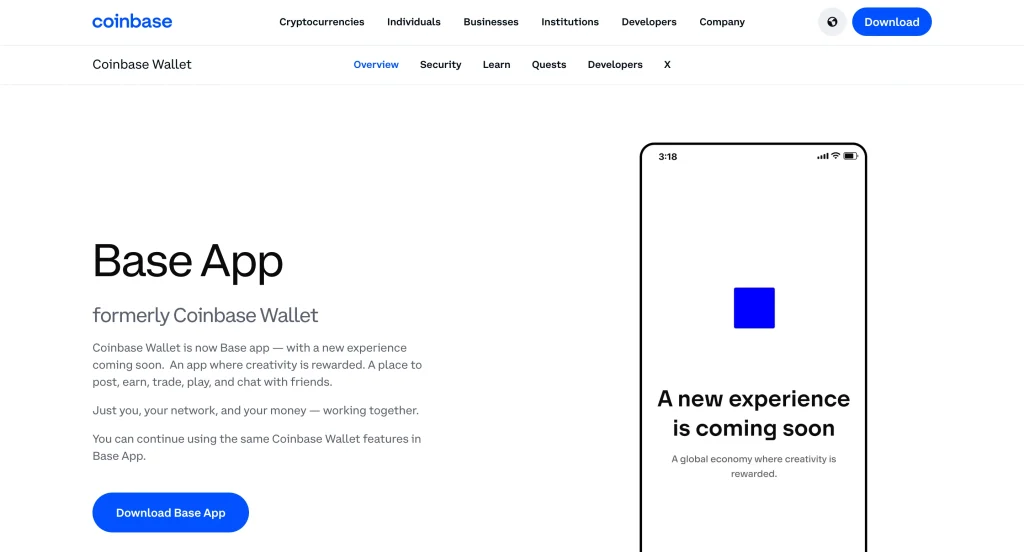
Coinbase Wallet is a self-custody wallet from Coinbase that pairs a simple design with strong multi-chain support. Unlike the Coinbase exchange, the wallet gives you full ownership of your private keys. Coinbase cannot touch your assets.
It supports a broader range of assets than MetaMask, including:
- Bitcoin (BTC) and Solana (SOL), which MetaMask does not support natively;
- Ethereum and the main EVM-compatible tokens;
- NFTs across multiple blockchains.
Coinbase Wallet also offers optional encrypted cloud backups, so you can store your seed phrase in Google Drive or iCloud. If you dread the thought of losing a slip of paper with your recovery phrase on it, this is the feature you will appreciate most.
To receive crypto in Coinbase Wallet, follow the steps in our Coinbase wallet address guide.
MetaMask vs Coinbase Wallet: Feature Comparison
Popularity tells you little. What matters is how each wallet performs where it counts. Both are non-custodial and both put you in charge of your keys, but they make different trade-offs, and the right one depends on what you need.
1. Security
Both wallets take safety seriously, but they get there differently. MetaMask keeps your private keys on your device and nowhere else. That is as decentralized as it gets, but it also puts the whole burden of backing up your seed phrase on you. Lose it, and there is no way to get your funds back.
Coinbase Wallet is also non-custodial, but it adds a safety net: encrypted cloud backups. That helps anyone who fears losing their recovery phrase. The trade-off is a small extra exposure. If your cloud account is weakly protected, your backup is too.
Neither wallet requires KYC, so you never verify your identity unless you use an external on-ramp. MetaMask is fully open-source, which lets anyone audit the code. Coinbase Wallet has closed-source parts, so you are trusting Coinbase’s security practices and reputation instead.
Verdict: MetaMask suits privacy-focused users who want full control. Coinbase Wallet gives beginners a safer learning curve.
2. Supported Assets & Networks
MetaMask is built for EVM-compatible blockchains: Ethereum, Polygon, Arbitrum, Avalanche, and similar networks. That makes it a strong fit for DeFi and NFTs, but it does not support native Bitcoin.
Coinbase Wallet supports Bitcoin, Solana, Dogecoin, and EVM chains, so it covers more of the coins people hold. It is the natural pick for a mixed portfolio, and it links to the Coinbase exchange for quick transfers.
Verdict: Coinbase Wallet supports more native assets. MetaMask wins on Web3 network flexibility.
3. User Experience & Interface
On usability, Coinbase Wallet leads. Its clean interface, quick setup, and direct link to the Coinbase ecosystem make it easy for first-timers. You can buy, send, and use crypto without feeling lost.
MetaMask is built for experienced users who want control over custom networks, gas settings, and token management. That power comes at a cost: newcomers can find it intimidating, especially when adding a new blockchain by hand or tweaking gas fees.
That said, MetaMask’s mobile app has improved a great deal. It is friendlier than the extension and offers almost all the same features.
Verdict: Coinbase Wallet is easier to use. MetaMask offers more flexibility and customization for advanced users.
4. Integration & Ecosystem
MetaMask dominates Web3 and DeFi. Thousands of dApps support it, including Uniswap, Aave, OpenSea, and Curve. If you are an active Web3 user, MetaMask is close to essential, because most dApps are built and tested against it first.
We take the extension apart on its own terms in our MetaMask review.
Coinbase Wallet’s edge is its tight link to the Coinbase exchange, which suits people who trade often. You can move funds between your Coinbase account and your wallet instantly, with no withdrawal fee.
On devices, MetaMask’s browser extension is lightweight and runs on Chrome, Firefox, Brave, and Edge. Coinbase Wallet’s mobile app is the smoother, more polished of the two, but its desktop experience is more limited.
Verdict: MetaMask leads in DeFi. Coinbase Wallet fits users who want exchange integration and a mobile-first wallet.
5. Fees & Transactions
Fees are where a wallet choice quietly costs you money, so they deserve a close look.
MetaMask lets you swap tokens inside the app by routing through multiple decentralized exchanges (DEXs). It charges a service fee of around 0.875% per swap, plus network gas fees that rise and fall with congestion. The upside is that pulling from several DeFi protocols often gets you a better rate.
Coinbase Wallet also supports in-app swaps, but its fees tend to run slightly higher, depending on the liquidity provider and network. In return, it offers a smoother fiat on-ramp through Coinbase Pay, so you can buy crypto with regular money without leaving the wallet. MetaMask hands that job to third-party providers such as MoonPay or Transak.
Verdict: MetaMask is cheaper for DeFi users who already hold crypto. Coinbase Wallet is the easier way to turn cash into crypto.
MetaMask vs Coinbase Wallet: Benefits and Limitations
MetaMask and Coinbase Wallet are two of the strongest non-custodial wallets you can pick today, but each has clear trade-offs. The choice comes down to whether you value freedom and customization (MetaMask) or ease of use and multi-chain coverage (Coinbase Wallet).
Here are the pros and cons side by side.
MetaMask
Coinbase Wallet
User Reviews & Experiences
Across Reddit threads, Trustpilot reviews, and crypto forums, the same patterns keep showing up.
1. Ease of Use & First Impressions
Coinbase Wallet earns steady praise for its smooth onboarding and intuitive layout. Many users say the link to the Coinbase exchange makes moving funds almost effortless, which takes a lot of the fear out of a first transfer.
MetaMask is seen as powerful but complicated for newcomers. Some users say it took a while to get used to custom networks, gas settings, and token approvals. Once they were comfortable, though, they valued the flexibility.
2. Fees, Transaction Issues & Network Pain Points
The most common MetaMask complaint is high Ethereum gas fees, especially when the network is busy. Users also report failed or “stuck” transactions when they set the gas limit too low, which forces them to resubmit or cancel and pay again.
Coinbase Wallet draws fewer gas complaints, since it spreads activity across several chains. Instead, users occasionally report slow performance or hiccups when switching chains or handling complex transactions.
3. Support, Security, and Trust
MetaMask’s support is a sore point. It is largely community-driven with no dedicated real-time support channel, so when something goes wrong, users end up in forums or the knowledge base on their own.
Coinbase’s support record is mixed. Some users report fast replies and resolved problems; others describe long waits or tickets that go nowhere. On Trustpilot and in forums, the criticism is usually about support responsiveness, not the wallet itself.
Security worries surface for both wallets. MetaMask users warn each other about phishing sites, fake dApps, and malicious tokens. Double-checking every URL is standard advice in Reddit and Telegram communities.
In the Coinbase ecosystem, scams lean on social engineering, such as fake “support calls” that talk victims into transferring funds. One real case: a user lost $36,000 after following instructions from someone posing as Coinbase support. No legitimate support team will ever ask you to move your funds.
Overall Takeaway
For most users, the trade-off is clear. Coinbase Wallet wins on convenience and accessibility, which makes it the easier way into crypto if you do not want to wrestle with settings. MetaMask is harder to learn, but experienced users stick with it for full control, customization, and deep DeFi access.
FAQ
Is it cheaper to buy ETH on MetaMask or Coinbase?
Buying ETH with fiat is often cheaper on Coinbase, because MetaMask’s swap feature adds a service fee on top of network fees. Coinbase also shows its pricing more clearly for direct purchases. If you already hold crypto and swap within DeFi, though, MetaMask can work out cheaper.
Is MetaMask a good wallet for Bitcoin?
Not really. MetaMask does not support native Bitcoin (BTC), because it was built for Ethereum and other EVM-compatible networks. To store or send native Bitcoin, Coinbase Wallet or a Bitcoin-specific wallet is the better choice.
Can I use MetaMask on my phone?
Yes. The MetaMask mobile app is available for Android and iOS and offers almost all the features of the browser extension, including dApp access, swaps, and NFT management.
Does MetaMask require KYC?
No. MetaMask is a non-custodial wallet, so it never asks for KYC (Know Your Customer) verification. You keep full control of your private keys and your identity. If you buy crypto through one of MetaMask’s third-party providers, however, that provider may ask for KYC to meet its own compliance rules.
How is MetaMask different from Coinbase?
MetaMask is a decentralized wallet built for Web3 and DeFi, with full control of your assets in your hands. Coinbase Wallet is also non-custodial, but it ties tightly into the Coinbase exchange and supports more networks, including Bitcoin. The biggest difference is who each one is for: MetaMask suits advanced users, while Coinbase Wallet is designed for beginners who want an exchange-connected wallet.
Final Thoughts
MetaMask or Coinbase Wallet comes down to your priorities. MetaMask is for users who value independence, customization, and control. Coinbase Wallet is for newcomers who want simplicity and an easy on-ramp.
If neither quite fits, our Rabby vs MetaMask comparison covers a newer EVM extension worth knowing about.
Both remain top choices in 2026. As hot wallets they need an internet connection, but both deliver reliable performance and strong security for everyday crypto. Either one also works well alongside other wallets, so you can keep using it as your holdings spread across more platforms. Whichever you pick, you keep your keys, and you can install it free in minutes.
How I review: Reviewed by Andrei B. I buy the hardware wallets I review, test every product myself and score it on security, UI/UX, ease of use, price and supported coins. Before I publish, I also check recent user reviews and any hack reports.
The whole process is explained on the How We Review page. You can read more about me, or contact me with corrections, from the links at the bottom of this page. For general safety advice, see the FTC guide to cryptocurrency scams.