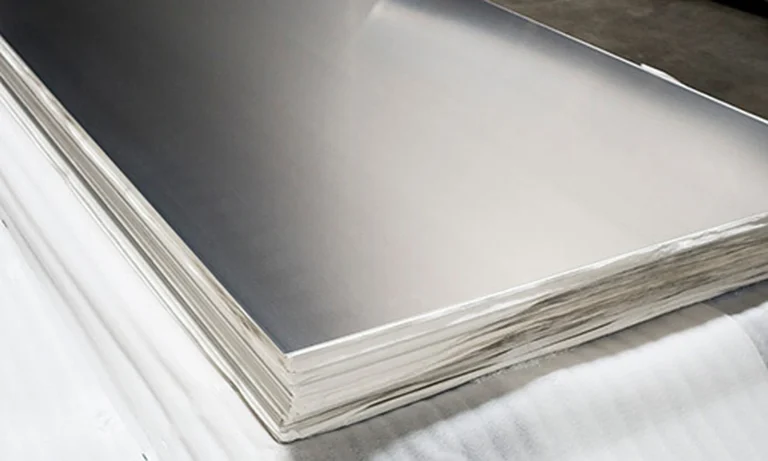

Three companies, one job. Cryptosteel, Cryptotag and Billfodl each sell a lump of metal that keeps the recovery words for your wallet readable long after the paper copy has burned, soaked or faded.
Where they part company is the method, and the method decides what a slip of the hand costs you. We’ll go through what each device is, how you get your words into it, what independent stress testing found, and who each one really suits.
Table of contents
So What Are Cryptosteel, Cryptotag and Billfodl?
Every one of them is a home for a seed phrase, the word list your wallet hands you on day one. Hold the words, hold the coins. There’s no battery in any of these things, no chip, no firmware and nothing to plug in.
Those words come from a standard called BIP39, which allows phrases of 12, 15, 18, 21 or 24 words pulled from a fixed list of 2048. BIP39 also promises that the first four letters pin down any word on that list, and that promise is why these devices give you room for only four characters per word.
Cryptosteel
Cryptosteel trades as Cryptosteel SWORD LTD from an address in Manchester. Its Cassette, the company says, was the first metal backup tool anybody could buy. That Cassette Solo carries a 149 euro list price and sits on clearance at 99 euros as we write this (September 2026).
The Capsule that made the name is being retired. Ask for its product page and you land on the Seed24, which Cryptosteel describes as the next-generation evolution of the Capsule. Over in the clearance section the Capsule Duo wears a “Discontinued Version” tag at 70 euros, down from 130 euros.
What replaces it costs less. The Seed24 Security Kit lists at 80 euros and was marked down to 50 euros, while the smaller Seed12 kit was 30 euros.
Cryptotag
Cryptotag builds in titanium instead of steel, and charges accordingly. Zeus is 149 euros including VAT, the plainer Loki is 99 euros, and the 48-word Thor asks 415 euros. Odin 3 and Odin 5, both aimed at Shamir shares, land at 240 euros and 350 euros.
Billfodl
Billfodl keeps it simple with a single device at $99. It’s 316 marine grade stainless steel, takes 96 characters, arrives with more than 300 laser-engraved tiles and weighs 0.4kg (14 oz). Follow a product link today and you’ll end up on privacypros.io, the parent brand.
It’s also the only one of the three that publishes real buyer protection. You get a 10 year warranty, free returns for 30 days, and a 125% money back guarantee that hands back your money plus 25% if you send the device home.
| What you’re comparing | Cryptosteel Seed24 | Cryptotag Zeus | Billfodl |
|---|---|---|---|
| What it costs | 80 euros, discounted to 50 euros | 149 euros including VAT | $99 |
| What it’s made of | Stainless steel | Titanium, 0.6 cm thick | 316 marine grade stainless steel |
| How the words go on | You slide tiles onto a core | You punch BIP39 numbers | You slide tiles into a chassis |
| How much it holds | Up to 128 characters | 24 words on 2 plates | 96 characters |
| Can you change it later | Yes, the tiles lift off | No, a punch is forever | Yes, the tiles pull out |
| What the vendor claims on heat | 1400 degrees C | 1667 degrees C | Twice an average house fire |
Getting Your Seed Phrase Into the Metal
Two of these devices ask you to file loose letters into a frame. The third asks you to dent metal once, forever. Almost every other difference grows out of that.
Loading a Cryptosteel Capsule
- Twist the cap off and pull the core clear of the shell.
- Take off the informative ribbon; Cryptosteel is clear that it “is only a reminder to fasten your data, not a fastener itself”.
- Spell out your words in character tiles. Twelve words fit in full, and anything longer uses the first four letters of each one.
- Thread the pierced tiles onto the core, dropping separators in wherever you want a break.
- Bend the fastener strap back past 90 degrees, sit it on the core and pull hard.
- Screw the shell back together.
Capacity on the Capsule is 123 characters. Cryptosteel says the Seed24 carries the same load, up to 128 characters, across the full ASCII set, so a password or a raw private key goes in as easily as a word list. The Seed System tile set alone runs past 820 tiles covering 94 printable characters.
One instruction is easy to skip, and skipping it gets expensive. Cryptosteel asks you never to pull the fastener off when you want to read a backup, and to shuffle the tiles along the core in the free space instead.
Loading a Billfodl
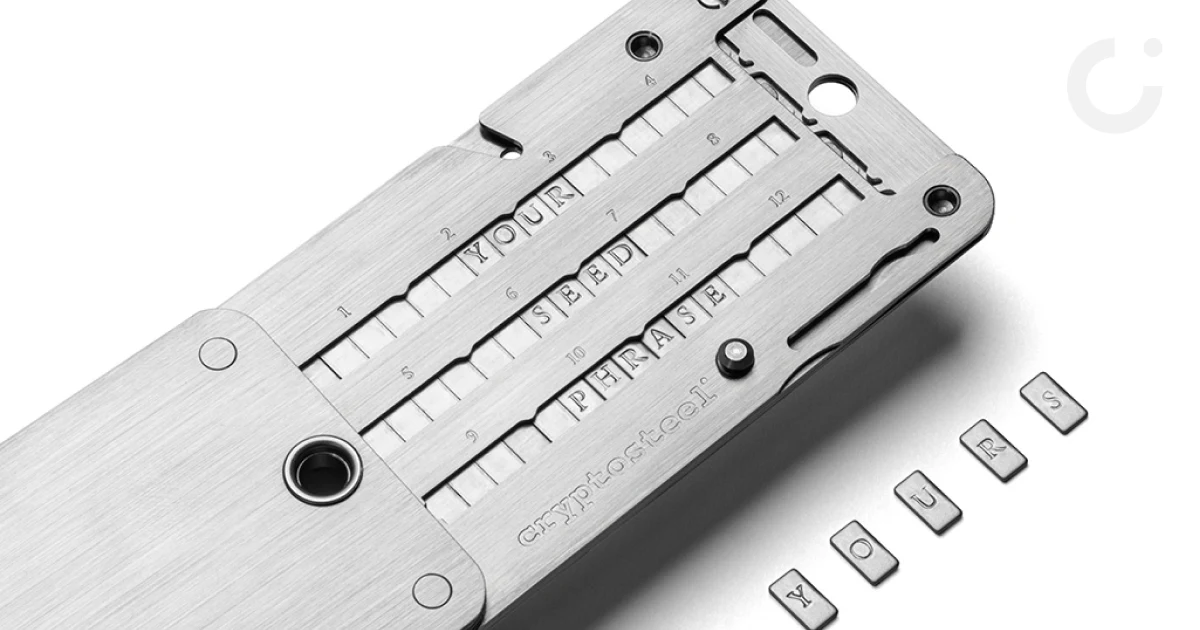
Billfodl’s chassis is a flat slab, 104mm x 58mm x 5mm, with a gate hinged along one side. Turn the top screw, press the spring lock at the bottom, then pull that gate open. Feed in the first four letters of every word and close the gate by turning the screw until the groove sits vertical.
Each slot is labelled with the word number it belongs to, which kills most miscounting. Half the phrase goes on one face and half on the other. Those 96 slots take 12, 18 and 24 word phrases, and they’ll hold hexadecimal or Wallet Import Format keys too.
Punching a Cryptotag Zeus
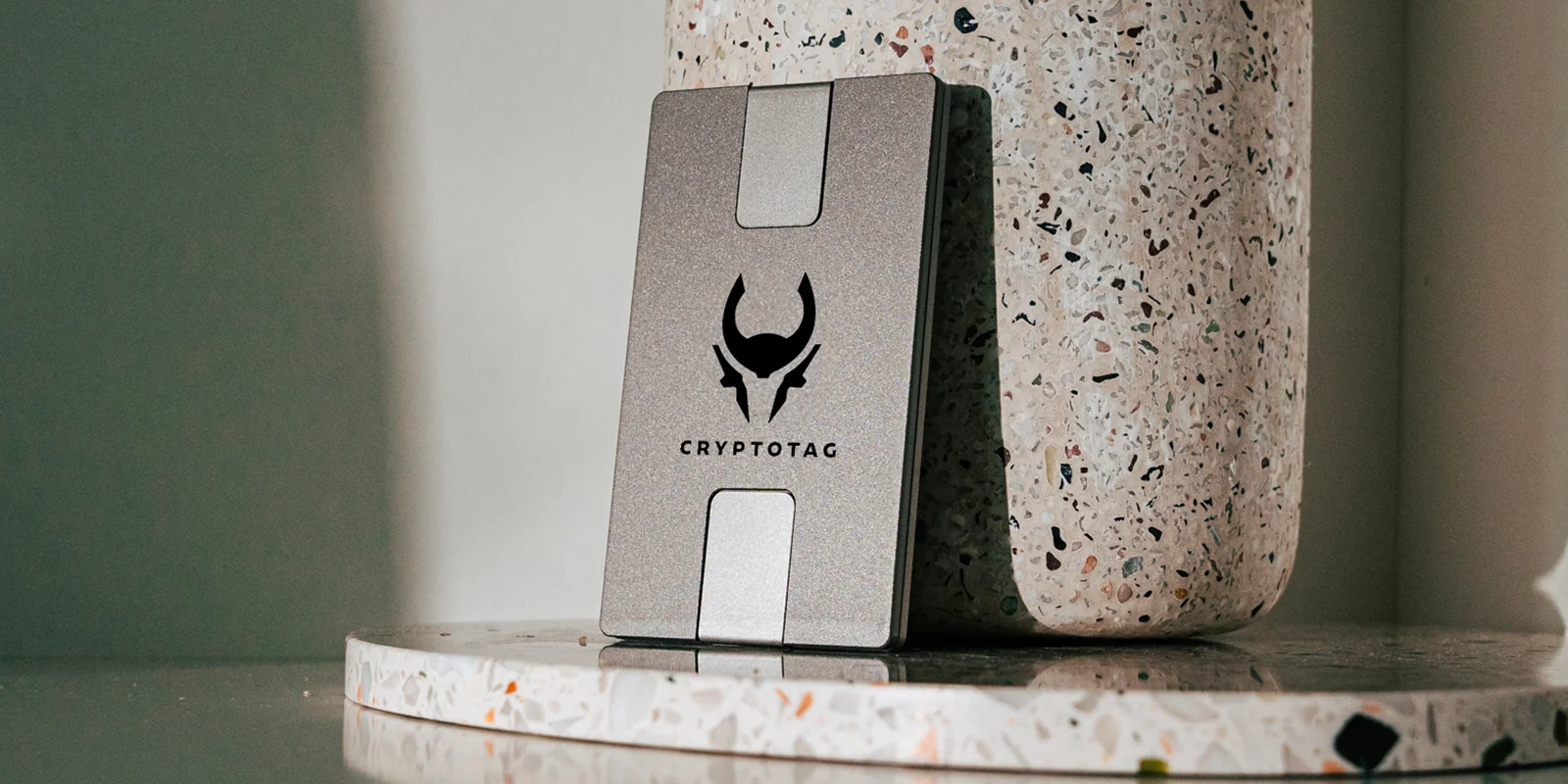
Zeus doesn’t store letters at all. It stores numbers. Cryptotag’s own reasoning is blunt: numbers “are easier to store in titanium than long words.”
You write the words on the conversion sheet in the box, look up each word’s BIP39 number, note it down, then punch those numbers into two titanium plates using the center punch supplied. Twelve words per plate, 210 grams for the pair. The kit also holds matches and ear plugs, which tells you how loud the work is and what you’re meant to do with the paper sheet afterwards.
Nothing about a punch is reversible. One wrong digit and that plate is scrap, and for us that’s the honest price of the design.
Why the Design Choice Decides Everything
Since 2018, Jameson Lopp has been feeding metal seed backups to a torch, a bucket of acid and a hydraulic press. As far as we know his rounds are the only independent testing this category has had more than once, and tile-based designs come off badly in them.
Round one landed on 14 July 2018, and it went poorly for both tile devices. A butane torch at 2,500 degrees F warped the Billfodl tray until, as Lopp put it, “a bunch of them fell out”, and after the 20-ton press he reported that “pretty much all of the letters had fallen out”. Cryptosteel’s device of the day took the heat better and still shed letters, which he logged as catastrophic failure.
His verdict pointed at the shared design rather than at either company: deform a rail-based device and the letters are free to walk.
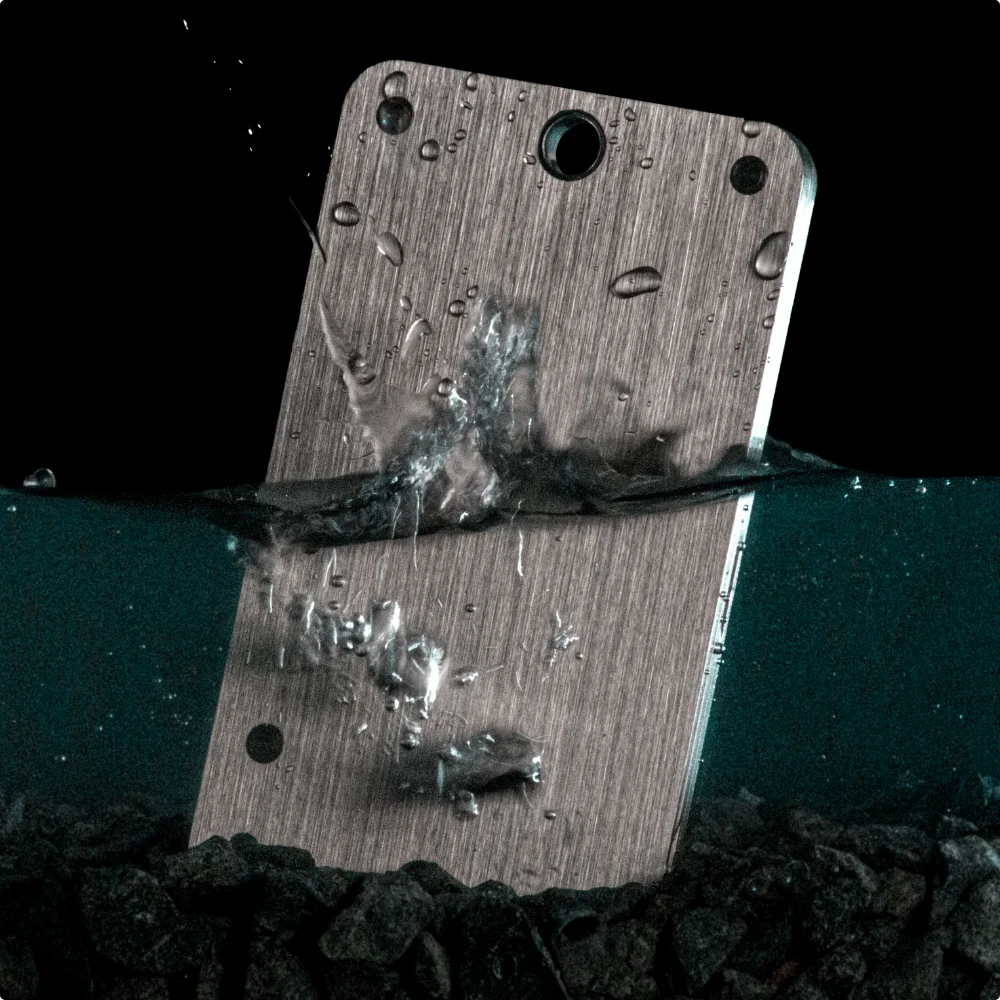
Cryptotag’s plates came through the same treatment far better. Round VI, dated 27 August 2022, handed both the CryptoTag Zeus and the CryptoTag Odin a grade of A. The Odin “barely even bent under 20 tons of force”, and Lopp liked the Zeus fasteners because they slide on and stay reachable even once the plate has bent.
How they did in independent stress testing | |
|---|---|
| Billfodl | In 2018 the letters came out under heat, then again under a 20-ton press. Lopp left it out of Round VI in 2022. |
| Cryptosteel | In 2018 it held heat better than the Billfodl and still dropped letters. Absent from Round VI in 2022 as well. |
| CryptoTag Zeus | Graded A in Round VI, 2022, with nothing lost. |
| CryptoTag Odin | Graded A in Round VI, 2022, and it barely bent under 20 tons. |
| What Round VI involved | Roughly 2000 degrees F for 10 minutes then a dunk in water, 12 hours or more in muriatic acid, and a 20-ton press. |
Read those grades with two caveats attached. Neither the Cryptosteel Capsule nor the Billfodl was in Round VI, so 2018 remains the newest independent word on either of them. Both have moved on since, and the Seed24’s deformation-resistant core and cotter pins look like a direct answer to what Lopp described.
Lopp’s design treatise, out on 13 August 2022, comes down in favour of 304 or 316L stainless steel or titanium, and prefers a center punch or an etch to a hammer stamp. Every brand here uses metal from that list, so the alloy isn’t what separates them. He also raises the recovery problem nobody enjoys thinking about: scramble a 96-tile device and the orderings run to 96 factorial.
Vendor heat figures are advertising, not lab reports. Cryptosteel claims 1400 degrees C, Cryptotag claims 1667 degrees C, and Billfodl promises more than double an average house fire. Cryptotag’s testing page shows blowtorches, a metal roller and pistol fire from 10 meters, yet no independent lab is named and no pass mark is given, which annoys us.
Cryptosteel vs Cryptotag vs Billfodl: Who Each One Is For
None of the three replaces a hardware wallet. Billfodl says so out loud on its own site, warning buyers off using the device in place of a Ledger or a Trezor.
Haven’t chosen a wallet yet? Our guide to the best crypto hardware wallets runs through the models worth your money.
Buy the Billfodl if you want the cheapest sealed steel and expect to change it later. Tiles slide out, so swapping in a new phrase is straightforward, and a spare set of tiles is $25.
Cryptosteel earns its place when what you’re storing isn’t a tidy 24-word phrase. Passwords, raw private keys and long passphrases all suit the ASCII tile set, and none of them suit a number-based Zeus. It’s also the only one here you can take apart and rebuild as often as you like.
Zeus is for the person who sets a phrase once and walks away. Our Cryptotag Zeus review covers the punching in more detail, including how the thing feels in the hand. We’d think twice if you rotate wallets every year, because a slip of the punch can’t be undone.
Splitting a backup across several pieces is covered by all three. Cryptotag’s Odin 3 and Odin 5 handle SLIP39 shares at 240 euros and 350 euros, Billfodl’s Multishard is a 2-of-3 set at $235, and Cryptosteel sells Seed MAX DUO, TRIO and QUINTET kits from 120 euros. Our best multisig wallets guide explains when that extra complexity earns its keep.
Weighing up the wallet that goes in front of all this? Start with our Ledger vs Trezor comparison, then widen out with our roundup of the best crypto cold wallets.
Habits That Keep a Metal Backup Useful
- Build the backup before any coins reach the wallet, while a mistake still costs you nothing.
- Wipe the wallet and restore it from the metal alone. Anything less and you’re trusting a phrase you have never actually tested.
- Put a passphrase on top, the one people call the 25th word. Billfodl pushes it for exactly the case where a stranger finds your device.
- Store the backup somewhere other than the hardware wallet. One break-in shouldn’t take both.
- Fit the tamper-evident seals if you got them. Cryptosteel’s Seed24 ships a serial-numbered PSW-97 seal rated to a 45 kg break strength.
- Burn the wallet’s paper card once the metal copy has been tested. Cryptotag puts matches in the box for a reason.
- If a backup is ever exposed and the funds have to move, send a small test amount first. Pick the wrong network or the wrong address and the money is gone, with nobody able to reverse it.
Mistakes We See All the Time
- Taking a photo of the phrase while you transcribe it. That picture is in a cloud backup within seconds, and your metal device has just become decoration.
- Pulling the fastener off a Cryptosteel to read it. The vendor tells you to slide the tiles along instead, because a loose core is exactly how tiles disappear.
- Punching a Cryptotag plate straight off the wallet screen. Fill the conversion sheet in first and check every number twice, since a punch never comes back out.
- Abbreviating a 12-word phrase when the device would hold each word in full. Cryptosteel lets 12 words go in unabbreviated, so use the room.
- Ordering a multi-share kit before you understand SLIP39. Three plates you can’t recombine are worse than one plate you can read.
- Reading a heat rating as a promise. A device can come through the fire intact and still lose its letters, which is precisely what happened in 2018.
FAQ
Has Cryptosteel stopped making the Capsule?
Pretty much. Its Capsule Solo page now sends you to the Seed24, which Cryptosteel calls the next-generation evolution of the Capsule, and the Capsule Duo is sitting in the clearance section with a “Discontinued Version” tag on it.
Titanium or stainless steel: does it matter?
Less than you would think. Titanium melts higher, and Cryptotag claims 1667 degrees C where Cryptosteel claims 1400 degrees C. Lopp’s treatise is happy with titanium and with 304 or 316L stainless, so what really separates these three is the way the characters are held in place.
Can a Cryptotag plate be used twice?
No. The punch leaves a permanent dent, so one plate carries one phrase for good. Tiles come out of a Cryptosteel or a Billfodl, so those you can redo.
Will these work with the wallet I already own?
Yes. They hold the words and never speak to your wallet, so compatibility is barely a question. Billfodl takes 12, 18 and 24 word phrases plus hexadecimal and Wallet Import Format keys, Cryptosteel covers the whole ASCII set, and Cryptotag’s plates follow the BIP39 and SLIP39 lists.
What do the three actually cost?
Billfodl is $99. Cryptotag’s Zeus is 149 euros including VAT and the Loki is 99 euros. Cryptosteel’s Seed24 Security Kit lists at 80 euros and was discounted to 50 euros when we looked in September 2026.
Does this replace my hardware wallet?
No, and Billfodl says the same on its own product page. These are backups. Use one next to a Ledger or a Trezor, never instead of one.
Our Pick
On the evidence anybody can go and check, Cryptotag is the one we would put a large balance behind. Zeus and Odin both took an A in Lopp’s Round VI, while the 2018 round of the tile-based Cryptosteel and Billfodl finished with letters scattered across the workbench.
That doesn’t make the other two bad buys. At $99 with a 10 year warranty behind it, Billfodl is the cheapest honest way into sealed steel, and Cryptosteel is the one to reach for when the thing you are saving is longer or stranger than a word list. Just keep in mind that neither has faced an independent press since 2018, and that the Capsule you will still see recommended everywhere is being wound down.
This article is for general information only and is not financial, legal, or investment advice. Prices and features change; check the vendor’s official page before buying.