
Two free wallets, both self-custody, both promising they’ll never hold a key of yours. That’s roughly where the resemblance stops.
Go with Exodus if crypto lives on your laptop, if you want a Trezor or a Ledger talking to the same app, and if a debit card wired to your wallet sounds handy. Trust Wallet suits you better when your coins are scattered over a dozen chains, when you’d rather hand nobody an email address, and when a certificate you can actually look up counts for something.
We’ve gone through the chains each one carries, how each has been broken into, what setup asks of you, and what a swap quietly costs. Every number here came off Exodus’s or Trust Wallet’s own pages in September 2026.

Table of contents
Exodus vs Trust Wallet, Boiled Down
The table below is the short answer, and each row underneath it gets a section of its own further down.
Exodus vs Trust Wallet: Comparison Chart | |
|---|---|
| What it costs | Exodus costs nothing to install. Neither does Trust Wallet. |
| Where it runs | Exodus builds for macOS, Windows, Linux, iPhone, Android and the browser. Trust Wallet stops at iPhone, Android and the browser, with no desktop app at all. |
| Networks | Exodus says 50+ crypto networks. Trust Wallet says 100+ blockchains. |
| Tokens | Exodus advertises 1,000,000+ assets. Trust Wallet claims 10M+ assets and 600M+ NFTs. |
| Code you can read | Exodus publishes some of its code and admits the rest is closed. Trust Wallet opens Wallet Core under Apache-2.0 and keeps the apps shut. |
| Outside checks | Exodus runs a HackerOne bug bounty and names no auditor. Trust Wallet claims independent audits plus ISO 27001 and ISO 27701. |
| Backing up | Exodus gives you 12 words, or a passkey tied to iCloud or Google Drive on mobile. Trust Wallet gives you 12 words plus Encrypted Cloud Backups. |
| Cold storage | Exodus talks to a Trezor on desktop and to a Ledger Nano X or Flex on mobile. Trust Wallet takes a hardware wallet on the extension only. |
| Cut taken on a swap | Exodus quotes rates from 0.5% and folds the cut into the spread. Trust Wallet names 0.7%, dropping to 0% between eligible stablecoins. |
| Help with gas | Exodus pays none of it, so every network fee lands on you. Trust Wallet sponsors the gas on 4 swaps a day. |
| Staking | Exodus stakes 9 assets through outside providers. Trust Wallet advertises up to 70% APR through providers of its own. |
| Who it suits | Exodus fits desktop users who want a card and a hardware wallet in one place. Trust Wallet fits phone users whose coins are spread thin. |
Exodus, in Plain Terms
Exodus has been going since 2015, and it’s self-custody all the way down. That phrase just means the private keys, the secret numbers that let coins move, sit on your machine rather than on somebody’s server. Exodus puts it flatly: it can’t reach your keys, so it can’t reach your crypto.
Which cuts both ways. Nobody can freeze you out, and nobody can dig you out.
Here’s something you rarely see in this corner of the market: the company behind it, Exodus Movement, trades on the New York Stock Exchange as EXOD, and its homepage says so beside a badge reading 11+ Years in crypto. A public listing means published accounts, which is more disclosure than any other wallet in this comparison can offer you.
Desktop is where it started and desktop is still the pitch. You’ll find it on macOS, Windows and Linux, on iPhone and Android, and as a browser add-on called Exodus Web3 Wallet. Our full Exodus crypto wallet review digs into that desktop app properly.
Six Things Exodus Gets Right
- Its reach runs to 50+ crypto networks, with unlimited token support on the biggest web3 chains.
- There’s a genuine desktop program for macOS, Windows and Linux, which is something Trust Wallet has never built.
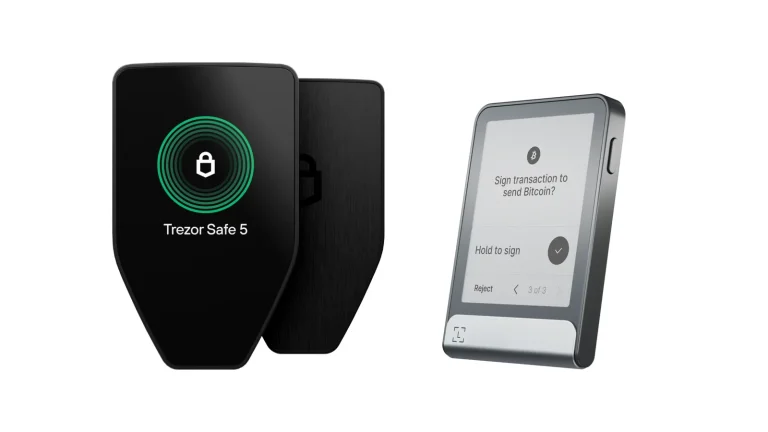
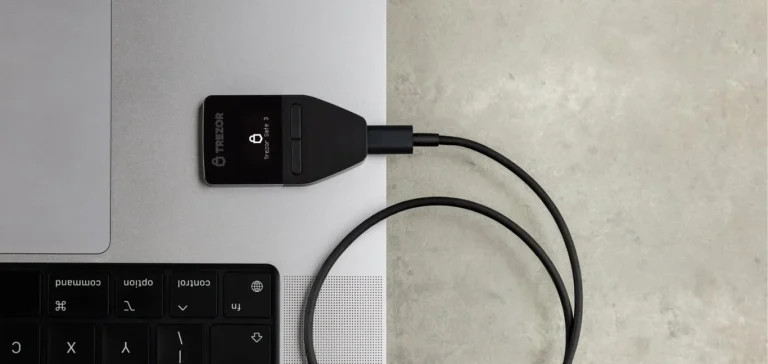
- A Trezor Model T, Model One, Safe 3 or Safe 5 plugs into Exodus Desktop over USB, and the Safe 7 pairs with Exodus Mobile instead.
- Ledger owners get the Nano X and the Flex, connected to Exodus Mobile over an encrypted Bluetooth link.
- Nine assets can be staked from inside the wallet: Ethereum, Aptos, Cardano, Cosmos, Injective, Kava, Polygon, Solana and Tezos.
- Exodus Pay bolts on a free Exodus Card and instant cash transfers to anyone else using Exodus Pay.
Trust Wallet, in Plain Terms
Trust Wallet turned up in 2017 and runs on the same self-custody principle. No account, no email address, nothing personal handed over. Its security page promises it never touches or stores your private keys, and that it logs neither your IP address nor your email.
Mobile is the priority here, the mirror image of Exodus. You get an iPhone app, an Android app, and an add-on for Chrome and Brave. Go looking for a desktop program on the site and you won’t find one.
Scale is something Trust Wallet enjoys talking about: the security page puts the number at over 200 million users, while its comparison pages stretch that to 220 million+ downloads and more than $30 billion sitting in user balances.
Billboard figures, in other words, not anything audited, so weigh them accordingly. The other head-to-head readers tend to want next is our MetaMask vs Trust Wallet piece.
Six Things Trust Wallet Gets Right
- It stretches across 100+ blockchains, which the homepage translates into 10M+ assets and 600M+ NFTs.
- Nothing asks you to register, hand over an email, or type a single personal detail.
- ISO/IEC 27001:2022 and ISO/IEC 27701:2019 certificates are on file, and Trust Wallet says it was the first crypto wallet to earn them.
- Trade one eligible stablecoin for another on the same chain and the swap fee is 0%.
- Gas Sponsorship covers the network fee on 4 swaps a day across BNB Chain, Solana and Ethereum.
- Newer arrivals include tokenized real-world assets, prediction markets, and perpetual futures routed out to Hyperliquid and Aster DEX.
Security: Exodus and Trust Wallet Compared
Neither company holds your keys, so one rule binds them both. Lose the phrase and it’s gone, and no support ticket brings it back. Exodus doesn’t soften that at all: whoever holds your 12-word secret key holds your money, and Exodus can’t recover the key for you.
Our custodial vs non-custodial wallets explainer spells out what that bargain feels like day to day.
Paperwork is where Trust Wallet gets ahead. It says it’s independently audited by industry leaders, and it holds ISO/IEC 27001:2022 and ISO/IEC 27701:2019 certifications. Nothing of the sort turns up anywhere on the Exodus side.
What you get from Exodus instead is a security team it says includes top 10 HackerOne researchers, plus a bug bounty anyone can file against. That’s a real program by any measure, though it still isn’t a report you can sit down and read for yourself.
Open source muddies both stories. Exodus admits only some of its code is public and gives its reasoning: publish the interface and convincing fakes get easier to build. Trust Wallet posts its Wallet Core cryptographic library to GitHub under the Apache-2.0 license, while the apps and the extension stay shut.
Its own comparison table still ticks Open Source with a plain yes, which flatters the truth.
The ugliest chapter belongs to Trust Wallet, and it’s recent. Someone pushed a poisoned version 2.68 of the browser extension onto the Chrome Web Store on December 24, 2025, using an API key that had leaked in November 2025 during the Sha1-Hulud supply chain attack. Open that build and log in across December 24 to 26, 2025 and you were exposed.
By the company’s own count that reached 2,520 addresses and about $8.5 million in assets. A clean version 2.69 followed, and Trust Wallet paid the affected users back without being obliged to. Its account of what happened deserves ten minutes before you install anything.
Exodus carries a scar too, though this one started outside the building. An npm package called pdf-to-office slipped malicious code into Exodus desktop builds 25.13.3 and 25.9.2 that were already sitting on developers’ machines, quietly rewriting the address a payment was headed to. ReversingLabs published the research on April 10, 2025.
No official installer was ever tampered with, and wiping the app then reinstalling it from the real site was enough to clear the problem.
Backups are the part we find genuinely interesting. Trust Wallet bolts Encrypted Cloud Backups onto the usual twelve words. Exodus does something else on mobile, encrypting your secret key into iCloud or Google Drive so that only a passkey unlocks it.
There’s a catch buried in that, and it’s a nasty one. Bin either the passkey or the backup file and there’s nothing left underneath you, and restoring only works on the same operating system you backed up from.
What Exodus and Trust Wallet Are Like to Use
One difference outweighs all the others, and it’s the desktop app. Exodus builds for macOS on Apple Silicon and Intel, for 64-bit Windows, and for Linux as a .deb or a .zip. Trust Wallet has no answer to that, so on a big screen it’s the browser add-on or nothing.
Swapping in Exodus is at least well signposted. Tap the swap icon on mobile, choose both assets, set the amount with MIN or MAX, then tap Swap. Desktop hides it behind a Swap tab, throws in HALF and ALL, and labels the confirm button Swap Now.
You can’t set a custom fee on a swap, so whatever the app picks is what you pay.
Chrome and Brave carry both add-ons, and that’s the end of the list. Safari and Firefox get nothing from either company. Store ratings make grim reading as well: Exodus Web3 Wallet sits on 3.4 out of 5 from 81 ratings with 100,000 users, Trust Wallet on 3.3 from 1.6K ratings with 1,000,000.
Hardware support in Exodus splits by device, which threw us at first. Trezor is a desktop thing, Ledger is a mobile thing, and whichever you plug in shows up as its own portfolio. Trust Wallet keeps things simpler by offering hardware support through the extension and nowhere else.
If the phone is where this will really live, our ranking of the best mobile crypto wallets takes in the wider field.
Privacy is where the mismatch bites. Nothing about the Exodus wallet asks who you are, and then Exodus Pay asks for the lot. Verification runs through Veriff, Americans may be asked for a Social Security number, the card wants a tax ID along with questions about income and employment, and the whole process can take up to 72 hours.
Trust Wallet sells no such product and asks for none of it.
Coins and Chains in Exodus vs Trust Wallet
Nothing else separates these two by this much. Trust Wallet’s homepage claims 100+ blockchains, 10M+ assets and 600M+ NFTs. Exodus’s help centre says 50+ crypto networks with unlimited token support on the biggest web3 chains, while its homepage shouts 1,000,000+ assets supported.
Those two Exodus numbers aren’t counting the same thing at all, since one of them counts chains while the other counts tokens.
Narrower again is the browser add-on. Exodus Web3 Wallet handles Bitcoin, Ethereum, Solana, Algorand, Arbitrum One, Aurora, Avalanche C-Chain, Base, BNB Smart Chain, Cardano, Flare, Optimism, Polygon and Rootstock. Aurora, Flare and Rootstock get what Exodus calls light support, meaning only outgoing transactions ever appear in your wallet.
Plug in a Ledger and the list shrinks further, down to Bitcoin, Ethereum, Solana, Base, Polygon, TRON and XRP Ledger. You also have to create an asset account for each network before any of it works.
| Coverage | Exodus | Trust Wallet |
|---|---|---|
| Networks the vendor claims | 50+ | 100+ |
| Tokens the vendor claims | 1,000,000+ | 10M+, plus 600M+ NFTs |
| Chains in the browser add-on | 14, and three of those are partial | Bitcoin, Ethereum, Solana and the major EVM chains |
| Chains once a Ledger is attached | 7 | Never published |
| Adding your own tokens | Works, on several networks | Works, in the extension |
| Assets you can stake | 9, each named on the site | No list published |
Both wallets share one merciless rule. Pick the wrong network, or paste an address with a single character out of place, and that money is gone with nobody able to claw it back. Read the chain, read the wallet address, then confirm.
What Exodus and Trust Wallet Charge You
Installing either one costs you nothing at the time of writing (September 2026). Swapping is where the bill turns up.
Exodus says it takes no fee of its own, and that 100% of a network fee goes to the network. Swaps are the exception, since they may include a spread as well as a network transaction fee, and the homepage puts rates as low as 0.5%. A spread is a slippery thing to audit, because it’s baked into whatever rate you get quoted.
Credit to Trust Wallet for printing a figure. Its comparison table names 0.7%, sitting next to $0 on staking, buying, sending and receiving.
Trade one eligible stablecoin for another on the same chain and that falls to 0%. USDT, USDT0, USDC, USDC.e, EURC, USDS, DAI and U all qualify, on BNB Chain, Solana, Arbitrum, Polygon, Base, Optimism and Avalanche.
Sometimes it’ll cover the gas as well. Gas Sponsorship pays for 4 swaps a day on BNB Chain with no floor, 4 a day on Solana above roughly $200, and 4 a day on Ethereum above $50. Nothing on the Exodus side answers that.
What Exodus does have is a card. Exodus Pay hands you a free Exodus Card, fee-free cash sends to other Exodus Pay users, and a $5 reward for finishing setup where that’s offered.
Your balance in there is XO Cash, a dollar-backed stablecoin on Solana issued with MoonPay. Backing runs 1:1, held as dollar deposits, US Treasuries and other cash equivalents.
Exodus vs Trust Wallet: What We Like and Don’t
Here’s what we’d praise about each one, and what we’d grumble about.
Exodus, Weighed Up
Trust Wallet, Weighed Up
So Which Wallet Do You Install?
Managing everything from a laptop? Exodus, and it’s not a close call. It’s the only one of the two with a desktop app, and Trezor support lives nowhere else.
Coins scattered across a dozen chains? Trust Wallet takes it. Double the network count is the whole argument, and eligible stablecoin swaps cost you nothing.
Want a card sitting beside your crypto? Exodus, though read what it asks for first. The wallet itself wants nothing from you, while Exodus Pay wants a tax ID, an identity check and possibly three days of waiting.
Exodus vs Trust Wallet FAQ
Which is the safer bet, Exodus or Trust Wallet?
Trust Wallet, on paper. It points to independent audits and to ISO/IEC 27001:2022 and ISO/IEC 27701:2019 certificates, where Exodus offers a HackerOne bug bounty and in-house researchers but nothing you can look up. Then again, it was Trust Wallet whose browser extension got hijacked in December 2025, costing 2,520 addresses roughly $8.5 million, and it chose to pay those people back.
Which one holds more coins?
Trust Wallet, comfortably. Its 100+ blockchains sit against the 50+ crypto networks Exodus quotes in its help centre, and Trust Wallet’s own comparison page uses exactly those two figures.
Can I run Trust Wallet on my desktop?
No. What you get is an iPhone app, an Android app and an add-on for Chrome and Brave. Exodus is the one shipping proper desktop builds for macOS, Windows and Linux.
Whose swaps work out cheaper?
Depends entirely on the pair. Trust Wallet prints 0.7% and waives it altogether between eligible stablecoins on one chain, while Exodus starts at 0.5% and takes its cut through the spread inside your quote. Gas gets added on top either way.
Will a hardware wallet work with either of them?
Yes, both, with caveats. Exodus Desktop pairs with a Trezor Model T, Model One, Safe 3 or Safe 5, Exodus Mobile pairs with a Trezor Safe 7 and with a Ledger Nano X or Flex over Bluetooth. Trust Wallet only does this through its browser extension.
Does one recovery phrase open both wallets?
It does. Twelve words in the standard BIP39 format drive each of them, so a phrase from one rebuilds the same addresses in the other. Do that on a machine you trust, and never type those words into a web page.
Does either wallet want my ID?
Not the wallets themselves. Exodus Pay is the exception: verification goes through Veriff, people in the US may be asked for a Social Security number, and switching on the Exodus Card means handing over a tax ID plus details of your income and employment.
Our Verdict on Exodus vs Trust Wallet
Judged on reach, and on how much it’s willing to publish about its own defenses, Trust Wallet takes this. Twice the chains, ISO 27001 and ISO 27701 on file, and not one personal detail asked of you. That December 2025 extension breach stains it badly, even if paying users back voluntarily is more than most firms bother with.
Anything involving a keyboard goes to Exodus. Most people who choose it choose it for the desktop app, Trezor support exists nowhere else, and an NYSE listing forces a level of disclosure nobody else here comes near.
Chain count is where it loses, and there’s no audit report for it to wave at anyone either.
Mostly this comes down to where you physically sit. Phone in hand with coins on ten chains, take Trust Wallet. Laptop open with a Trezor in the drawer, take Exodus.
If neither of them fits the way you hold crypto, our roundup of the best non-custodial wallet choices covers what’s left.
This article is for general information only and is not financial, legal, or investment advice. Prices and features change; check the vendor’s official page before buying.