
Crypto options trading is booming, but picking a platform still feels like a gamble. You sit down to open a position and the site won’t load, throws a Cloudflare error, or blocks you with a security check it never explains. Meanwhile, the market keeps moving without you.
These aren’t rare glitches. Poorly built platforms expose you to failed withdrawals, stalled orders, and systems that buckle when everyone tries to trade at once. In a volatile market, a few minutes of downtime can turn a planned hedge into an open loss.
To help you trade smarter, we analyzed dozens of exchanges and narrowed the list to the 5 best crypto options trading platforms. Each one handles complex order flow, executes fast, stays up under stress, and keeps errors from locking you out when it matters most. Let’s dive in.
Table of contents
5 Best Crypto Options Trading Platforms | |
|---|---|
| Binance | Best For: Overall for High-Liquidity Multi-Asset Options Trading Options Model: European-style Fees: 0.02% maker/taker Margin: Cross & isolated supported KYC: Required |
| Crypto.com | Best For: Mobile & Secure Access Options Model: European-style Fees: 0.075% maker/taker Margin: Spot-based only KYC: Required |
| Bybit | Best For: Stablecoin-Settled Flexibility Options Model: European-style Fees: 0.020% maker/0.030% taker Margin: USDC-based cross margin KYC: Required |
| OKX | Best For: Institutional-Grade BTC & ETH Options Options Model: European-style Fees: ~0.030% maker/taker (volume-based) Margin: Standard & portfolio margin KYC: Required |
| Deribit | Best For: Pro BTC/ETH Options Traders Options Model: European-style Fees: 0.00% maker / 0.05% taker Margin: Standard & portfolio margin KYC: Required |
Binance – Best Overall for High-Liquidity Multi-Asset Options Trading
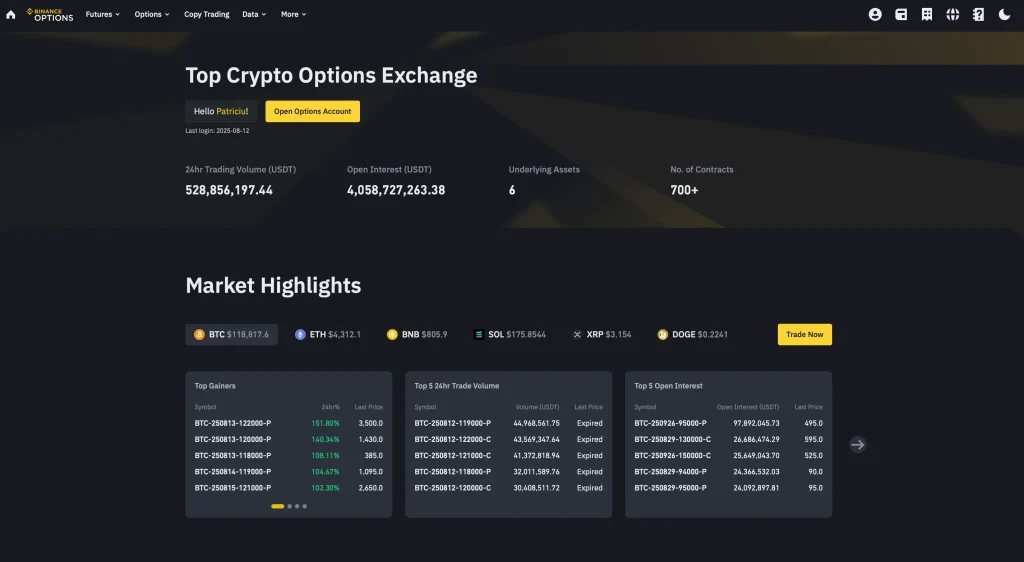
Binance takes the top spot for its deep liquidity, broad toolset, and long track record on uptime and security. Liquidity matters more in options than almost anywhere else: it means tighter spreads and fills close to the price you saw.
It offers European-style options on major crypto assets, including BTC, ETH, BNB, SOL, and XRP, so you can hedge or speculate beyond Bitcoin and Ether alone.
On security, Binance enforces mandatory KYC verification, uses Cloudflare protection against online attacks, and layers account defenses that include 2FA, cold storage, and real-time IP address tracking. If someone logs in from an unfamiliar location, you hear about it.
Fees are a flat 0.02% maker/taker on options, far below what traditional options brokers in Canada or the USA charge. There are no hidden settlement costs, and the interface lets you move between options, futures, and spot markets without leaving the page. Idle capital can sit in Binance Earn instead of doing nothing.
Reddit users often point to Binance’s reliability, especially on BNB pairs and BTC options, citing low latency and responsive support.
Crypto.com – Best for Mobile & Secure Access
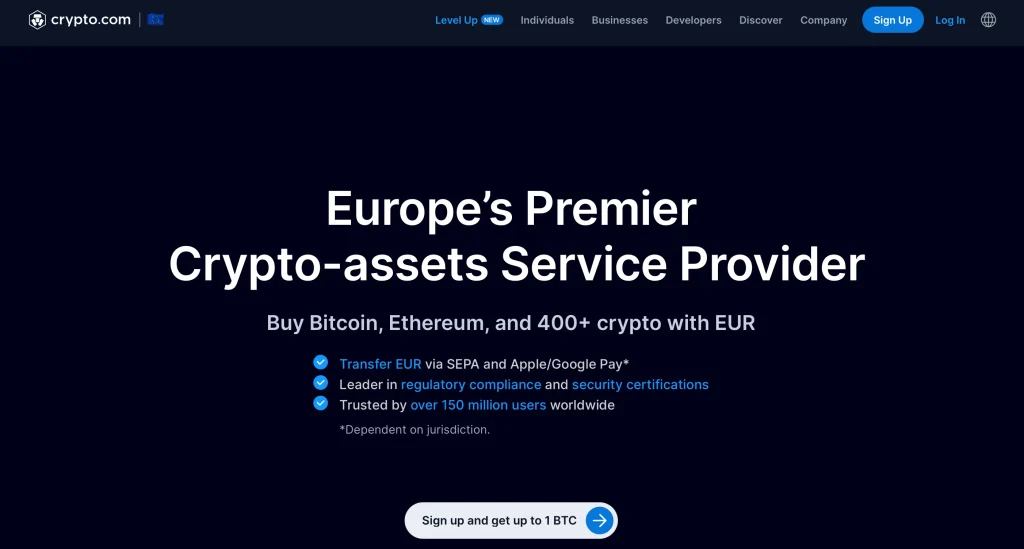
Crypto.com earns its place for a polished mobile experience, tight integration across its financial products, and institutional-grade security. It offers European-style cryptocurrency options, a good fit for retail traders who want simple, fixed-risk strategies they can manage from a phone.
As of 2026, Crypto.com offers options on top crypto assets, including BTC, ETH, CRO, SOL, and MATIC. That’s a solid list, though smaller than Binance’s.
Security is one of Crypto.com’s strongest pillars. The platform holds ISO/IEC 27001:2013, SOC 2 Type II, and PCI-DSS compliance, keeps user assets in cold storage via Ledger Vault, and uses MFA, IP whitelisting, and Cloudflare protection to block attacks. KYC is mandatory before you can trade anything, options included.
Reddit users praise Crypto.com for easy onboarding, a clean UI, and mobile-first tools, but report mixed liquidity on less popular option pairs. Thin order books mean wider spreads, so check depth before sizing up on an altcoin contract.
Fees are competitive and easy to predict. The base maker fee is 0.075% and the taker fee is 0.075%, with discounts of up to 50% for high-volume traders or those staking CRO tokens.
Bybit – Best for Stablecoin-Settled Flexibility
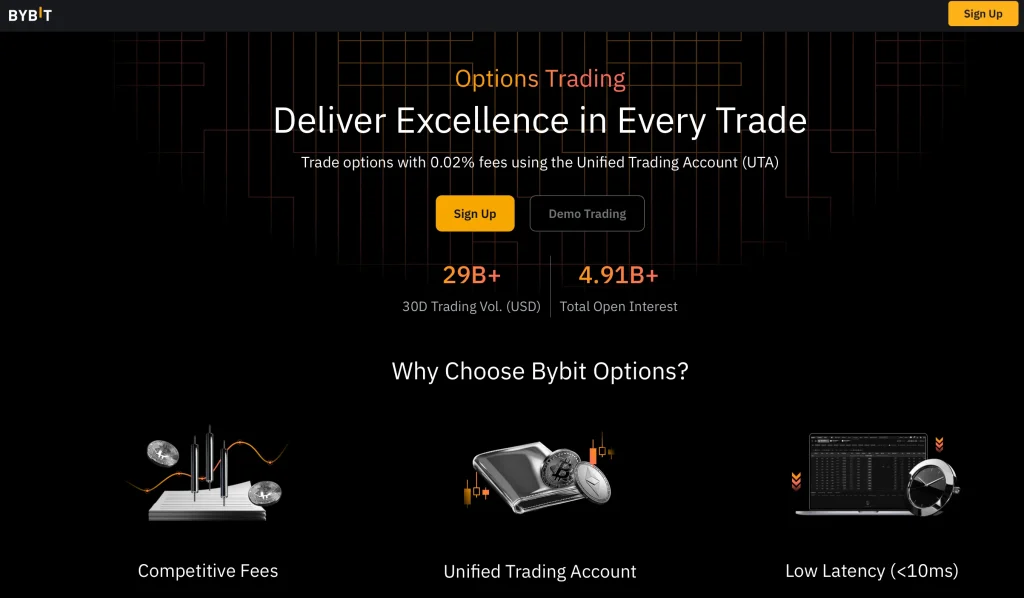
Bybit is a strong pick for options traders who want low fees, fast execution, and a clean interface.
It offers European-style options on major digital assets like BTC, ETH, and SOL, using USDC as both margin and settlement currency. That keeps your collateral and your profit and loss in one stable unit, so you can judge a trade’s result without your margin coin moving underneath you. Contracts settle automatically at expiration, using a time-weighted price calculation that is harder to manipulate in the final minutes.
Fees are competitive. Standard rates start at 0.020% for maker orders and 0.030% for taker orders, with tiered discounts for active or VIP traders.
On security, Bybit uses cold wallet storage, 2FA, and full KYC compliance, which suits retail and institutional traders alike.
Community feedback, especially on Reddit, is broadly positive: users highlight the platform’s responsiveness during volatile conditions and its intuitive web and mobile experience.
OKX – Best for Institutional-Grade BTC & ETH Options
OKX stands out in 2026 as a top-tier venue for BTC and ETH options, built for traders who value precision, deep liquidity, and institutional-grade infrastructure.
It offers European-style options only, settled at expiration, with expiries from daily to quarterly. Margin tools and pro-level analytics (options chains, Greeks, and an RFQ block trading system) are built in, so you can price a spread and size it without switching tools.
Security is strong: 2FA, cold wallet storage, and Cloudflare protection, plus full KYC and regulation across the U.S., EU, UAE, and Asia.
Fees follow a transparent, tiered model: base users pay 0.030% maker/taker, while high-volume or VIP traders can access lower or negative fees. OKX also recently lowered fee caps and exercise/liquidation thresholds, which cuts costs for active traders.
Reddit users often highlight OKX’s execution speed and institutional-grade UI, though they note the limited range of supported options assets.
Deribit – Best for Pro BTC/ETH Options Traders
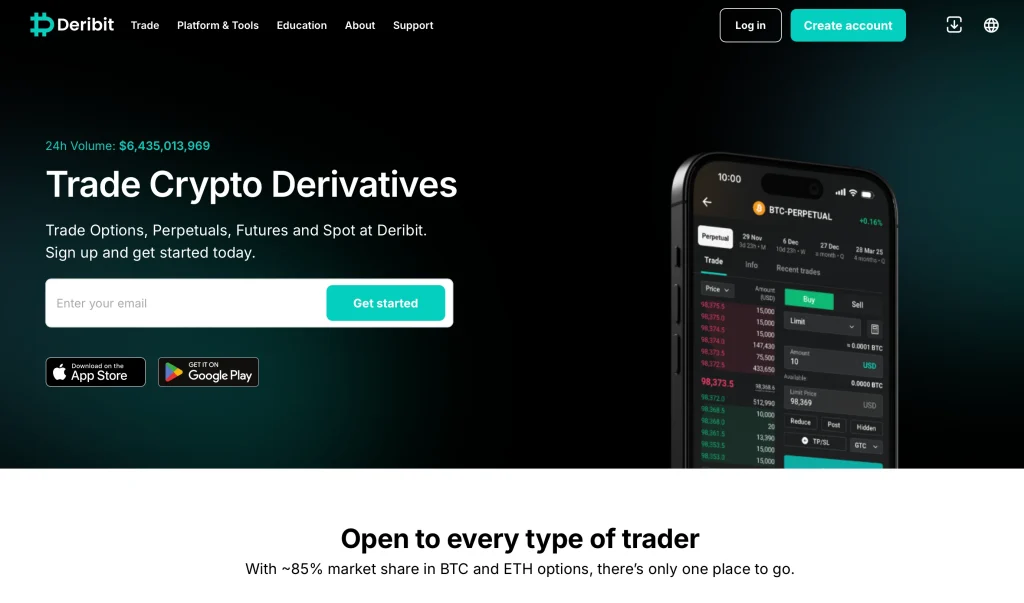
Deribit is the go-to venue for experienced options traders focused on Bitcoin and Ethereum derivatives.
It specializes in European-style options that settle at expiration, which makes risk easy to define: you know your maximum loss the moment you open the trade.
The platform is known for deep liquidity and low-latency execution, backed by institutional-grade infrastructure and a global user base. In May 2025, Coinbase agreed to acquire Deribit, a sign of how central it has become to crypto derivatives.
Deribit’s fee structure is clear and competitive: makers pay 0.00%, while takers pay 0.05%. Multi-leg option combos get discounted through combo fee adjustments, so spreads and strangles cost less than the sum of their legs.
Security is a priority: most funds sit in cold wallets, 2FA is mandatory, and the platform maintains broad safety protocols and an insurance fund to protect users. Deribit also supports standard and portfolio margining, so traders can put capital to work across futures and options without over-collateralizing.
Methodology: How We Chose the Best Crypto Options Trading Platforms
To find the best crypto options trading platforms, we ran a multi-layered review focused on real-world usability, safety, and practical value to active traders. We looked at more than a dozen platforms and judged each against the criteria below:
1. Security Standards & KYC Verification
We checked each platform for security measures such as cold wallet storage, 2FA, and IP address monitoring. We favored platforms with a solid record of defending against online attacks and DDoS threats (Cloudflare protection, for example) and of handling user data responsibly. We also noted KYC requirements to gauge account protection and regulatory standing.
2. Liquidity & Market Depth
We gave heavy weight to deep liquidity, especially in BTC, ETH, and popular altcoin contracts. Platforms that make margin management smooth, support large-volume crypto futures trading, and keep bid-ask spreads tight in the Bitcoin market ranked higher. Liquidity decides whether you can enter and exit options at a fair price or eat slippage on every fill.
3. Fees, Collateral, and Settlement Models
Transparent fees were essential. We compared maker/taker fees, discount tiers, and combo pricing. Platforms with flexible settlement (USDC, BTC, or ETH) and low-cost contracts that work for both short-term and long-term strategies rated higher.
4. User Experience & Community Feedback
We factored in feedback from Reddit, Twitter, and trading communities to capture real trader sentiment. Platforms praised for fast execution, responsive interfaces (especially on mobile), and consistent support scored higher. We excluded platforms blocked in key regions or flagged for outages and errors under heavy load.
FAQ
What is crypto options trading?
Crypto options give you the right, but not the obligation, to buy or sell a cryptocurrency at a set price on a future date. You pay a premium for that right, and as a buyer, the premium is the most you can lose.
Can you trade options on cryptocurrencies?
Yes. You can trade crypto options on several exchanges, including well-known names like Binance. These platforms offer Bitcoin options, BNB pairs, altcoin contracts, and more.
Do I need to complete KYC to trade crypto options?
Most crypto options platforms require KYC verification, especially those serving regulated markets like the USA or Canada. Some DeFi options protocols let you trade without KYC, but you give up the protections a regulated exchange provides.
How do you trade F&O in crypto?
To trade crypto futures and options (F&O), register on a trading platform, complete KYC, deposit funds, and open the contracts you want using the platform’s leverage or hedging tools. Look for deep liquidity if you plan to trade short-term.
What’s the difference between European and American-style options?
European-style options can only be exercised at expiry. American-style options can be exercised early. Most crypto options on global platforms follow the European model because it simplifies settlement.
What is the main advantage of European-style options in crypto trading?
European-style options are generally cheaper and more predictable than American-style ones. Because they can only be exercised at expiration, they’re less exposed to price manipulation and tend to carry lower fees. That suits traders planning around a specific expiry rather than reacting to short-term swings.
Can I benefit from market moves before expiration with European options?
Not directly. You can’t exercise a European-style contract early, even if the market moves your way. You can, however, sell the contract on the platform before expiry (if there’s enough liquidity) and lock in the gain that way. Plan around the expiration date rather than mid-term price action.
What is the difference between crypto options and futures?
Options give you the right to trade an asset; futures create an obligation. Traders use options to protect a portfolio or speculate with a capped downside, while futures carry higher margin and leverage risk.
Final Thoughts
Choosing a crypto options platform isn’t only about low fees or asset variety. It’s about trusting the systems behind every trade. On a reliable platform, orders fill, settlements run on time, and withdrawals go through. If a single bad input can break a page, or trades don’t execute when they should, treat that as a red flag.
Stick with platforms built to handle complexity without compromise, and you’ll trade with confidence, not uncertainty. Every platform above requires KYC, so expect to verify your identity before you fund an account, and keep only the capital you plan to trade on the exchange.
How I review: Reviewed by Andrei B. I buy the hardware wallets I review, test every product myself and score it on security, UI/UX, ease of use, price and supported coins. Before I publish, I also check recent user reviews and any hack reports.
The whole process is explained on the How We Review page. You can read more about me, or contact me with corrections, from the links at the bottom of this page. For general safety advice, see the FTC guide to cryptocurrency scams.