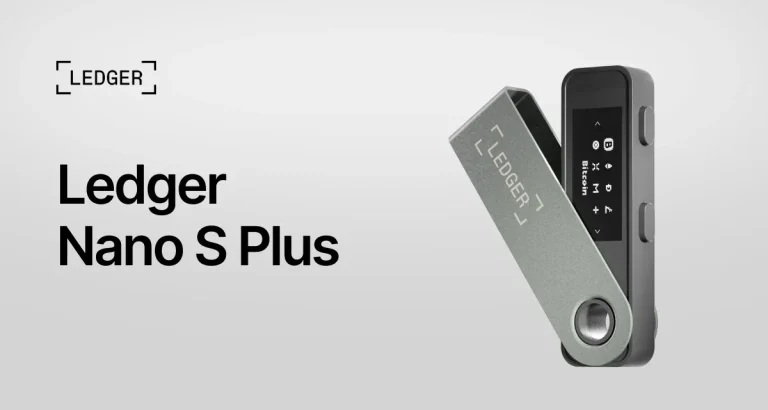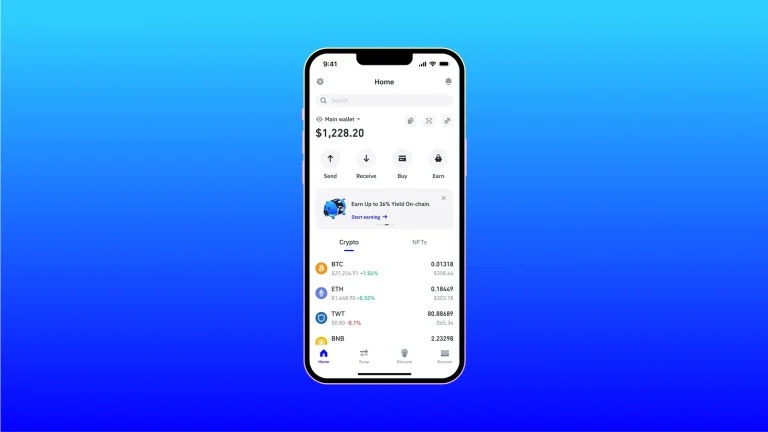

Line these two up and they look like twins. Trust Wallet and Coinbase Wallet are both free, both leave the keys sitting on your own phone, and both come as an app plus a browser add-on. Then you notice that one of them has quietly stopped using its own name.
Go with Trust Wallet when you want one app that holds nearly everything: 100+ blockchains, no sign-up, no email handed over. Coinbase Wallet, which is now the Base app, suits you better if Base and Ethereum are where you actually spend your time, if you’d rather log in with a passkey than copy out twelve words, and if rewards and a social feed inside your wallet sound useful rather than annoying.
We’ve gone through the chains each one carries, how they handle a compromised phrase, what setup feels like, and what a swap takes out of you. Every number below came off Trust Wallet’s or Coinbase’s own pages in September 2026.
Table of contents
Trust Wallet vs Coinbase Wallet at a Glance
Here’s the whole argument in a table. Everything in it gets unpacked below.
Trust Wallet vs Coinbase Wallet: Comparison Chart | |
|---|---|
| What it costs | Trust Wallet costs nothing to install. Neither does Coinbase Wallet. |
| What it’s called today | Trust Wallet has kept the same name since 2017. Coinbase Wallet answers to Base app, with the old wallet tucked away in legacy mode. |
| Where it runs | Trust Wallet: iPhone, Android, and an add-on for Chrome and Brave. Coinbase Wallet lands in exactly the same four places. |
| Networks | Trust Wallet reaches 100+ blockchains. Coinbase Wallet stops at Ethereum and the EVM crowd, plus Solana and Bitcoin. |
| Tokens | Trust Wallet claims 10M+ assets and 600M+ NFTs. Coinbase Wallet says thousands of assets, every ERC-20 among them. |
| How it guards the keys | Trust Wallet gives you 12 words and a scanner that flags risky signatures. Coinbase Wallet gives you 12 words too, or a passkey smart wallet once Base mode is on. |
| Code you can read | Trust Wallet opens its Wallet Core library under Apache-2.0 and keeps the apps shut. Coinbase Wallet opens nothing at all. |
| Backing up | Trust Wallet encrypts a copy to iCloud or Google Drive. So does Coinbase Wallet. |
| Cut taken on a swap | Trust Wallet won’t name a figure, though eligible stablecoin pairs go through at 0%. Coinbase Wallet says up to 1%. |
| Cold storage | Trust Wallet pairs with a Ledger on the extension, just not through Firefox. Coinbase Wallet pairs with a Ledger too, but only your first account. |
| Everything else | Trust Wallet throws in staking, NFT tools and 4 sponsored swaps a day. Coinbase Wallet throws in a Farcaster feed, USDC rewards and a 25% referral cut. |
| Who it suits | Trust Wallet fits anyone whose coins are scattered over a dozen chains. Coinbase Wallet fits anyone trading on Base who wants signing in to be painless. |
So What Is Trust Wallet, Exactly?
Started in 2017, Trust Wallet is self-custody all the way down. That phrase just means the private keys, the secret numbers that let coins move, live on your handset rather than on somebody’s server. Trust Wallet’s line is that it never touches or keeps them, which cuts both ways: no support desk can lock you out, and no support desk can dig you out either.
You’ll find it on iPhone, on Android, and as an add-on for Chrome and Brave. Nothing asks you to register, and the security page promises the company logs no personal details, not your IP address and not your email. We think that’s worth something if the idea of emailing a company to hold your own money grates on you.
How big is it? Trust Wallet’s own comparison page puts the count at 220 million+ downloads and more than $30 billion sitting in user balances, while the extension page rounds it off to 200M people.
Marketing figures, in other words, not anything audited, so read them accordingly. The other head-to-head people usually want is our MetaMask vs Trust Wallet comparison.
What Trust Wallet Does Well
- Its reach runs to 100+ blockchains, which the homepage translates into 10M+ assets and 600M+ NFTs.
- Before you sign anything, the Security Scanner tags the transaction with a risk level and puts a warning in front of you.
- Swapping covers 1M+ cryptocurrency pairs, with orders split across several DEXs so slippage takes a smaller bite.
- Gas Sponsorship picks up the network fee on 4 swaps a day, across BNB Chain, Solana and Ethereum.
- Staking gets advertised at up to 70% APR, though that rate belongs to outside providers rather than to Trust Wallet itself.
- Your recovery phrase can go into an encrypted cloud copy, and a Ledger will pair with the extension.
And What Is Coinbase Wallet Now?

It’s the Base app. Coinbase’s help centre calls the old thing “the legacy Base app (formerly Coinbase Wallet)” and puts a date on the ending: the classic wallet closes August 15, 2026. Two experiences now sit inside the same download, Base mode and that legacy Coinbase Wallet mode.
Self-custody survived the rename. A Base wallet, Coinbase says, hands you complete control of your crypto, with the private keys held on your device instead of at the exchange. Nobody asks you for a Coinbase account, and this is a different product from the Coinbase app where you buy coins.
Turn Base mode on and you get smart wallets, a Farcaster social feed and rewards. Shifting coins over from the exchange? Our walkthrough on how to transfer crypto from Coinbase to Coinbase Wallet handles that, and the MetaMask vs Coinbase Wallet piece covers the rival most people ask about next.
What Coinbase Wallet Brings
- Ten networks arrive already configured: Arbitrum, Avalanche C-Chain, Base, Bitcoin, BNB Chain, Ethereum, Optimism, Polygon, Solana and Zora.
- You can get in with an email, a Google login, an Apple login or a phrase you already own, so the opening screen never shoves twelve words at you.
- Smart wallets in Base mode lean on a passkey instead of anything you have to copy onto paper.
- There’s a feed built on the Farcaster protocol where posts can earn money, English only for the moment.
- Hold at least $1 USDC and rewards land weekly, at whatever rate Coinbase feels like setting that week.
- Refer a friend and 25% of the net swap fees they generate comes back to you, up to a ceiling of 100,000 USDC.
Security: Where Trust Wallet and Coinbase Wallet Split
Custody sits with you in both, so nobody else spends your coins and nobody else gets them back for you. Coinbase doesn’t dress this up: once a scammer has your recovery phrase, neither Coinbase nor anyone else can stop the money walking. What that costs you in daily life is the subject of our custodial vs non-custodial wallets explainer.
Audits are where Trust Wallet pulls clear. Certik, Cure53, Halborn, Kudelsky Security and Quantstamp all get named on its security page, and A-LIGN issued it ISO 27001 and ISO 27701 certifications on top. Nothing comparable exists for Coinbase’s wallet, which leaves you trusting a logo rather than a report.
Then there’s the Security Scanner, which grades each transaction and throws up a warning. It only warns.
Somebody in a hurry can still tap straight through it, which annoys us. App Lock is the closest thing Coinbase offers, asking for a fingerprint or passcode when the app opens, when money moves, or on both.
Trust Wallet’s history has an ugly chapter in it. Someone pushed a poisoned version 2.68 of the browser extension onto the Chrome Web Store on December 24, 2025, having got hold of a Chrome Web Store API key that leaked during the Sha1-Hulud supply chain attack. Open the extension and log in over December 24 to 26, 2025 and you were exposed.
By the company’s own count, 2,520 addresses were hit and roughly $8.5 million in assets went with them. A clean version 2.69 followed, and Trust Wallet chose to pay affected users back with no obligation to do so.
Its write-up of what happened is worth ten minutes before you install anything. Back in November 2022 an earlier extension bug spat out weak seed phrases, patched inside the same month.
Source code is a narrow win for Trust Wallet. The Wallet Core cryptographic library is on GitHub under the Apache-2.0 licence, even though the apps around it stay closed. Coinbase ships neither its app nor its extension as readable code, so nobody outside can check a line of either.
Living With Trust Wallet vs Coinbase Wallet
Getting going with Trust Wallet asks nothing of you. There’s no registration and no personal detail to type. Out comes a recovery phrase, which you either write down or push into an encrypted iCloud or Google Drive copy.
More doors are open on the Coinbase side. An email works, so does a Google login, an Apple login, or a phrase imported from somewhere else. Base mode takes it further with a passkey, and if that passkey already sits in iCloud Keychain, Google Password Manager or something like 1Password, there’s usually nothing left to back up.
Passkeys hide a trap, though. That smart wallet recovery phrase has to be created while the first passkey is still in your hands, and since the wallet is a smart contract, generating one means paying a network fee once per chain you touch. Wait too long and there’s nothing underneath you.
Chrome and Brave carry both extensions. Safari and Firefox are things Coinbase’s help centre says it hopes to reach one day. The Coinbase add-on also makes you pick a username during setup that you’ll never be able to change, and we’d think twice before typing the first thing that came to mind.
Look at the store ratings and neither side comes out well. Trust Wallet’s Chrome listing holds 3.3 from 1.6K ratings, Coinbase Wallet’s holds 2.7 from 915 ratings, and each claims 1,000,000 users. If the phone is where you’ll actually use this, our ranking of the best mobile crypto wallets takes in the wider field.
Which Coins Each Wallet Actually Holds
Nothing else separates these two by this much. Trust Wallet puts 100+ blockchains, 10M+ assets and 600M+ NFTs on its homepage. Coinbase’s Base app covers Ethereum, the EVM networks, Solana and Bitcoin, with ten of them ready to go from the start.
Plenty got left behind in the move, too. Gone are Dogecoin, Litecoin, Bitcoin Cash, Ethereum Classic, Stellar, XRP, Blast, Celo, Core DAO, Flare, Fantom Opera, Gnosis, NEAR, Plasma, Ronin, Sei, Sonic, Story, Unichain, VeChain and zkSync Era, and any network you’d added by hand went with them.
The advice Coinbase gives those holders is sound enough. Balances haven’t moved, the addresses are the same as they always were, and a recovery phrase keeps working forever, so you import it into a wallet that still speaks that network. Something holding 100+ chains is an obvious candidate.
| Network | Trust Wallet | Coinbase Wallet (Base app) |
|---|---|---|
| Ethereum and the EVM chains | Handled | Handled |
| Bitcoin | Handled | Held, but Base mode won’t swap it |
| Solana | Handled | Handled |
| Dogecoin and Litecoin | Handled | Only if you flip back to legacy mode |
| XRP | Handled | Dropped |
| Networks you add yourself | Handled | Dropped |
Both wallets share one unforgiving rule. Choose the wrong network, or paste an address with a character out of place, and that money is gone with nobody able to claw it back. Read the chain and read the wallet address before you hit send, because Coinbase spells out that using an unsupported network can cost you the lot.
What Trust Wallet and Coinbase Wallet Really Cost
Neither one charges you a penny to install at the time of writing (September 2026). Swapping is where the bill shows up.
Credit to Coinbase for saying the number out loud. Its help centre states that Base charges a fee of up to 1% on swaps, and DEX aggregator fees and gas stack on top of that. Come in through somebody’s referral link and you’ll pay 10% less on the fee itself.
Trust Wallet, meanwhile, prints no such percentage anywhere we could find. What it says is that the fee is baked into the exchange rate and shown in full before you tap confirm, and that staking, buying, sending and receiving all run at $0.
Fine as a promise. You just can’t hold a promise up against a number.
There is one place Trust Wallet quotes a figure, and it’s 0%. Swap between two eligible stablecoins on the same network and the fee disappears. USDT, USDT0, USDC, USDC.e, EURC, USDS, DAI and U all qualify, on every supported network apart from Ethereum, which suits anyone who sits in stablecoins between trades.
Gas Sponsorship is Trust Wallet’s other giveaway. BNB Chain gets 4 free-gas swaps a day with no floor at all, Solana gets 4 a day above roughly $200, and Ethereum gets 4 a day above $50. Coinbase answers with USDC rewards, which build daily and pay out weekly on any balance of $1 USDC or more.
The Good Bits and the Irritating Bits
Where each wallet earns its place, and where it doesn’t.
Trust Wallet: the Upside and the Downside
Coinbase Wallet: the Upside and the Downside
So Which One Should You Install?
Coins spread over more than a few chains? Trust Wallet, without much argument. It reaches 100+ blockchains and lets you bolt on your own networks, and the Base app now does neither of those things.
Trading on Base with a Coinbase account already open? Take Coinbase Wallet. Buying is easier when the accounts are linked, the swap fee is stated rather than hinted at, and once your balances get big the rewards stop being loose change.
New to all this, and the words “seed phrase” make you sweat? Coinbase Wallet in Base mode is the gentler start, because a passkey tucked into your password manager is harder to misplace than twelve words on a scrap of paper. Set the recovery phrase up anyway, while you still can.
Trust Wallet vs Coinbase Wallet FAQ
Does Coinbase Wallet still go by that name?
Barely. Coinbase’s help centre writes about the Base app these days, and calls the old one the legacy Base app, formerly Coinbase Wallet. One download now holds a Base mode and a legacy Coinbase Wallet mode, and the classic wallet closes August 15, 2026.
Which of the two holds more coins?
Trust Wallet, and it isn’t close. Its pages advertise 100+ blockchains, 10M+ assets and 600M+ NFTs. The Base app sticks to Ethereum, the EVM networks, Solana and Bitcoin, having cut loose more than twenty networks including XRP, Stellar and zkSync Era.
Whose swaps come out cheaper?
Hard to say, oddly enough. Coinbase names its fee as up to 1%, while Trust Wallet names no percentage anywhere, so the only figure you can pin down on that side is the 0% it charges between two eligible stablecoins on the same network. Gas gets added on top in both.
Is it safe keeping crypto in either one?
Both hand you the keys, meaning nothing leaves your device and nobody can recover a lost phrase for you. Trust Wallet lists five audit firms and holds ISO 27001 and ISO 27701 certifications, which is more paperwork than Coinbase publishes. It also had its browser extension compromised in December 2025, costing 2,520 addresses roughly $8.5 million, and it paid those users back.
Will the same recovery phrase open both?
It will. Twelve words in the standard format drive each one, so dropping your Trust Wallet phrase into the Base app rebuilds the identical addresses with the identical balances. Coinbase has even published the taps for digging that phrase out of Trust Wallet. Do it on a computer you trust, and never type those words into a web page.
Can I plug a hardware wallet into them?
Yes, as long as you’re on the extension. A Ledger will talk to Trust Wallet’s add-on, though not if you’re running Firefox. Coinbase’s add-on takes a Ledger as well, but it reads only your first account, and support for more is filed under coming soon.
My coins were on a network the Base app dropped. Now what?
Relax. Coinbase’s position is that nothing about the balances or the addresses has changed, and the app has simply stopped showing those networks. Load your recovery phrase into a wallet that still handles the chain, or leave everything sitting exactly where it is.
Our Verdict: Trust Wallet or Coinbase Wallet?
On breadth, and on how openly it talks about its own security, Trust Wallet takes it. There are 100+ chains inside, audits from five named firms on the record, and ISO 27001 and ISO 27701 certificates behind them. That December 2025 extension breach is an ugly stain, even if paying users back voluntarily is more than most companies bother with.
These days Coinbase Wallet is built around Base first, and it suits you accordingly if that’s your patch. For a beginner, signing in with a passkey beats wrestling with a seed phrase, the fee is written down where you can see it, and buying through the linked exchange takes seconds. Losing all those networks is the price of admission.
Most people reading this hold a jumble of coins, and for them Trust Wallet is the sensible default. Ask anyone whose balance got stranded when the Base app quietly dropped their chain.
Need to find an address inside either app? Our guide on how to find your Coinbase Wallet address runs through it.
This article is for general information only and is not financial, legal, or investment advice. Prices and features change; check the vendor’s official page before buying.