
Choosing between two blockchains used to come down to which one had the bigger name. Now it comes down to which one will still be quick, still cheap and still busy in a few years’ time, and that’s much harder to judge from a project’s landing page.
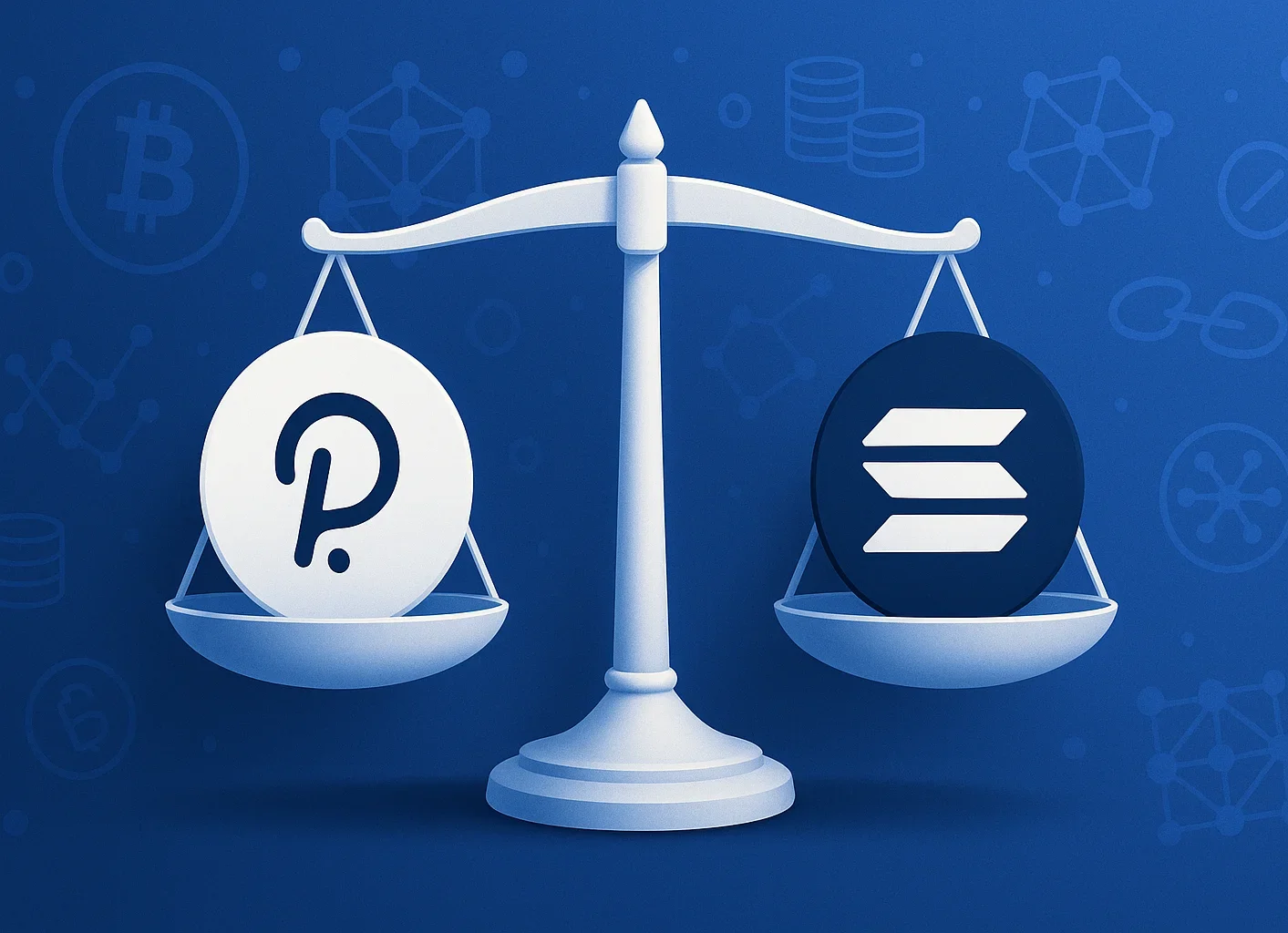
When someone types Polkadot vs Solana into a search box, what they usually want to know is whether the network they’re about to build on, stake on, or simply send money across will hold up under attack, grow with them, and keep its developers around.
The honest answer is that both chains do certain things well and were designed for quite different jobs. A developer, a token holder and someone who only opens a dApp on a Sunday afternoon could each come away with a different pick, and all three could be right.
What follows sets the two against each other on performance, security, the case for holding DOT or SOL, and what people have actually shipped on each network. We’ve tried to say where we’d lean rather than hiding behind “it depends” for three thousand words.
What’s in this comparison
Polkadot and Solana side by side | |
|---|---|
| Polkadot | Speed: Modest on any one parachain, though the network adds capacity by adding chains; Fees: Fair, and they differ depending on which parachain you’re on; Interoperability: Built into the protocol as cross-chain messaging; Developer Experience: Substrate for building chains, with ink! and Solang for contracts; Security: Parachains inherit it from the Relay Chain; Governance: Fully on-chain, with DOT holders voting; Real-World Focus: Interconnected Web3 projects and purpose-built enterprise chains. |
| Solana | Speed: Extremely quick, with a design ceiling of 65,000 TPS; Fees: Usually a fraction of a cent; Interoperability: Not native, so external bridges do the work; Developer Experience: Rust and C, with approachable SDKs; Security: Proof of History alongside Proof of Stake, with centralization still debated; Governance: Off-chain for now, moving gradually toward decentralization; Real-World Focus: Busy dApps, DeFi, NFTs and games. |
Polkadot, the chain that connects other chains
Polkadot is a protocol whose job is to take a collection of independent blockchains and knit them into one decentralized network. That sounds abstract until you’ve watched an asset hop between two of those chains with nothing in the middle.
It isn’t one enormous chain that tries to do everything. The team describes it as a “blockchain of blockchains”, and the phrase is fair, since each connected chain runs itself, keeps its own logic, and can still exchange messages with the others in a way the protocol guarantees.
For you that mostly matters because of the bridge. A third-party bridge is the risky part of nearly every cross-chain move, and it’s the piece you get to skip when assets or data travel from one Polkadot chain to another.
The parts that matter | |
|---|---|
| Cross-chain Communication (XCM) | The messaging layer that carries assets and data between parachains, and out to other networks, without a bridge operator in the way. |
| Shared Security Model | Any parachain connected to the Relay Chain gets the Relay Chain’s security thrown in, which takes a heavy load off the team running that chain. |
| Substrate Framework | The modular toolkit developers use to put together a custom chain (a parachain) built around one particular purpose. |
Consensus on Polkadot: Nominated Proof of Stake (NPoS)
Polkadot’s validators are chosen through Nominated Proof of Stake. The arrangement is worth understanding, because it’s where DOT holders get their say over who runs the network.
- The validators are the machines that assemble new blocks and check the transactions inside them.
- Nominators are ordinary DOT holders who pick validators they’re prepared to vouch for and back that choice by staking their own tokens behind them.
- Since the community decides who does the securing, honest operators get rewarded and control ends up spread across many hands rather than a few.
- Set against Proof of Work the energy cost is a fraction, and transactions still reach finality quickly without any loss of security.
- The validator set stays wide enough that no single operator, or small group of them, can take the network over.
Solana, the chain that was built to be quick
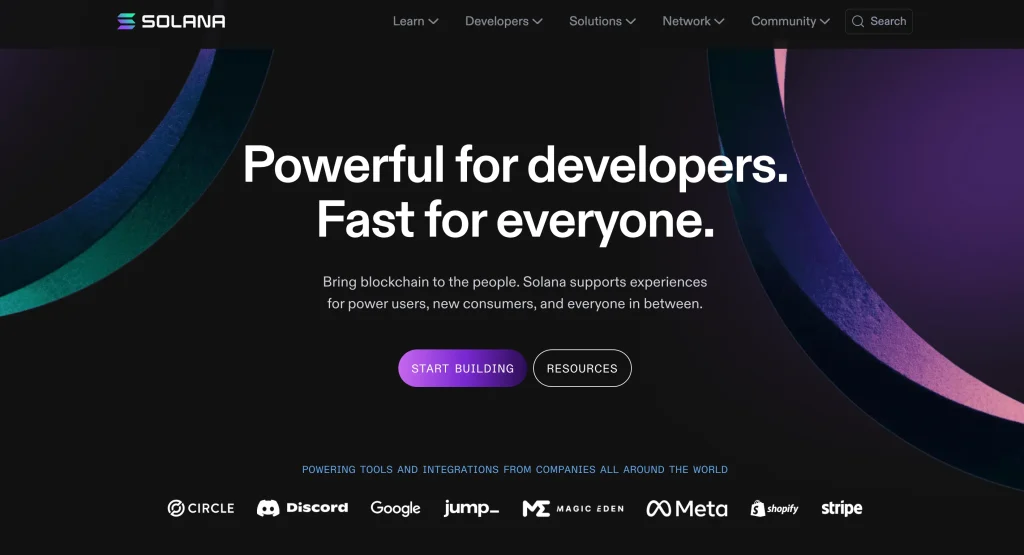
Solana was engineered around speed, scale, and transactions that cost close to nothing, in roughly that order. Almost everything else about the chain follows from those priorities.
For decentralized applications (dApps) and the projects behind them, that translates into a network that can take a sudden surge of traffic without fees climbing. That surge is precisely the moment when fees on a congested chain hurt the most.
Add a developer community that keeps turning up, and the “Ethereum killer” label that gets attached to Solana starts to make sense. We’ve always thought it was a bit much, for what it’s worth.
That label gets tested properly in our Solana vs Ethereum comparison.
The parts that matter | |
|---|---|
| High Throughput Architecture | An unusual architecture that lets the chain handle tens of thousands of transactions per second (TPS), enough to rank it among the fastest networks in operation. |
| Developer-Friendly Tools | Programs are written in Rust and C, two languages with large existing communities, so developers building scalable dApps rarely have to learn something new first. |
| Low-Cost Transactions | The fee model is designed to keep costs very low, which is what makes heavy workloads such as DeFi, NFTs and games practical. |
Consensus on Solana: Proof of History (PoH) with Proof of Stake (PoS)
Solana gets its performance by layering two consensus ideas rather than relying on one. The division of labor between them is neat once you see it.
- Proof of History (PoH) acts as a cryptographic clock, keeping a verifiable record of when each event happened, so ordering transactions and closing out blocks takes far less time than it otherwise would.
- Proof of Stake (PoS) runs alongside it and looks after security, with validators locking up tokens and taking part in consensus in the usual way.
Between the two, Solana can push transactions through at speed while, at least on paper, staying secure and decentralized. We’ll come back to the “at least on paper” part.
1. Performance: throughput, fees and scaling
Both networks were built to be fast. They took such different routes, though, that comparing raw numbers can mislead you unless you know what sits behind them.
Transactions per second
Solana is the quicker chain by a wide margin, on paper and, most of the time, in practice as well. The design target is up to 65,000 TPS, and no single Polkadot chain comes near that.
Polkadot doesn’t really have one headline figure, because every parachain runs at its own pace and the network’s total capacity grows as more of them are added. The fair comparison is one parachain against Solana. In that contest the parachain is usually slower.
Transaction fees
Solana earned its reputation for cheap fees honestly, since a transaction often costs a fraction of a cent. If you trade frequently or send small amounts, that difference compounds in your favor over a year.
If sending stablecoins is the actual task, our guide to how to send USDT covers the network choice.
Polkadot fees depend on which parachain you happen to be using, though in our experience they stay reasonable. The shared security model exists partly so that individual chains don’t have to charge heavily to protect themselves.
Scalability and throughput
Solana scales the direct way, by making one monolithic chain as fast as the engineering allows, with Proof of History carrying most of the load in transaction processing.
Polkadot goes the other direction and shards. Parachains process transactions in parallel, so capacity comes from adding chains rather than from squeezing more out of one, which is slower to show results but harder to hit a ceiling with.
2. Interoperability and what surrounds each chain
Polkadot’s edge: chains that talk to each other
Interoperability isn’t a feature Polkadot added later; it’s the reason the protocol was built. The Relay Chain is what lets parachains pass messages and assets between themselves without a middleman anyone has to trust.
Bridges extend that reach to blockchains outside Polkadot. The result is a set of specialized chains that cooperate instead of competing, which is why so many Web3 projects that need to work together end up sitting on top of it.
How Solana’s ecosystem grew
Cross-chain communication was never the design goal for Solana in the way it was for Polkadot, and it shows. The ecosystem grew quickly regardless, with DeFi, NFTs and gaming out in front.
What Solana wants to be is the fast home for applications that only make sense when latency is low and throughput is high. On that narrower brief it has done well.
Developer experience on each
On Polkadot
Building on Polkadot usually means building your own chain with the Substrate framework, which gives you an unusual amount of freedom over how that chain behaves. For smart contracts the common choices are ink!, which is Rust-based, or Solang, a Solidity compiler that targets Polkadot.
On Solana
Solana programs are mostly written in Rust, so a developer who already knows the language can be productive quickly. The SDKs and tooling are built with high-throughput applications in mind rather than bolted on afterwards.
3. The investment case for DOT and SOL
1. DOT token economics
DOT has no hard cap. The supply keeps growing through inflation, with new tokens minted on a regular schedule, and that’s a deliberate choice rather than an oversight.
The inflation is there to push holders toward staking, which means locking DOT up to help secure the chain in exchange for rewards paid in freshly minted tokens. More people end up with a reason to contribute to security that way.
Paying stakers this way keeps the network safe and spread out. If you stake your DOT the rewards help offset the inflation over time. If you simply hold and never stake, your share of the total slowly shrinks.
What DOT does
- Staking DOT helps secure the network and earns you rewards for doing it.
- Anyone holding DOT can vote on the big decisions, upgrades and rule changes among them.
- Projects that want a parachain slot bid DOT in auctions to win one.
2. SOL token economics
Solana went the other way and put a hard ceiling on how many SOL will ever exist. There’s a limit on circulation that DOT simply doesn’t have.
On top of that, every transaction “burns” a sliver of SOL, destroying those tokens for good. Over enough transactions that trims the supply, which can help support the price, since a scarcer token tends to hold its value better.
Despite the fixed cap, Solana launched with inflation to pay the people staking SOL and securing the network. That rate steps down over time on a schedule that was set in advance.
What SOL does
- SOL pays for transactions and for running smart contracts.
- Staking SOL supports network security and earns rewards in return.
- Holders can take part in governance, though governance on Solana is still being worked out.
DOT and SOL compared: utility and inflation
| Point of comparison | DOT on Polkadot | SOL on Solana |
| Supply cap | None, so inflation keeps adding to it. | A fixed maximum. |
| Purpose of inflation | Rewarding stakers so the network stays secure. | Rewarding stakers, at a rate that falls on a schedule. |
| Deflationary pressure | None built in. | Yes, since fee burning removes tokens. |
| Uses | Staking, governance votes, and parachain auction bids. | Fees, staking, and a still-developing governance role. |
| Effect on holders | Unstaked DOT is diluted over time; staking rewards counter that. | Burning can tighten supply and support value, though early inflation offsets part of the gain. |
What to weigh before you invest
1. Risk
DOT carries the technical complexity of the parachain model, along with the risk that the ecosystem never reaches the adoption it needs. Then there’s the regulatory fog that hangs over everything in crypto at the moment.
SOL is exposed to outages first, then to the centralization doubts, and then to the execution risk that comes with a team that moves as fast as this one does.
2. Volatility
DOT tends to move a moderate amount, with ecosystem growth and parachain activity behind most of its swings.
SOL swings harder in both directions. It rises on good technical news and drops quickly whenever the network goes down, which anyone who has held it through an outage will confirm.
3. Growth potential
DOT has real strength in interoperability, developer tooling and the kind of infrastructure value that pays off over years. Whether it grows depends almost entirely on the parachains themselves succeeding.
SOL continues to attract DeFi, NFT and Web3 applications on the back of its speed and low fees, with active venture funding and an energetic community behind it.
4. Security and decentralization
How the two chains are secured
Polkadot’s shared security means the central Relay Chain protects every parachain. A brand-new chain gets the full network’s protection from its first block, rather than launching with a small validator set that an attacker could overwhelm.
Solana relies on its combination of Proof of History and Proof of Stake for fast, secure transactions, and the arrangement works. Validators need expensive hardware, though. Between that and the record of outages there are legitimate questions about how decentralized the network really is.
Stability and uptime
Polkadot’s multi-chain layout was designed with stability as a goal, and performance has stayed steady as more chains have joined. That’s roughly what you’d hope for from a network whose pitch is infrastructure.
Solana, quick as it is, has halted more than a few times. While the chain is down you cannot move or trade anything until it comes back, and it’s a strange feeling the first time it happens to you.
Those outages have cost it trust that the developers are still working to earn back. However much progress they make on resilience, it remains a fair mark against the network.
Governance
Polkadot has one of the more decentralized governance systems we’ve come across, and it runs entirely on-chain. DOT holders vote directly on upgrades and other decisions, so the community is never merely consulted after the fact.
Governance on Solana still happens off-chain. There are ongoing efforts to bring more of the community in and move toward decentralization, but it hasn’t got there, and we’d want to see that change before calling the two equal on this point.
5. What actually gets built on each
Polkadot in practice
Polkadot suits a project that needs one of the following. It tends to be an awkward fit for one that doesn’t.
- Cross-chain DeFi, meaning financial applications that operate across several blockchains at the same time.
- Web3 infrastructure, where connected dApps draw on chains that each do one thing well.
- Enterprise systems built as custom blockchains for companies that need to exchange data with other chains.
Solana in practice
Solana is at its best when an application needs high throughput and low latency. The examples below are where that shows most clearly.
- NFT marketplaces, where minting and trading happen quickly and cost very little.
- Decentralized exchanges (DEXs) that settle trades almost instantly for next to nothing in fees.
- Gaming, particularly fast-moving blockchain games with in-game economies of their own.
Who each chain is for
Polkadot is going after a wide set of industries that stand to gain from custom, interconnected blockchains. That lines up with the broader Web3 idea of specialized chains working together.
Solana is chasing high-volume, real-time applications where speed and low cost decide everything, and it isn’t shy about saying so.
Polkadot vs Solana FAQ
Which swap is best on Solana?
For a long stretch the answer was Serum, a decentralized exchange built on Solana that traders used for SPL tokens because it was cheap, quick, and had deep liquidity. Solana’s DEX scene turns over quickly, though. We’d check which exchanges are still active and properly funded before swapping anything.
Is Polkadot worth holding?
If you think in years rather than months there’s a reasonable case. You get a multi-chain network, a solid developer community and an ecosystem that keeps expanding.
The bet on interoperability and scalability gives it lasting value as infrastructure. It remains a crypto asset, though, and the risk that comes with that doesn’t go away because the technology is sound.
Can assets be bridged between Solana and Polkadot?
They can, through a cross-chain bridge such as Wormhole, which moves assets from one network to the other.
Bear in mind that the bridge is an extra layer of risk sitting on top of the two chains. We’d stick to ones with a long track record and treat anything newer with some suspicion.
Which chain suits an NFT project better?
Solana, most of the time, because the low fees and quick processing suit the way NFT projects mint and trade. Polkadot’s interoperability can still earn its keep when an NFT ecosystem is complicated and spans several chains.
What are the biggest risks on each platform?
On Solana the risks are outages and the unresolved centralization question. On Polkadot they’re cross-chain security and the sheer complexity of the technology. Both deserve an honest look before any money goes in.
Our verdict: Polkadot or Solana?
We don’t think Polkadot vs Solana produces a single “winner”, and anyone who tells you otherwise is probably holding a bag of one of them. The better question is which platform lines up with what you’re trying to do.
Category by category
- Speed goes to Solana, and it isn’t close, given the transaction throughput.
- Interoperability goes to Polkadot, since cross-chain communication is what the protocol was designed around.
- Fees go to Solana, which is generally cheaper, with the gap widening as volume rises.
- Ecosystem maturity is a draw, because both have active, growing ecosystems that happen to be strong in different places.
- Investment potential depends on what you’re after, with Polkadot as the long-term infrastructure bet and Solana aimed at fast-growing, high-speed applications.
Which one, then?
For developers
- Polkadot is the pick when your project needs its own blockchain logic, cross-chain messaging or shared security.
- Solana is the pick when raw transaction speed, low fees and a simpler Rust-based setup matter more to you.
For investors
- Polkadot fits if what you want is a foundational interoperability layer tied to a long-term Web3 vision.
- Solana fits if you want exposure to fast-growing, high-performance areas such as DeFi and gaming, and your risk tolerance and time horizon should settle the rest.
For users
- Solana is normally the better choice for quick, cheap transactions, whether you’re flipping NFTs or using DeFi apps that trade constantly.
- Polkadot comes out ahead if the apps you expect to use are specialized ones spread across different chains.
Polkadot and Solana occupy different corners of the market, and they complement each other more than they compete. It’s no surprise that plenty of people hold both, and as a pair they make a reasonable way to spread a crypto portfolio around.
Everything above is general information rather than financial, legal or investment advice. Figures and features change often, so check each project’s official page before committing to anything.
How I review: Reviewed by Andrei B. I buy the hardware wallets I review, test every product myself and score it on security, UI/UX, ease of use, price and supported coins. Before I publish, I also check recent user reviews and any hack reports.
The whole process is explained on the How We Review page. You can read more about me, or contact me with corrections, from the links at the bottom of this page. For general safety advice, see the FTC guide to cryptocurrency scams.