
Choosing a blockchain platform can feel like a gamble. Every network claims the best speed, scalability, and decentralization. How do you know which one delivers?
Get it wrong and you feel it fast. Slow transactions, thin developer support, or a stagnant ecosystem cost more than frustration. They cost time, money, and missed opportunities.
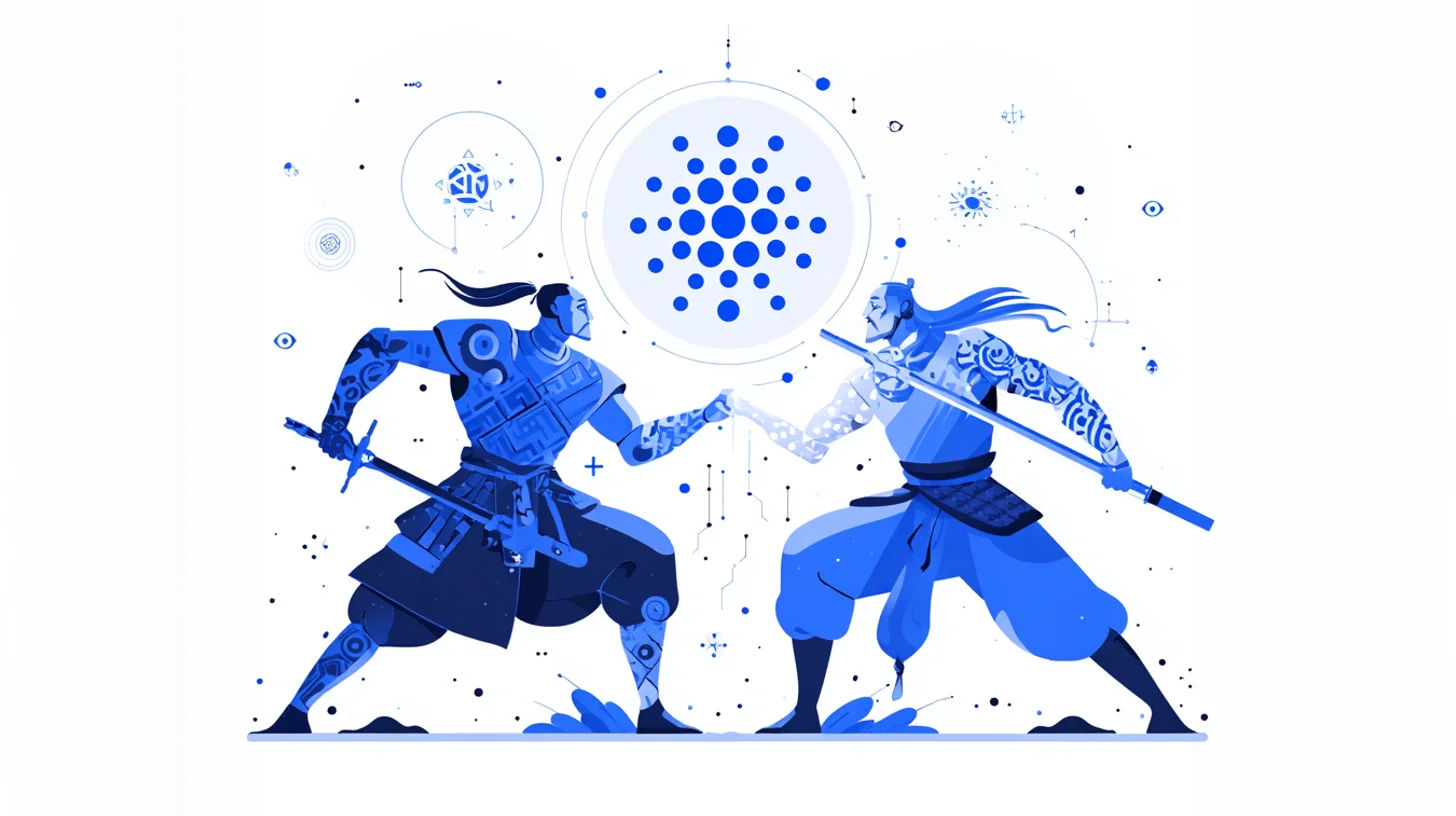
This guide compares Solana vs Cardano vs Polkadot vs Avalanche across the areas that matter: consensus mechanism, scalability, interoperability, developer adoption, and token utility.
By the end, you will know which blockchain fits your goals, whether you are building, investing, or exploring.
Table of contents
Quick Overview: Solana, Cardano, Polkadot, Avalanche | |
|---|---|
| Solana | Consensus: Proof of History + PoS Transactions/sec: 65,000+ Finality: ~400 ms Smart Contracts: Rust/C/C++ Ecosystem: High-speed DeFi & non-fungible tokens Native Token: SOL |
| Cardano | Consensus: Ouroboros PoS Transactions/sec: ~250 Finality: ~5–10 mins Smart Contracts: Plutus/Haskell Ecosystem: Research-driven & slow rollout Native Token: ADA |
| Polkadot | Consensus: Nominated PoS Transactions/sec: 1,000 (relay chain) Finality: ~60 secs Smart Contracts: WASM Ecosystem: Interoperability hub Native Token: DOT |
| Avalanche | Consensus: Avalanche Consensus + Snowman Transactions/sec: 4,500+ (per subnet) Finality: ~2 secs Smart Contracts: Solidity/Subnets Ecosystem: Scalable multi-chain apps Native Token: AVAX |
1. Solana: The Fastest Blockchain for DeFi, NFTs, and Scalable Web3
Solana is a high-performance network built for fast, low-cost transactions. Thousands of decentralized applications (dApps) and NFT collections run on it without bottlenecks, which is why it draws traders and gamers who hate waiting.
Our Solana vs Ethereum comparison takes that rivalry on its own.
Specifications | |
|---|---|
| Proof of History (PoH) + PoS | Solana’s unique PoH timestamping system enables speedy ordering of transactions before reaching consensus through PoS. |
| Blazing Transaction Speed | Capable of 65,000+ TPS in ideal conditions; typically achieves 1,000–3,000 TPS in real-world environments. |
| Ultra-low Latency | Block finality in ~400 milliseconds allows near-instant confirmation. |
| Developer-Friendly Stack | Supports Rust, C, and C++, powerful but has a steeper learning curve. |
| Ecosystem Strength | Thriving in NFTs, DeFi, and gaming, with strong community growth despite past network outages. |
2. Cardano: Secure, Sustainable Blockchain Built on Peer-Reviewed Research
Cardano is a research-driven platform known for energy efficiency, smart contracts, and formal verification. Built with Haskell and Plutus, it targets governments, institutions, and users who need strong compliance.
Holding ADA? See our picks for the top Cardano wallets for 2026 and beyond.
Specifications | |
|---|---|
| Ouroboros PoS Protocol | A scientifically-reviewed consensus model prioritizing security, energy efficiency, and long-term sustainability. |
| Two-Layer Architecture | Splits computation (CCL) and settlement (CSL), improving modularity and scalability. |
| Smart Contracts via Plutus | Built using Haskell, offering high assurance but slower adoption due to the learning curve. |
| Hydra Layer 2 Scaling | Promises millions of TPS in the future via off-chain “Hydra heads”; currently early in deployment. |
| Slow but Steady Roadmap | Emphasizes research, formal verification, and regulatory readiness over rapid experimentation. |
3. Polkadot: Leading Interoperable Blockchain for Multi-Chain Web3
Polkadot is a modular Layer 0 network that connects other blockchains. Developers build on it with Substrate, and its chains talk to each other natively through XCMP.
Its parachains cover everything from DeFi to IoT, which makes Polkadot a serious contender for anyone building across more than one chain.
Specifications | |
|---|---|
| Nominated PoS + Parachains | Uses BABE and GRANDPA consensus mechanisms with a unique system of interconnected parachains. |
| True Cross-Chain Messaging | XCMP and HRMP protocols enable trustless, native communication between parachains. No bridges required. |
| Shared Security via Relay Chain | Parachains inherit security while maintaining execution independence. |
| Substrate Framework | Allows developers to build custom blockchains with tailored logic and consensus. |
| Parachain Auctions | Slots are limited, and competition can be costly, but this model fosters innovation and community backing. |
4. Avalanche: The Custom Blockchain Platform for Web3 at Enterprise Scale
Avalanche stands out for its subnet architecture. Its three core chains, the C-Chain (contracts), P-Chain (platform), and X-Chain (exchange), let developers launch subnets with their own consensus, economics, and compliance rules.
It also supports Ethereum tooling through Solidity and Vyper, so Ethereum developers can move over quickly.
Specifications | |
|---|---|
| Avalanche + Snowman Consensus | Uses probabilistic consensus with near-instant finality (~2 seconds) while staying decentralized. |
| EVM Compatibility | Full support for Solidity and Ethereum tooling, making migration and onboarding seamless. |
| Subnets for Customization | Developers and enterprises can launch independent blockchains (subnets) with their validators, rules, and economics. |
| Scalability Without Sacrifice | Each subnet processes transactions in parallel, enabling thousands of TPS network-wide. |
| Enterprise Ready | Attracts partnerships like Deloitte, AWS, and Alibaba Cloud due to customizable compliance features. |
Solana vs Cardano vs Polkadot vs Avalanche: Feature-by-Feature Breakdown
1. Consensus Mechanisms: How They Secure Their Networks
Solana PoH
Solana’s key innovation is Proof of History (PoH), a cryptographic timestamping technique that orders transactions before consensus.
PoH works like a decentralized clock. Nodes spend less time talking to each other, and validators then use Proof of Stake (PoS) to agree on the state of the chain.
Strengths:
- Ultra-high throughput (up to 65,000 TPS in theory).
- Near-instant finality (~400 ms).
Trade-offs:
- Validators need specialized, powerful hardware.
- Network outages have occurred, partly because of this complexity.
- The hardware barrier leads some to call it less decentralized.
Cardano Ouroboros
Cardano runs on Ouroboros, the first peer-reviewed PoS protocol. It divides time into epochs and slots and randomly elects block producers, with provable security and low energy use as the goals.
The chain is split into two layers, settlement (CSL) and computation (CCL), which keeps the design modular.
Strengths:
- High security backed by formal verification.
- Low energy use compared with PoW.
- Designed for long-term sustainability.
Trade-offs:
- Lower throughput (~250 TPS).
- Slower finality (5–10 minutes).
- A conservative upgrade path means features arrive slowly.
Polkadot NPoS
Polkadot pairs Nominated Proof of Stake for validator selection with two protocols: BABE for block production and GRANDPA for finality. NPoS lets DOT holders nominate validators without running nodes, so more people share in keeping validators honest.
Strengths:
- Strong security through slashing and nomination incentives.
- Efficient block production and fast finality (~60 seconds).
- Built for a multi-chain environment with shared security.
Trade-offs:
- Limited parachain slots mean auctions, which can be competitive and costly.
- Complex architecture can add development overhead.
Avalanche Consensus
Avalanche uses a consensus model based on repeated random sampling of validators, paired with Snowman for linear chains such as smart contract chains. The result is fast, probabilistic finality without sacrificing decentralization.
Strengths:
- Finality in ~2 seconds, among the fastest in the space.
- Scalable, resilient consensus that runs on commodity hardware.
- Supports complex custom blockchains through subnets.
Trade-offs:
- Less proven at massive scale than older protocols.
- Subnet deployment has a learning curve.
2. Scalability: Throughput & Network Efficiency
Solana
The theoretical maximum is above 65,000 TPS. In practice, network conditions and node processing bring it down to around 1,000–3,000 TPS for most dApps.
Solana gets there through PoH-enabled parallel transaction processing. Validator hardware demands and occasional outages remain the concerns.
Cardano
Cardano handles about 250 TPS natively today. Its scaling plan is Hydra, a Layer 2 that uses off-chain “heads” (channels). Each head can process around 1,000 TPS, and many heads can run in parallel, which could take Cardano to millions of TPS. Hydra is still early in adoption, so treat those numbers as a promise, not a benchmark.
Polkadot
Polkadot scales with parachains: independent, parallel blockchains that share security through the Relay Chain. Each parachain can run its own consensus and execution model, spreading transaction load horizontally.
The catch is that parachain slots are limited (100+ at present), which caps network-wide TPS until more open up.
Avalanche
Avalanche scales through subnets, each a customizable blockchain with its own validator set. Every subnet can process thousands of TPS on its own, so capacity grows as subnets are added.
That suits enterprises and any use case that needs compliance or custom rules, especially those handling large volumes of digital assets.
3. Interoperability: Cross-Chain Communication
Polkadot
Polkadot was built for interoperability from day one. Parachains communicate natively through XCMP (Cross-Chain Message Passing) and HRMP (Horizontal Relay-routed Message Passing), giving trustless messaging and asset transfers with no bridges involved.
That is why Polkadot is widely seen as a leading Layer 0 interoperability platform.
Avalanche
Avalanche connects to other chains through the Avalanche Bridge for major assets like BTC and ETH. It is also developing cross-subnet protocols, such as Teleport and HyperSDK, to move assets and data between subnets. Subnets can enforce regulatory compliance, which gives regulated projects unusual flexibility.
Cardano
Interoperability is a work in progress. Projects like Midnight (a privacy-focused sidechain) and Mithril (light client sync) aim to improve cross-chain connectivity and secure state verification. Cardano puts security and regulatory compliance first, but these solutions are not yet production-ready.
Solana
Solana relies heavily on third-party bridges like Wormhole and Allbridge. Those bridges have suffered security breaches, and when a bridge is breached, it is users’ funds on the line.
Native interoperability is limited. Improvements are underway, including Firedancer, a new validator client aimed at making the network more reliable and consistent.
4. Developer Experience & Ecosystem Maturity
Solana
- Languages: Rust, C, C++.
- Ecosystem: Strong NFT marketplaces (Magic Eden), DeFi protocols, and gaming platforms.
- Developer Tools: Growing SDKs and active hackathons, though Rust’s complexity can be a barrier.
- Community: Large and fast-growing, but the concentrated validator set is a concern.
Cardano
- Languages: Plutus, Haskell.
- Ecosystem: Focused on academic-grade projects, identity (Atala PRISM), and governance (Project Catalyst).
- Developer Tools: Built around formal verification and security, so onboarding is slower.
- Community: Strong academic and institutional backing, but a smaller dApp ecosystem.
Polkadot
- Languages: Rust (via Substrate), ink! (Rust-based smart contracts), Solidity (via Moonbeam).
- Ecosystem: Fast-growing parachain projects across DeFi, gaming, and IoT.
- Developer Tools: Substrate simplifies building a blockchain; Moonbeam adds EVM compatibility.
- Community: Active, with sizeable grants and community support.
Avalanche
- Languages: Solidity (EVM-compatible), plus custom VMs for subnets.
- Ecosystem: Growing DeFi, NFT, and enterprise dApps; AWS and Alibaba Cloud integrations for enterprise users.
- Developer Tools: Easy onboarding for Ethereum developers, plus subnet creation tools for customization.
- Community: Strong enterprise focus, pulling traditional businesses into Web3.
5. Token Utility & Economics
Specifications | |
|---|---|
| SOL | Utility & Use Cases: Transaction fees, staking, and upcoming governance. Supply Model & Economics: Inflationary (~8% decreasing), validator rewards from fees & inflation. |
| ADA | Utility & Use Cases: Staking, governance, identity verification. Supply Model & Economics: Fixed supply (45B), staking rewards, community treasury (Project Catalyst). |
| DOT | Utility & Use Cases: Staking, governance, bonding for parachain slots. Supply Model & Economics: Inflationary (~10%), balancing staking demand with network growth. |
| AVAX | Utility & Use Cases: Fees, staking, subnet creation, governance. Supply Model & Economics: Fixed max supply (720M), variable staking rewards, subnet fee sinks. |
6. Governance and Decentralization
- Solana remains relatively centralized, though it is moving toward more open governance.
- Cardano funds community projects through Project Catalyst and is rolling out full on-chain governance with Voltaire.
- Polkadot has one of the most advanced on-chain governance systems, with token holders voting directly on changes.
- Avalanche lets each subnet set its own rules and governance, which gives builders flexibility and control.
In short: Polkadot leads on transparent governance. Cardano favors structured community participation. Avalanche decentralizes through subnets. Solana still centralizes key decisions.
Solana vs Cardano vs Polkadot vs Avalanche: Use Cases & Real-World Applications
Real-World Use Cases of Solana
- NFT Ecosystems: Magic Eden and Metaplex offer fast, low-cost minting and trading. Minimal fees and instant confirmations have made Solana a top choice for creators and collectors.
- Decentralized Exchanges (DEXs): Orca and Raydium deliver real-time trading with minimal latency, which suits high-frequency DeFi.
- Web3 Gaming: Star Atlas and Aurory use Solana’s performance for complex game logic and smooth in-game economies.
- Payment & Micropayment Platforms: Low fees and fast finality make Solana a growing choice for real-time tipping, streaming payments, and point-of-sale systems.
Solana’s Target Markets and Industries:
- High-throughput consumer apps: gaming, DeFi, NFTs.
- Retail and entertainment platforms that need a smooth user experience.
- Developers building interactive, low-latency applications.
Real-World Use Cases of Cardano
- Digital Identity Verification: With Ethiopia’s Ministry of Education, Atala PRISM is issuing blockchain-based IDs and academic credentials to millions of students.
- Verifiable Credentials: Used for anti-fraud and compliance in academia, finance, and supply chains.
- Governance & Voting Systems: Project Catalyst and Voltaire let the community decide on funding and future upgrades.
- Sustainable Development Projects: Cardano is exploring ESG reporting, agricultural traceability, and aid transparency in developing regions.
Cardano’s Target Markets and Industries:
- Governments, NGOs, and educational institutions.
- Projects in emerging markets that need scalable but secure digital infrastructure.
- Builders focused on long-term sustainability and social good.
Real-World Use Cases of Polkadot
- Cross-Chain DeFi: DeFi protocols on Polkadot talk across blockchains without third-party bridges. Acala and Interlay use parachains to pool assets and liquidity from other ecosystems such as Ethereum and Bitcoin.
- Custom Blockchain Infrastructure: With Substrate, developers build specialized chains for supply chains, identity, or IoT while inheriting Polkadot’s shared security.
- Enterprise and Government Collaboration: Emerging use in digital ID, logistics, and data-sharing systems that need privacy, control, and interoperability.
Polkadot’s Target Markets and Industries:
- Web3 developers focused on modular architecture and cross-chain logic.
- Enterprises that need integration across multiple blockchain environments.
- Public sector and regulated markets that need secure, interoperable infrastructure.
Real-World Use Cases of Avalanche
- Private & Regulated Blockchain Networks: Institutions create isolated subnets with custom compliance rules. Deloitte, for example, uses Avalanche to streamline disaster recovery fund tracking.
- Tokenized Real-World Assets (RWAs): Avalanche is a popular choice for digitizing real estate, securities, and collectibles. Republic and Intain use it to launch asset-backed tokens.
- Decentralized Finance Platforms: Trader Joe and Benqi run on Avalanche for its fast transactions and low fees, even under heavy load.
- Interoperable Enterprise Applications: Native EVM support and subnet isolation suit businesses that need control, speed, and compatibility with Ethereum tools.
Avalanche’s Target Markets and Industries
- Enterprises that want customizable, high-performance blockchain infrastructure.
- Fintech and asset management firms launching RWAs and token platforms.
- Institutional partners that need compliance, scalability, and multi-chain logic.
FAQ
What is the future of Avalanche crypto?
Avalanche keeps gaining traction as a custom blockchain ecosystem for enterprises and dApp developers. Its subnet model could become a cornerstone of scalable Web3 infrastructure, especially in regulated and private blockchain environments.
Which blockchain is the most scalable?
Solana wins on raw TPS. Avalanche offers more flexibility. Polkadot scales horizontally through parachains, and Cardano is scaling step by step with Hydra.
Is Polkadot better than Avalanche?
It depends on what you are building. Polkadot excels at cross-chain communication. Avalanche is stronger on customization and speed. If you want modular architecture, lean toward Polkadot; if performance comes first, choose Avalanche.
Which is better, Solana or Avalanche?
Solana is better if you want ultra-fast transactions, especially for DeFi and NFTs. Avalanche offers more flexibility through subnets and suits enterprise applications and teams that need Ethereum compatibility.
Is it better to buy Cardano or Solana?
Cardano fits if you want a long-term, research-based project focused on governance and sustainability. Solana fits if you want speed, active dApps, and a strong presence in NFTs and gaming. Neither is a guaranteed winner, so size any position to what you can afford to lose.
Final Verdict: Solana, Cardano, Polkadot, or Avalanche
There is no one-size-fits-all answer to Solana vs Cardano vs Polkadot vs Avalanche. Each chain wins in a different area, so the right pick depends on what you need.
Choose Solana if:
- You put speed, low fees, and DeFi/NFT activity first.
- You are building high-performance dApps or games.
- You are comfortable with Rust/C/C++ and a less decentralized but efficient network.
Choose Cardano if:
- You value security, peer-reviewed development, and a long-term vision.
- Your project leans toward academia, institutions, or identity-focused governance.
- You prefer a methodical rollout with a strong emphasis on formal verification.
Choose Polkadot if:
- Your goal is cross-chain interoperability and modular blockchain design.
- You want to build a custom parachain with shared security.
- You are focused on scalable, future-proof Web3 applications.
Choose Avalanche if:
- You want customization through subnets, EVM compatibility, and enterprise-level flexibility.
- You are building in a multi-chain environment that demands fast finality.
- You need a balance of speed, scalability, and decentralization.
In the end, the “winner” depends on your goal: speed, decentralization, interoperability, or flexibility. Whichever chain you pick, keep your tokens in a wallet where you control the keys.
How I review: Reviewed by Andrei B. I buy the hardware wallets I review, test every product myself and score it on security, UI/UX, ease of use, price and supported coins. Before I publish, I also check recent user reviews and any hack reports.
The whole process is explained on the How We Review page. You can read more about me, or contact me with corrections, from the links at the bottom of this page. For general safety advice, see the FTC guide to cryptocurrency scams.