
Getting started with crypto trading shouldn’t feel like a labyrinth. But for many new traders, the first hurdle (converting fiat to digital assets) is where things get messy. High fiat-to-crypto fees, confusing interfaces, and long KYC waits can suck the momentum out of your first trade.
Worse, not all platforms are built the same. Some exchanges bury their fees in the small print. Others skimp on security or don’t support your local currency, which makes funding your account, or selling crypto when you need cash, a chore. And let’s not talk about the apps that feel like they were built in 2008.
That’s why we tested and ranked the best fiat-to-crypto exchanges in 2026. Whether you’re buying your first coin or looking for a faster, cheaper way to trade, the five platforms below deliver real value without the usual headaches.
One note before we start: every exchange here requires identity verification (KYC) before you can deposit fiat, and we tell you how long that took for each one. Let’s dive in.
A fiat-to-crypto exchange is a platform where you pay in regular money, such as dollars or euros, and get cryptocurrency in return.
Table of contents
Best Fiat-to-Crypto Exchanges in a Nutshell | |
|---|---|
| Binance | Best For: Low fees & fast onboarding; Supported Fiat Currencies: 30+ (USD, EUR, AUD, JPY, etc.); Fees (Approx): 0.10% base (25% off with BNB), 2% card deposit; Wallet Integration: Wallet Direct, Trust Wallet; KYC Required: Yes (2–48 hrs); |
| Kraken | Best For: Regulated trading & security; Supported Fiat Currencies: USD, EUR, GBP, CAD, AUD, CHF; Fees (Approx): 0.25% maker / 0.40% taker; wire free, cards 2–3%; Wallet Integration: Kraken Wallet, WalletConnect; KYC Required: Yes (2–15 days); |
| Coinbase | Best For: Fast KYC & strong compliance; Supported Fiat Currencies: USD, EUR, GBP; Fees (Approx): Up to 1.20% taker + 0.5% spread; card ~3.99%; Wallet Integration: Coinbase Wallet, Web3 Browser; KYC Required: Yes (minutes); |
| Bybit | Best For: Speed + Web3 features; Supported Fiat Currencies: USD, EUR, GBP (and more); Fees (Approx): 0.15% maker / 0.20% taker; cards 1–3%; Wallet Integration: Bybit Wallet, Web3 Portal; KYC Required: Yes (15 mins – 48 hrs); |
| KuCoin | Best For: Altcoin access & global reach; Supported Fiat Currencies: 50+ (USD, EUR, GBP, etc.); Fees (Approx): 0.10% base; cards 2–3%; Wallet Integration: KuCoin Wallet, WalletConnect; KYC Required: Yes (hours; varies by region); |
Leaning toward Bitget instead? Our Bitget referral code guide explains the sign-up bonuses and trading fee discounts on offer.
1. Binance, Best Exchange Overall for Low Fees and Fast Onboarding
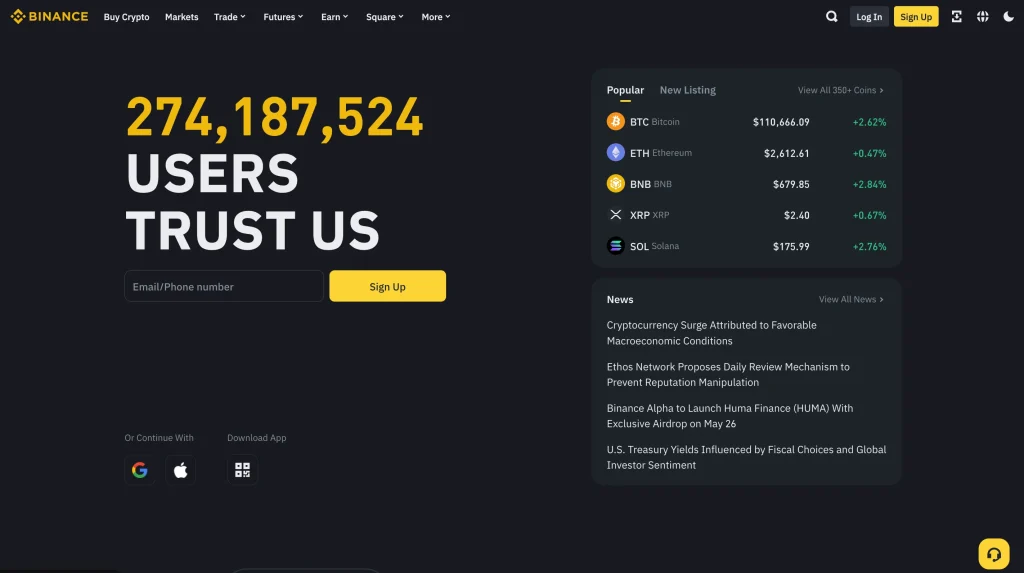
Based on our research and hands-on testing, Binance is the best fiat-to-crypto exchange in 2026. It stands out for low fees, fast verification, solid security, and a smooth user experience.
Start with the numbers. Binance charges a standard 0.10% maker and taker fee on most fiat-to-crypto trades. That’s already competitive, and you can cut it further by climbing the VIP ladder (based on trading volume) or holding BNB, which takes 25% off trading fees. Fiat deposits by bank transfer are usually free. Credit and debit card deposits cost 2%, which isn’t ideal, but it’s still lower than many competitors charge.
On security, Binance doesn’t mess around. It holds regulatory registrations in several European countries, including Italy and Sweden, so it answers to local financial watchdogs. User funds are also backed by the Secure Asset Fund for Users (SAFU), a $1 billion reserve that steps in if something goes catastrophically wrong. Funds sit in cold storage, two-factor authentication is standard, and real-time risk monitoring flags suspicious activity before it becomes a problem.
Account verification is fast. Thanks to a mix of automation and human review, most users clear KYC in under 48 hours. In our test with three accounts, it took 2 to 3 hours. That’s the balance you want: thorough enough to be secure, quick enough that you’re not waiting days to make your first trade.
Binance also nails wallet integrations. With Wallet Direct, you can connect your Binance account to a Binance Chain Wallet or Web3 wallet in a few clicks. No pasting addresses by hand, and no worrying about sending funds to the wrong place. If you use Trust Wallet, Binance Connect lets you buy crypto inside the app with your fiat balance.
Binance accepts more than 30 fiat currencies for deposits, including EUR, USD, JPY, TRY, AUD, PHP, RON, and PLN. With those currencies you can buy more than 385 coins and tokens (the exact list depends on your fiat currency).
The mobile app is another strong point. It holds a 4.6-star rating on Google Play and 4.8 stars on the App Store. It’s packed with features but doesn’t feel overwhelming, largely because it comes in two modes: one built for beginners and one for advanced users. That makes it a good fit for anyone who wants to watch markets, trade, or stake on the go.
We rank Binance first for fiat-to-crypto in 2026 because it ticks every box: low costs, serious security, fast onboarding, wallet flexibility, and a reliable mobile app that doesn’t skimp on features.
Pros and Why We Like Binance
- The world’s largest and best-known crypto exchange;
- Trading fees start at 0.10%, with BNB and VIP discounts on top;
- $1 billion SAFU fund and strong regulatory coverage;
- Fast KYC approvals (hours in our test, under 48 hours for most users);
- Easy wallet linking with Wallet Direct and Binance Connect;
- Highly rated mobile apps on both Android and iOS.
Cons and Things We Don’t Like on Binance
- 2% fee on card deposits;
- Still facing regulatory pressure in some jurisdictions;
- Fee discounts and VIP tiers can confuse new users;
- Mixed reports about customer support;
- Occasional user reports of minor app bugs and UI hiccups.
2. Kraken, Best for Security and Regulated Trading
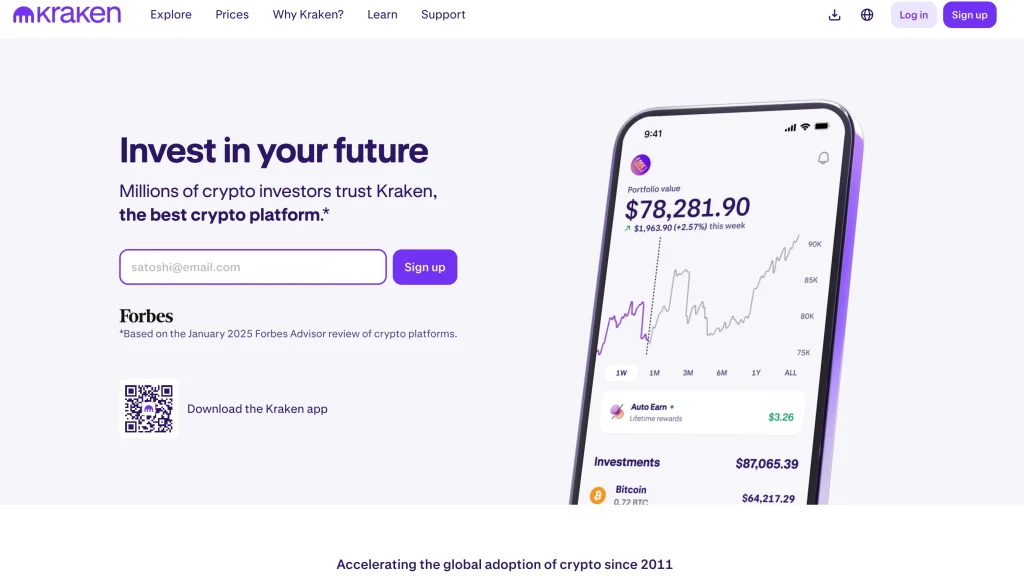
Kraken is our second-best fiat-to-crypto exchange in 2026. It delivers a secure, regulation-friendly experience with solid fiat on-ramps, strong custody options, and reliable wallet integrations. It’s neither as beginner-friendly nor as fast as Binance, but it makes up for that with regulatory clarity and institutional-grade infrastructure.
Kraken’s fees are slightly higher at the entry level: fiat-to-crypto trades start at 0.25% for makers and 0.40% for takers. Fees drop as your 30-day trading volume grows, bottoming out at 0.00% maker and 0.08% taker for accounts trading more than $100 million a month. For everyday users, fiat deposits by wire transfer are usually free, though some intermediary banks charge depending on the currency and country. Card deposits carry 2–3% fees, which add up fast if you fund your account this way often.
On security, Kraken is one of the most heavily regulated platforms in the space. It’s licensed as an Electronic Money Institution (EMI) in the UK and registered with the FCA as a cryptoasset firm. It’s also expanding into the EU under a MiFID license, which lets it offer regulated financial products in several European countries. Cold storage plays a big role in its custody strategy. And with Kraken Wallet, you get a native self-custody option that supports WalletConnect and multiple blockchains, so you can hold your own keys without leaving the Kraken ecosystem.
Where Kraken falls behind is onboarding speed. KYC verification usually takes up to 5 business days, but user reports show it can stretch to 2 or even 3 weeks during busy periods or if documents get flagged. It’s thorough rather than fast, which will frustrate anyone eager to start today.
At the time of writing, Kraken accepts USD, EUR, CAD, GBP, CHF, and AUD. On the crypto side, it lists more than 295 coins and tokens (and, since April 2025, more than 11,000 stocks).
Kraken’s mobile experience is impressive. The standard Kraken app is rated 4.6 stars on Google Play and 4.7 on the App Store, with users praising its clean interface and dependable performance. For advanced users, Kraken Pro offers real-time charting tools, margin trading, and quick execution with minimal lag. It holds 4.7 stars on Android and 4.8 on iOS, so it’s as capable on mobile as on desktop.
We rate Kraken second because it offers a secure, well-regulated, and reliable environment for converting fiat to crypto, especially if you value safety, compliance, and long-term trust over lightning-fast onboarding.
Pros and Why We Like Kraken
- One of the most secure and most heavily regulated exchanges available;
- Maker fees start at 0.25% and taker at 0.40%, with significant volume discounts;
- Regulated in multiple markets, including the US, UK, and Europe;
- Cold storage plus a native Kraken Wallet with WalletConnect;
- User-friendly mobile apps with high ratings (4.6–4.8 stars);
- Deep institutional features and low fees at high volumes.
Cons and Things We Don’t Like on Kraken
- KYC can take 5 days to 3 weeks, depending on demand;
- Deposit fees can be high because of intermediary banks;
- The fee structure is complex and not beginner-friendly;
- Some fiat options and features are limited by region.
3. Coinbase, Best for Fast KYC and Strong Compliance
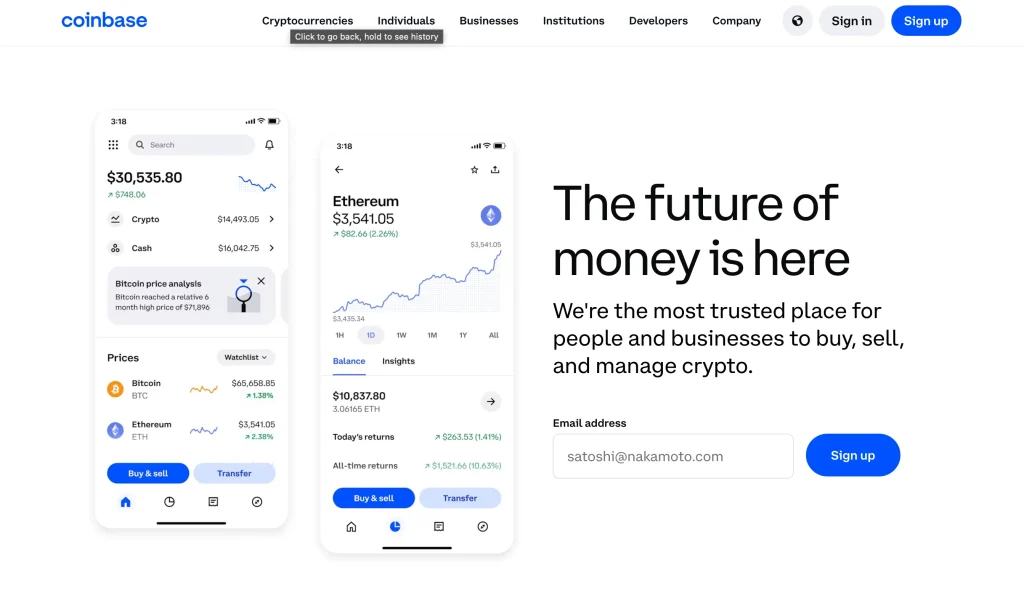
Coinbase takes third place among our fiat-to-crypto exchanges for 2026. It combines a publicly traded pedigree with extensive regulatory compliance, multiple fee tiers, rapid KYC, native wallet features, and a polished mobile experience. As the largest publicly traded crypto exchange (and an S&P 500 member since 2025), it safeguards more than $193 billion in assets. It holds fiduciary licenses and passes SOC audits, which makes it a go-to for anyone who wants peace of mind along with convenience.
Coinbase’s fees split between Retail and Advanced Trade. Retail trades carry a 0.60% maker fee and 1.20% taker fee, plus a spread of up to 0.50% on each transaction. Advanced Trade users get maker fees as low as 0.05% and taker fees down to 0.60%, depending on 30-day volume. Fiat deposits vary by method: ACH and US bank wires are usually free, while credit and debit cards cost roughly 3.99% per deposit.
Security sits at the core of Coinbase. It’s a Qualified Custodian under New York State banking law, and its Vault and Prime custody services undergo SOC 1 Type II and SOC 2 Type II audits by Deloitte & Touche. On the retail side, Coinbase keeps 98% of funds in encrypted cold storage, backed by multi-factor authentication and real-time risk monitoring.
Getting started is almost instant. Thanks to automated identity verification, most users clear KYC within minutes in 2026, and simple cases are often approved the moment the documents upload. You can go from signup to your first trade with almost no waiting.
Native wallet features make fiat-to-crypto easy. Inside the Coinbase app, open the Web3 Browser, tap “Connect Your Wallet,” and bridge your on-chain assets to dApps without pasting addresses. Developers and power users can use the Coinbase Wallet SDK (formerly WalletLink) to integrate desktop and mobile dApps.
Coinbase accepts three major fiat currencies: USD, EUR, and GBP. On the crypto side, it offers more than 240 coins and tokens.
App ratings are mixed: a 2.1-star average on Google Play against 4.5 stars on the App Store. The app has more than 50 million downloads, and some users praise its intuitive interface and staking features. Honestly, though, as a European investor I find it far from perfect, especially on functionality and UI/UX.
Pros and Why We Like Coinbase
- Publicly traded, heavily regulated, and secure;
- Supports only well-vetted cryptocurrencies;
- Lightning-fast KYC, with most approvals in minutes;
- Built-in Web3 wallet.
Cons and Things We Don’t Like on Coinbase
- Higher fees than some competitors;
- Weak customer service and a patchy mobile app;
- Card deposit surcharges (about 3.99% per transaction);
- Some features and payment methods depend on your jurisdiction.
4. Bybit, Best for Speed and Web3 Features
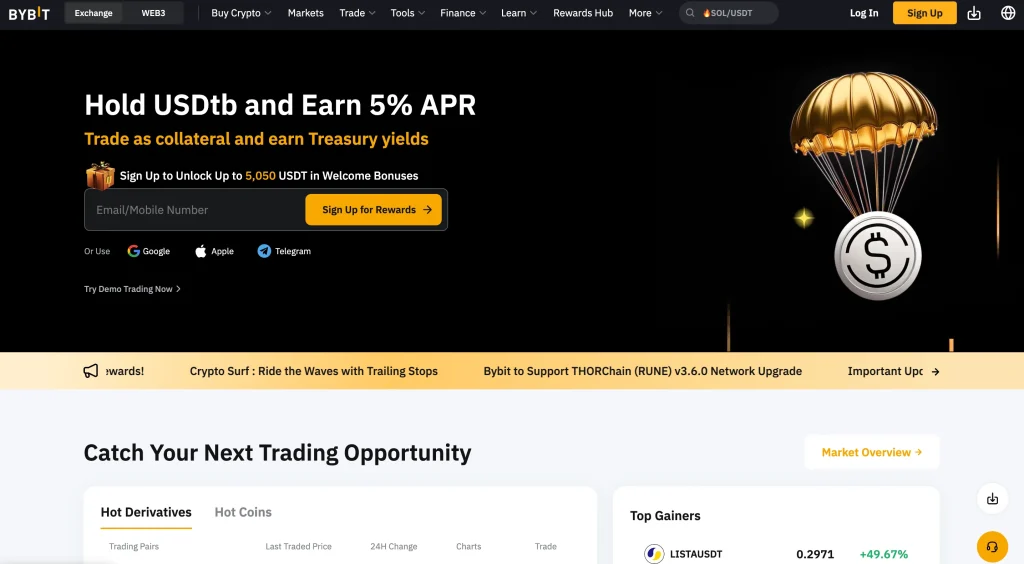
Bybit is our fourth-best fiat-to-crypto exchange in 2026. It offers competitive tiered fees, very fast account verification, institutional-grade custody partnerships, a strong Web3 portal, and a highly rated mobile app.
Bybit’s fiat-to-crypto fees start at 0.15% maker and 0.20% taker, and drop further as you climb the VIP ladder based on trading volume. Internal transfers and on-chain crypto deposits carry no fees, which keeps costs down when you move assets between wallets. Debit-card and third-party provider fees vary by currency but typically run 1% to 3%, so bank transfers remain your cheapest route in.
On security, Bybit partners with Zodia Custody to offer independent, institution-grade custody and off-venue settlement for large clients. For everyday users, two-factor authentication, real-time risk monitoring, and multi-signature cold storage underpin the standard offering.
Account verification at Bybit is among the fastest we’ve seen. Most users finish individual KYC in about 15 minutes, and even edge cases clear within 48 hours.
Bybit’s Web3 Portal plugs straight into your trading account. Connect a wallet through the browser extension or mobile app, then explore DeFi, earn airdrops, and trade NFTs without leaving Bybit. Technical docs cover dApp integrations through the Bybit Wallet SDK, so developers can embed fiat on-ramps directly into their products.
Bybit offers trading for more than 340 cryptocurrencies and supports multiple fiat currencies, including USD, GBP, and EUR.
The Bybit mobile app holds a 4.6-star rating on Google Play from more than 1.3 million reviews, with users praising its clean UI, one-tap trading, and full feature parity with desktop. iOS ratings are similarly strong, making it a solid choice for trading on the go.
Pros and Why We Like Bybit
- No fees on internal transfers or on-chain deposits;
- Institutional custody through the Zodia partnership;
- KYC in as little as 15 minutes;
- Low trading fees;
- Extensive trading options and features;
- Powerful Web3 Portal and SDK for dApp integrations;
- Highly rated mobile app (4.6 stars, 1.3M+ reviews).
Cons and Things We Don’t Like on Bybit
- Debit-card and top-up fees still run 1–3%;
- VIP fee tiers can confuse new users;
- Institutional custody through Zodia is only for large accounts.
5. KuCoin, Best for Altcoin Access and Global Reach
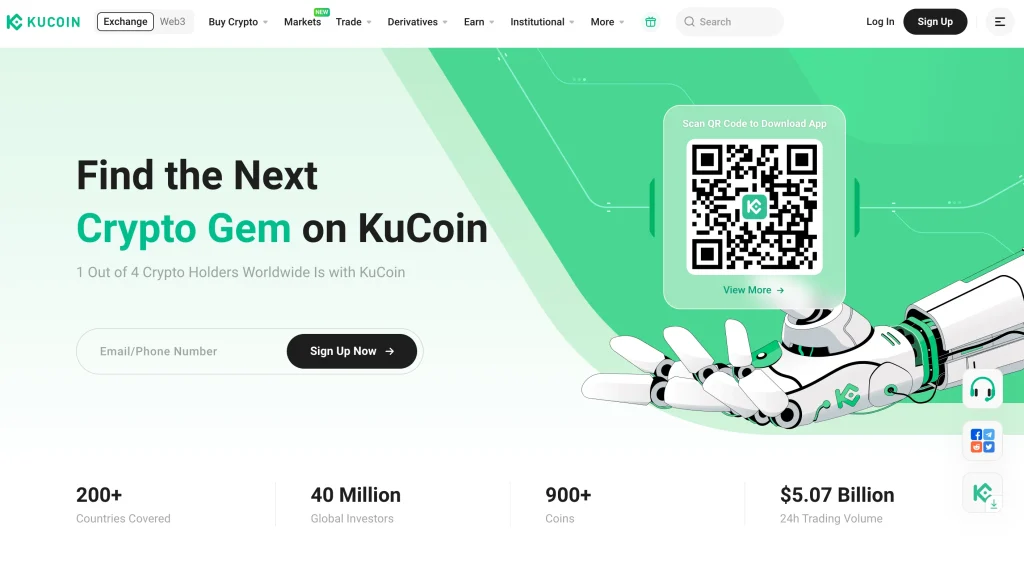
Our fifth and final fiat-to-crypto exchange for 2026 is KuCoin. It isn’t as widely available as its peers, but it offers low entry-level fees, a growing set of wallet integrations, and a global community, despite regulatory headwinds.
KuCoin’s base maker and taker fees start at 0.10% each, with tiered volume discounts and KCS-based incentives that lower fees as you trade more or hold KCS tokens. Fiat deposit fees depend on your region and payment rail: wire transfers are often free or a small flat fee, while card purchases carry 2–3% surcharges.
Security on KuCoin rests on cold storage, multi-factor authentication, and a bug bounty program.
Standard KYC on KuCoin usually wraps up within a couple of business days, and most users are cleared in hours if their documents are in order. Regional licensing gaps mean some jurisdictions can’t complete KYC at all, so features vary by country.
KuCoin’s Web3 wallet supports WalletConnect, so you can access dApps, swap assets, and stake without leaving the KuCoin ecosystem.
KuCoin supports an impressive 900+ cryptocurrencies and handles fiat-to-crypto purchases in more than 50 fiat currencies, including USD, EUR, and GBP, through a range of payment methods.
The KuCoin mobile app holds a 4.7-star rating on both Google Play and the App Store.
We rank KuCoin fifth because it offers one of the widest altcoin selections, low starting fees, and strong community support. Regulatory limits and occasional feature gaps keep it from placing higher.
Pros and Why We Like KuCoin
- Low spot fees at 0.10% maker/taker, with volume and KCS discounts;
- Cold storage and an active bug bounty program;
- KYC in hours for most users;
- A wide variety of trading and earning features;
- Web3 wallet with WalletConnect support;
- Highly rated mobile apps.
Cons and Things We Don’t Like on KuCoin
- No official U.S. KYC, so U.S. residents are effectively locked out;
- Fee tiers and KCS incentives add complexity for newcomers;
- Fewer fiduciary licenses than top-tier exchanges.
Methodology: How We Picked the Best Fiat-to-Crypto Exchanges
We ranked these exchanges on practical, user-first criteria. Each platform was scored on the following:
- Supported fiat currencies: More options mean more people can buy. We favored exchanges that support a wide range of national currencies and crypto assets through local payment methods (bank transfers, cards, SEPA, and so on).
- Low fees: We compared maker/taker fees, fiat deposit costs, and hidden spreads. Only platforms with fair, transparent fee structures made the cut.
- Security and regulation: Top marks went to exchanges with strong custody practices, third-party audits, insurance coverage, and active licenses with financial regulators.
- Speed of KYC approval: Nobody wants to wait days just to start. We favored platforms with fast, automated identity verification (under 24 hours preferred).
- Direct wallet integrations: Native wallets, WalletConnect support, and Web3 SDKs made a big difference. Platforms that let you move or manage assets across apps instantly ranked higher.
- Mobile experience: Clean design, fast performance, and high app store ratings pointed us to platforms that deliver smooth trading on the go.
- How we tested: We combined hands-on testing with public data, user reviews, security records, and fee disclosures to build a list that balances usability, trust, and affordability.
FAQ
Can you convert fiat to crypto or crypto to fiat?
Yes. Fiat-to-crypto exchanges let you convert traditional currency (USD, EUR, or GBP, for example) into digital assets such as Bitcoin or Ethereum, and sell crypto back to fiat when you need cash. Depending on the platform, supported payment methods often include Visa, Mastercard, bank accounts, and PayPal.
Can I buy cryptocurrency with a credit card?
Yes. Many exchanges accept credit card payments, so you can buy crypto with a Visa or Mastercard. It’s one of the fastest ways to deposit traditional currency and start trading. Expect card fees and exchange spreads on top of the trading fee, and note that some platforms limit credit card use by region or transaction amount.
Is it safe to buy cryptocurrency on an exchange?
Generally, yes. Buying crypto on a reputable exchange is considered safe. Look for platforms with two-factor authentication, cold wallet storage for user funds, and active regulatory licenses. Even so, no platform is immune to risk. Use a strong password, avoid public Wi-Fi, and always enable 2FA. Some exchanges also offer insurance on stored deposits, which adds another layer of protection.
How do I swap fiat for cryptocurrency?
First, register with an exchange that supports your preferred payment method and local bank account. Complete KYC verification if required. Once verified, choose the crypto you want to buy, enter the fiat amount, and confirm the payment. The crypto usually lands in your exchange account or wallet within minutes.
Are fiat-to-crypto exchanges legal?
Yes, most fiat-to-crypto exchanges are legal, especially when they comply with local financial regulations and maintain strong security. Some jurisdictions restrict their use, so always check your local laws before registering.
How long does it take to convert fiat to crypto?
It varies. With a credit card or instant bank payment, conversions often complete in seconds to a few minutes. Wire transfers can take 3–4 business days. Your exchange’s internal processes also affect how quickly deposits and withdrawals clear.
Final Thoughts
After more than a decade of rapid growth in crypto, today’s buyers and traders have more options than ever for funding their crypto journey. Whether you’re heading into futures trading, exploring decentralized finance, or just want fast fiat withdrawals, your choice of exchange can make or break the experience.
We focused on platforms with solid trading features, competitive fees, and support for a range of payment methods, so you can move fiat in and out smoothly and reach your assets quickly. Some platforms offer reduced fees for high-volume trading or for meeting a minimum deposit. Watch out for hidden withdrawal fees, though, especially when moving fiat off the exchange.
For experienced traders, it’s about more than low costs. It’s about security, flexibility, and tools that help you stay sharp in a market that never stops moving. The exchanges above strike that balance, letting you buy, sell, and manage digital assets with confidence, whether you’re a beginner or a seasoned pro.
Once you have bought, getting the coins off the exchange is the next step. Our Ledger Flex setup guide covers preparing a device to hold them.
How I review: Reviewed by Andrei B. I buy the hardware wallets I review, test every product myself and score it on security, UI/UX, ease of use, price and supported coins. Before I publish, I also check recent user reviews and any hack reports.
The whole process is explained on the How We Review page. You can read more about me, or contact me with corrections, from the links at the bottom of this page. For general safety advice, see the FTC guide to cryptocurrency scams.